7 Days Shipping in “Ship Now” Collection
WORLDWIDE SHIPPING EXCEPT INDIA
Minimum Order Value: $1000
25 October, 2026

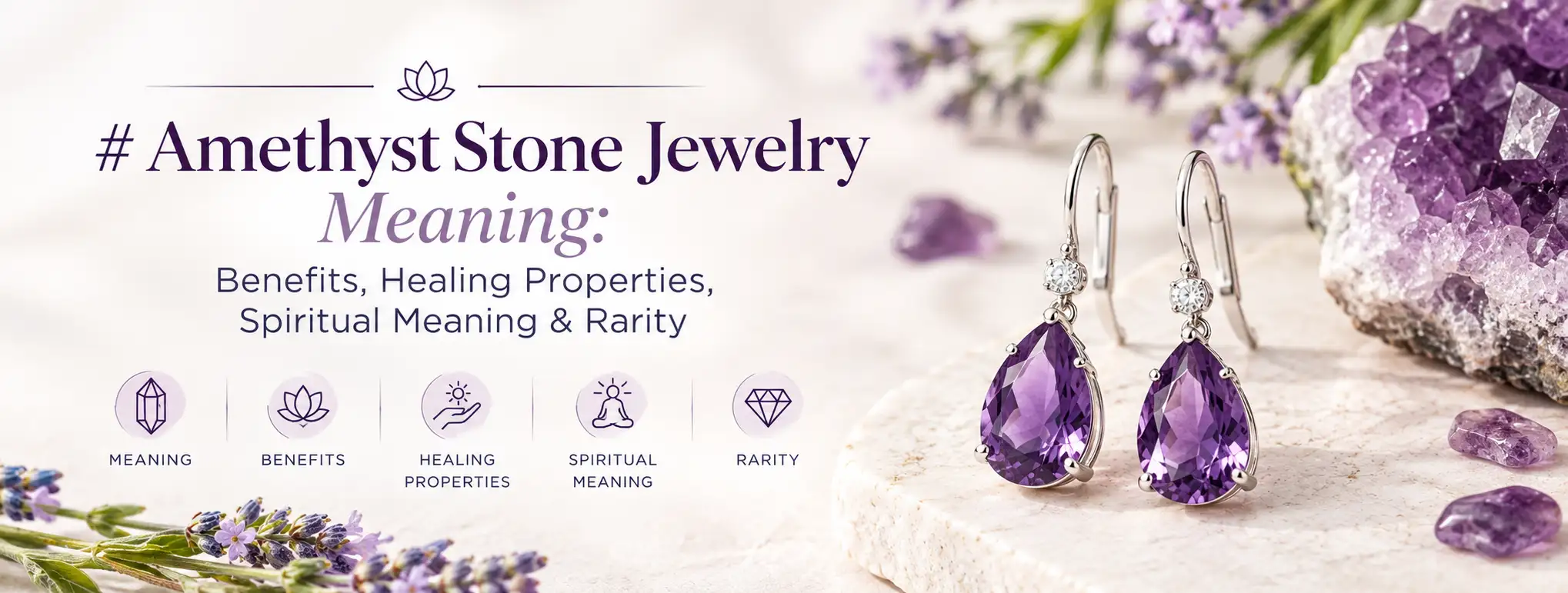
Amethyst Necklace Meaning Benefits Healing Properties Spiritual Meaning and Rarity
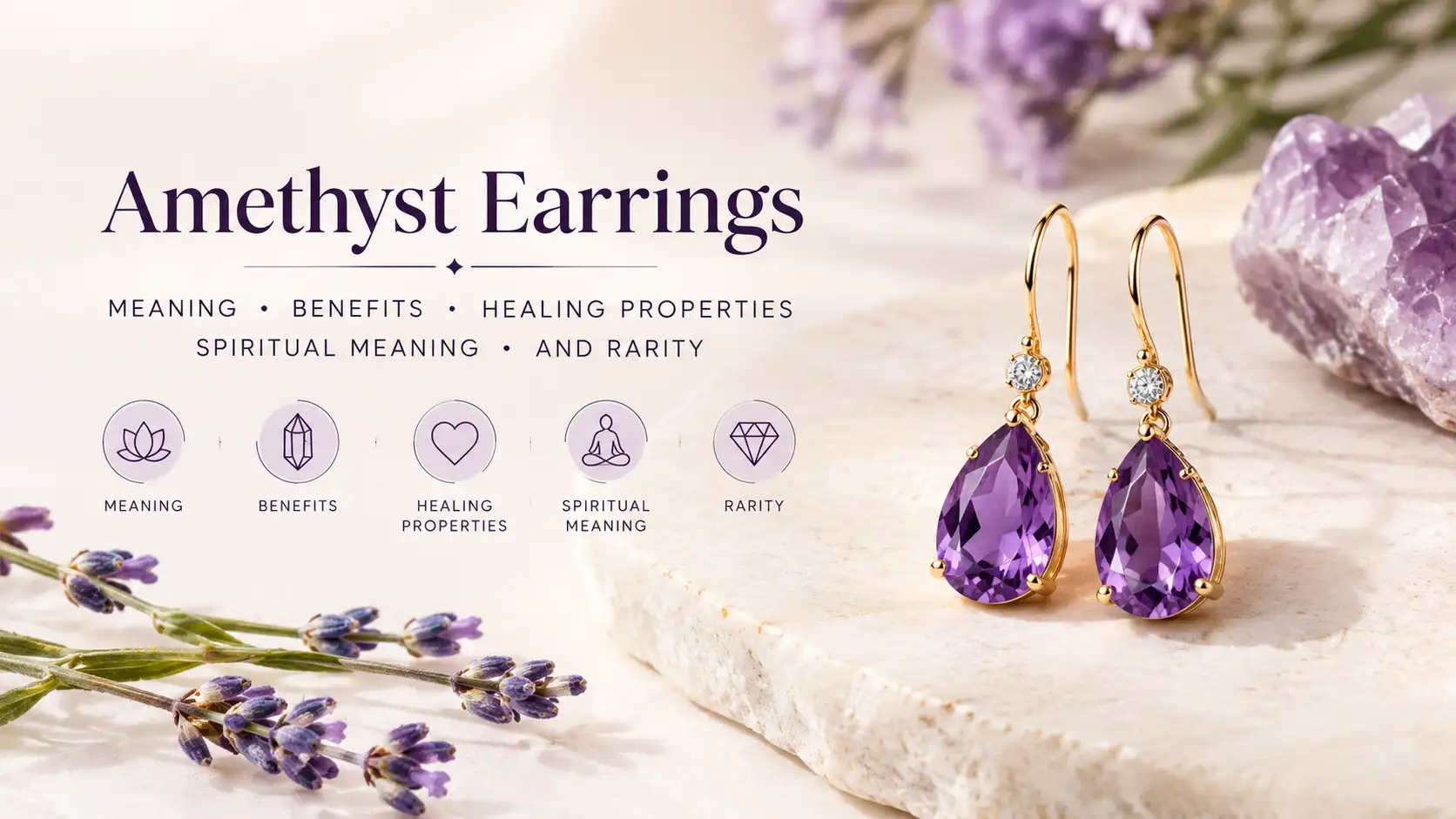
Amethyst Earrings Meaning Benefits Healing Properties Spiritual Meaning and Rarity
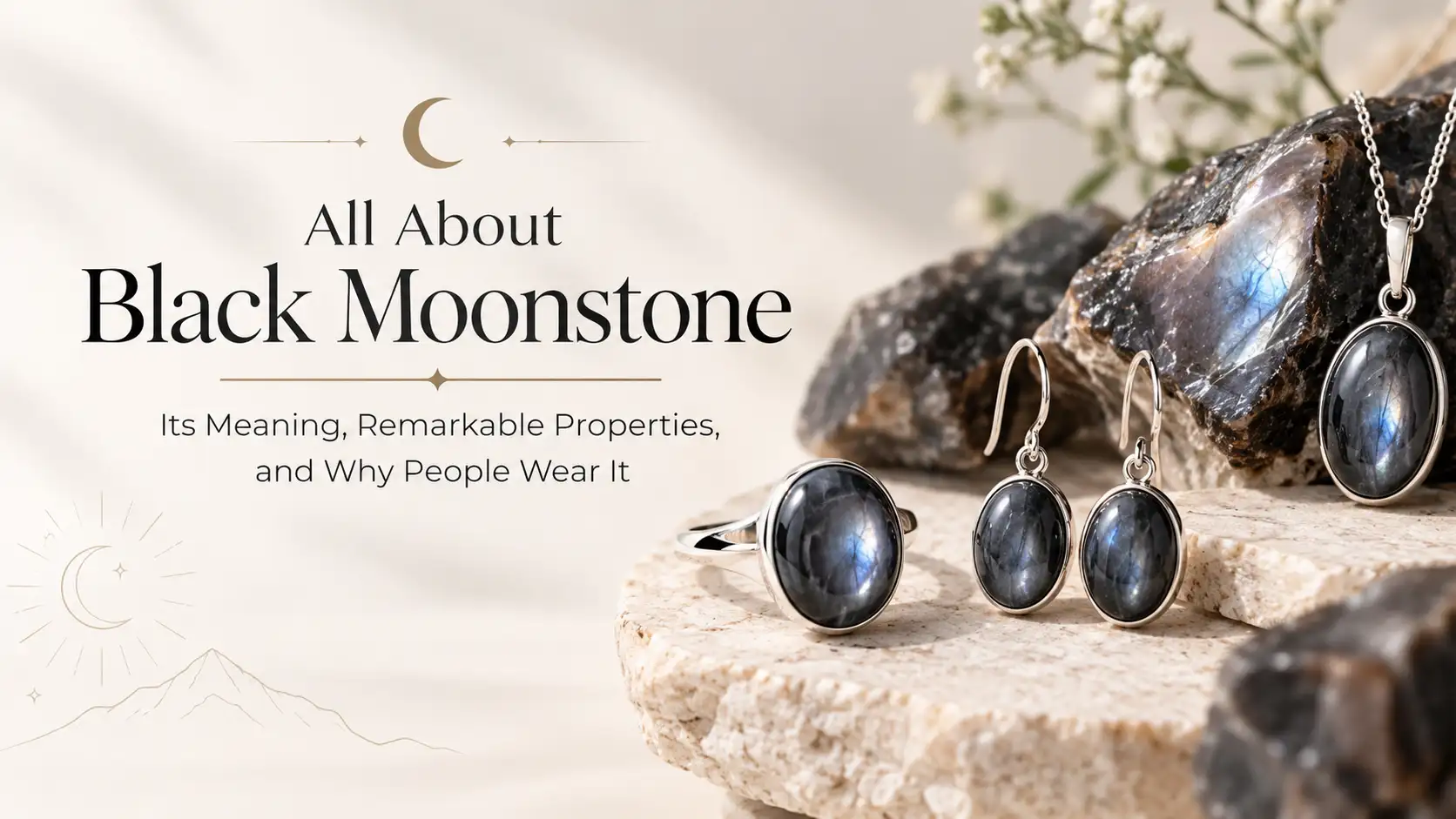
All About Black Moonstone its Meaning Remarkable Properties and Why People Wear It

top 10 wholesale 14k gold earrings suppliers in the usa
Most people fall for amethyst twice. First for the color, a purple that runs from pale lilac to something close to grape juice held up to a sunny window. Then for the stories: Greek wine cups, bishops' rings, Catherine the Great, an American-born duchess at Versailles, and a few thousand years of people tucking a chunk of it under the pillow.
We make gemstone jewelry in Jaipur, India, a city that has cut colored stones for nearly 300 years, and the Valentine group behind JewelPin started out in the emerald trade in the 1920s. Amethyst is a staple of our catalog in 14K gold and sterling silver.
This guide covers what amethyst means, how people use it spiritually and which healing claims hold up. It also covers the part most articles skip: how rare amethyst really is, and why one stone sells for $2 a carat while another goes for $100. We checked the facts against the Gemological Institute of America (GIA) and the other sources listed at the end, and where something is folklore rather than fact, we say so.
Amethyst means calm, clarity and self-control. Its name comes from the Greek amethystos, "not intoxicated," because people once wore it to keep a clear head. Spiritually, it's linked to the crown and third-eye chakras, intuition, protection and restful sleep. It's the February birthstone and the traditional gem for a 6th wedding anniversary. As a mineral it's common quartz, but deep, evenly colored "Siberian" grade amethyst is rare.
In this guide: what amethyst means · the real history (and the myth almost everyone gets wrong) · spiritual meaning · benefits and healing properties · how rare amethyst is and what it costs · jewelry meaning by piece · who should and shouldn't wear it · care and cleansing · notes for retailers · FAQ
At its core, amethyst is the stone of a clear head.
The ancient Greeks called it amethystos, "not intoxicated." The idea was simple: wear amethyst, or drink from a cup carved from it, and the wine wouldn't get the better of you. According to GIA, people also believed it kept them clear-headed and quick-witted in battle and in business.
Over the centuries, that idea branched into a handful of related meanings. When someone wears or gives amethyst today, it usually stands for one or more of these:
Clarity and self-control. The "sober mind" idea, updated: thinking before you act and keeping your head when things get heated.
Calm. Probably the meaning people connect with most, and the color alone does a lot of the work.
Protection. From bad influences and bad decisions, and in spiritual circles, from negative energy.
Devotion. Amethyst sat on bishops' fingers for centuries and still carries a sense of faith and commitment.
Dignity. Purple dye was once ruinously expensive and reserved for the powerful, so purple gems borrowed that status.
Faithful love. A popular legend says St. Valentine wore an amethyst ring carved with Cupid's likeness, one reason the stone feels so at home in February.
People have worn amethyst for thousands of years, and you can see the proof in New York. The Metropolitan Museum of Art displays a girdle made for the Egyptian princess Sithathoryunet around 1887–1813 B.C., strung with gold leopard heads and round amethyst beads. Honestly, it would still turn heads today.
The Greeks gave the stone its name and its reputation for sobriety, and the Romans kept both.
You've probably read this story somewhere. Bacchus, the god of wine, chases a young woman named Amethyste. The goddess Diana turns her into white stone to protect her, and a remorseful Bacchus pours wine over the statue, staining it purple forever.
It's a lovely tale. It just isn't ancient. According to the International Gem Society, the French poet Rémy Belleau invented it in 1576, during the Renaissance.
Plenty of gem websites still call it Greek mythology, so now you know something they don't.
Amethyst runs deep in Christian tradition. In the King James Bible, Exodus 28:19 places it on the high priest's breastplate, and Revelation 21:20 names it as the twelfth foundation stone of the New Jerusalem. (Scholars still debate exactly which stone the Hebrew word in Exodus describes.)
By the Middle Ages, bishops wore amethyst rings as a sign of piety and restraint, which is where the old nickname "the bishop's stone" comes from. The custom survives in many bishops' rings today.
For most of history, amethyst was a true luxury. In 1652, the English writer Thomas Nicols declared a fine amethyst equal in value to a diamond of the same weight, as gem dealer Richard W. Wise points out. Catherine the Great of Russia adored it, and Russia was the world's main source until the 19th century.
Then huge deposits turned up in Brazil. In GIA's words, a gem once "as rare as ruby or emerald" was "suddenly in abundance." Prices fell, and amethyst slid from "precious" to "semi-precious."
Royalty kept wearing it anyway. In 1953, Wallis, Duchess of Windsor, who was born in Pennsylvania and raised in Baltimore, wore a Cartier bib necklace of amethysts, turquoise and diamonds to a gala at Versailles. It's still one of the most famous amethyst jewels ever made.
Spiritually, amethyst is a stone for quieting mental noise so you can hear yourself think. People use it to deepen meditation and prayer, sharpen intuition, sleep more peacefully and keep negativity at arm's length.
In chakra traditions, amethyst is tied to the two highest energy centers:
The crown chakra (Sahasrara), at the top of the head, associated with spiritual connection and a sense of something larger than yourself.
The third-eye chakra (Ajna), between the eyebrows, associated with intuition and inner vision.
That's why people often rest a small amethyst on the forehead while meditating, or choose earrings and pendants that keep the stone near the head and heart. If you want a full set, our guide to chakra jewelry shows where amethyst fits alongside the other six stones.
Amethyst beads turn up in Buddhist malas and Catholic rosaries alike, which says a lot about how far the stone's calm reputation has traveled. The color helps too. Holding something smooth and purple is an easy cue to slow down.
Keeping amethyst under the pillow or on the nightstand is one of the oldest crystal habits around. Folk belief says it wards off nightmares and brings clearer dreams. A few people find it makes their dreams more vivid than they'd like, and if that's you, move it to the dresser.
Amethyst has a long reputation as a protective stone. Soldiers once wore it to keep a cool head in battle, and plenty of people today keep a geode by the front door to "filter" whatever comes in.
The oldest meaning is still very much alive. Some people working on sobriety, or on any habit they want to break, carry a small amethyst as a pocket reminder of the promise they made to themselves. It isn't a treatment, it's a touchstone, and sometimes a touchstone is exactly what helps.
In Vedic (Hindu) astrology, amethyst is called katela or jamunia and is linked to Saturn (Shani). It's traditionally worn as a gentler, more affordable substitute for blue sapphire, Saturn's main stone, usually on the middle finger. If you follow this tradition, astrologers generally recommend a birth-chart reading first.
People mostly turn to amethyst for calm, focus and better sleep. Below are the traditional benefits:
Calm is the headline. Amethyst has a long reputation for easing stress, anxious thoughts and irritability, and for helping people move through grief or heartbreak without being swallowed by it. Soft purples read as restful to most of us, so the color does part of the work.
The old Greek idea of keeping a clear head has turned into a modern association with focus, better decisions and less mental clutter. That's why amethyst is such a popular desk stone.
Many people keep amethyst by the bed as part of a wind-down routine. If it's going anywhere near your pillow, pick a smooth tumbled stone rather than a pointy cluster.
Crystal healers have credited amethyst with easing headaches, supporting the immune system and more.
Amethyst the mineral is common, but amethyst in top color is not. Quartz is one of the most abundant minerals on Earth, and Brazil produces amethyst geodes big enough to stand inside. Only a small slice of all that purple has the deep, even, glowing color that jewelers compete for.
Brazil. Still a giant, especially the southern state of Rio Grande do Sul, where the rough tends to run lighter in color.
Uruguay. Known for dark, glossy geodes, especially from the Artigas region.
Zambia. Home to the Kariba mine, one of the largest amethyst producers in the world, famous for richly saturated color.
Bolivia. The Anahí mine, which also produces ametrine, the natural purple-and-gold mix of amethyst and citrine. Here's how ametrine forms.
Russia. The Ural Mountains produced the legendary "Siberian" amethyst that set the standard for top color.
United States. Four Peaks in Arizona is the standout, with smaller finds in states such as North Carolina, Pennsylvania, Montana and Colorado. The Smithsonian displays specimens from several of them.
About 46 miles from Phoenix, in the most rugged part of Arizona's Mazatzal Mountains, sits the Four Peaks amethyst mine, at roughly 7,000 feet. GIA describes a remote site with hot summers and no water or power. Even so, it yields "some very fine dark purple and purplish red amethyst crystals." The type it produces is known as "Siberian Red" amethyst.
The numbers tell you everything about rarity. In January 2020, ABC15 Arizona reported that about a ton of amethyst left the mine each year and yielded only around 50 pounds of gemstones. Two miners worked it week on, week off, living in a small solar-powered home near the entrance.
Later that year, the Bush Fire tore up the mountain. "Everything was completely vaporized," owner Kurt Cavano told KPHO in 2022, while paying $1,500 an hour for a helicopter to haul out debris and bring in supplies. GIA's journal Gems & Gemology notes the mine has produced gem-quality amethyst for more than a century, though uneven color makes a steady supply of cuttable rough hard to come by.
GIA's quality guidelines come down to five points:
Color comes first. The most valued stones are a strong reddish purple or pure purple with no visible color zoning, meaning bands of lighter and darker purple. Brownish or bronze tints lower the value dramatically.
Darker isn't always better. A stone that's too dark can look almost black in dim light. For everyday jewelry, a medium-deep purple usually looks best.
Clarity. Most faceted amethyst is eye-clean. Zambian stones often carry a few more inclusions, which buyers accept because the color is so good.
Size is friendly. Unlike diamond, amethyst's price per carat doesn't rise dramatically as stones get bigger. That's why it's such a popular pick for cocktail rings and statement pendants.
Cut. Good cutting spreads the color evenly and avoids dull, see-through "windows." Skilled cutters also orient the rough to hide zoning.
"Siberian" now describes a color grade, not a mine. A Brazilian, Zambian or Arizona stone can earn the name if the color is there, and FossilEra notes the trade uses the term for top-color amethyst no matter where it was mined.
Quality moves the price far more than size does. For loose faceted stones, here's a rough guide:
The first two rows come from FossilEra and the last two from AJLuxe's 2026 buying guide. Gem dealer Richard W. Wise put the "finest of the fine" at about $100 per carat in a high-end jewelry store.
Even at the top, fine amethyst costs a fraction of a comparable sapphire or ruby, which is a big part of its appeal. In finished jewelry, the metal, setting and labor often cost more than the stone itself.
Heat treatment is the most common treatment. GIA says it can lighten very dark amethyst or remove brownish tints, and the change is permanent. Heat some amethyst far enough and it turns yellow, which is where much of the citrine on the market comes from. Curious about that stone? Read who should wear citrine.
Lab-grown amethyst has existed since the 1970s. It's real quartz, chemically the same as mined amethyst, and can be very hard to tell apart without advanced testing. In the US, sellers must tell you whether a gem is natural or synthetic. Our guides to synthetic amethyst and real vs. fake amethyst go deeper.
Dyed quartz turns up at the bottom of the market. GIA notes that pale amethyst and even colorless quartz have been dyed purple.
"Green amethyst" is a misnomer. The correct name is prasiolite, a green quartz usually made by heating certain amethyst.
"White amethyst" isn't a recognized variety. The name gets attached to colorless or milky quartz from amethyst deposits, or to banded "chevron" amethyst with white quartz layers.
"African amethyst" is a trade term for deep, saturated material, much of it from Zambia. Our African amethyst guide covers it in detail.
Where you wear amethyst changes what it means to many people, and it changes how well the stone holds up.
A ring keeps the stone in your line of sight all day, which makes it the classic choice for amethyst's "clear head, steady hand" meaning. Traditions differ on the finger:
Middle finger: linked to Saturn in palmistry and Vedic astrology, so it's the usual choice when amethyst is worn as a Saturn stone.
Index finger: linked to Jupiter, confidence and leadership.
Ring finger: love and commitment, a natural fit for a 6th-anniversary or February-birthday ring.
On durability, amethyst rates 7 on the Mohs scale. GIA calls that fine for daily wear, though a ring worn every day may show wear over the years and need a re-polish. A bezel or halo setting protects the edges, and it's smart to take the ring off for the gym, gardening and moving furniture.
A pendant sits over the heart, so people tend to choose it for emotional calm and comfort, especially during grief or big life changes. A longer chain keeps the stone near the heart, while a shorter one sits at the throat.
Earrings keep amethyst close to the head, which is why crystal fans connect them with the crown and third-eye chakras, mental clarity and intuition. One practical note: a pair needs color-matched stones, and amethyst's natural zoning makes good matching harder than it looks. Compare both earrings side by side in daylight before you buy.
Bracelets are the everyday workhorse, whether that's a beaded stretch bracelet or a sterling silver bangle. Crystal tradition says the left wrist "receives" energy and the right "sends" it out, so most people wear amethyst on the left for calm. We explain the full logic in which hand to wear a crystal bracelet on.
Yellow gold warms up deep purples and makes them look richer. White gold, platinum and sterling silver keep things cool and crisp, which flatters pale and lavender stones. Rose gold is lovely with pinkish Rose de France amethyst.
Yes, if you go in with open eyes. It's affordable, meaningful and easy to find in big sizes. It's also softer than sapphire or diamond, so choose a protective setting and plan on a re-polish down the road.
Amethyst pairs well with clear quartz, rose quartz, citrine, moonstone and lapis lazuli, which is why you'll often see them together in stacked bracelets and layered necklaces. If you like mixing stones, see our guides to lapis lazuli crystal combinations and crystals that don't work well together.
Look at the stone in daylight and indoor light. Good amethyst stays purple in both instead of turning gray or inky.
Check for zoning. Dealers lay a loose stone face-down on white paper and look for light and dark bands, and you can too.
Pass on brownish or bronze tints, which GIA says lower value dramatically.
Ask whether it's natural or lab-grown. US sellers have to tell you.
Expect heat treatment. It's common and permanent, so it's no reason to walk away.
Check the setting. Prongs or a bezel should cover pointed corners, and the metal should carry a 925 or 14K stamp.
Read the return policy before buying online, because purple is hard to photograph accurately.
Amethyst is one of the most wearable stones there is, physically and symbolically. It tends to suit:
People born in February. It's the month's stone on the US birthstone chart, which American jewelers standardized in 1912.
Aquarius (January 20 to February 18) and Pisces (February 19 to March 20). February spans both signs, which is why sources disagree, and both are right.
Couples celebrating a 6th wedding anniversary.
Anyone building a meditation, prayer or sleep routine.
People working on self-control, from sobriety to screen time.
In Vedic astrology, people advised to strengthen Saturn.
Who might want to skip it, or at least think twice:
Vedic astrology followers with an unfavorable Saturn placement. Some astrologers also advise against wearing amethyst alongside ruby, pearl, red coral or yellow sapphire. If you follow this system, have your chart read first.
People with metal allergies. The stone itself is inert quartz. The usual culprit is a cheap setting that contains nickel, so look for nickel-free sterling silver or yellow gold.
Homes with small children. Loose tumbled stones are a choking hazard, and clusters have sharp points.
Beach-every-day people. GIA notes that some amethyst fades with prolonged exposure to strong light. Normal wear is fine, but daily sunbathing in your amethyst ring is not.
There are no known physical side effects from wearing amethyst. The complaints you'll hear are anecdotal: a few people say it gives them vivid dreams or leaves them restless at night. If that happens, keep it in another room overnight.
One real safety point: if you make "crystal water," don't drop the stone straight into your drink. Some low-grade amethyst and quartz is dyed, and dye can leach. Put the crystal in a sealed glass container inside the water instead.
Amethyst care is simple: warm soapy water, a soft brush, and no long stretches in strong sun or high heat.
Wash it with warm water, mild soap and a soft brush. Rinse well and pat dry.
GIA says ultrasonic cleaners are fine for amethyst, but steam cleaning isn't recommended. Skip the ultrasonic if your stone has visible cracks or might be dyed.
Store it in its own pouch or compartment, because diamonds, sapphires and rubies are harder and will scratch it.
Keep it away from high heat, which can change or even remove the color. If a ring goes in for repair, remind your jeweler that it's amethyst.
Don't leave it in strong sunlight for long stretches, and keep geodes off sunny windowsills.
Amethyst is one of the easiest stones to sell well. It's the February birthstone, February is Valentine's month, and Aquarius and Pisces season runs from late January into March, so you get a long selling window. Because price per carat stays fairly flat as size grows, you can also offer statement rings and pendants at prices that would be impossible in sapphire.
It works in every metal, too. Pale lavender suits minimalist sterling silver, and deep "African" tones look rich in gold. Many shoppers already know amethyst stands for calm or protection, so a simple meaning card next to the piece does a lot of the selling.
Questions your customers will ask, with short answers your team can use:
"Is it real?" Tell them whether it's natural or lab-grown. In the US, that disclosure is required.
"Will it fade?" Not with normal wear. Just don't leave it in the sun for days at a time.
"Can I wear it every day?" Yes. Take rings off for heavy work.
"What does it mean?" Calm, clarity and protection, and it's the February birthstone.
JewelPin is an RJC-certified manufacturer of amethyst jewelry in 14K gold and 925 sterling silver, and many of our designs can be ordered in classic amethyst or the deeper African amethyst. Browse our amethyst jewelry collection, or request a sample order to see the color in person first, with no minimum quantity on samples.
For something one of a kind, our team also takes custom orders. Comparing suppliers? Our roundup of wholesale amethyst ring suppliers in the USA can help.
Spiritually, amethyst is used to calm the mind, deepen meditation and strengthen intuition. It's linked to the crown and third-eye chakras, and many people keep it close for protection from negativity and more peaceful sleep. These are traditional beliefs rather than proven effects.
Amethyst as a mineral is common, which is why it's affordable. What's rare is top color: a deep, even purple with red and blue flashes, often called "Siberian." Arizona's Four Peaks mine, for example, has reported about 50 pounds of gemstones from a ton of rough a year.
Usually not. Most loose amethyst sells for $2 to $10 per carat, and top "Deep Siberian" stones run about $40 to $150 per carat. In finished jewelry, the metal and craftsmanship often cost more than the stone.
Today it's classed as semi-precious. It was once valued alongside ruby and emerald, but huge 19th-century finds in Brazil made it plentiful and far more affordable.
Amethyst gets its color from tiny amounts of iron in the quartz, activated by natural radiation from the surrounding rock. Heat can destroy those color centers, which is why amethyst can fade or turn yellow. Some older sources credit manganese, but that explanation is outdated.
In Vedic astrology, people with an unfavorable Saturn placement are often told to consult an astrologer first. Otherwise, the cautions are practical: avoid nickel settings if you have metal allergies, keep loose stones away from small children and don't leave amethyst in strong sun for long periods.
No physical side effects are known. Some people report vivid dreams or restlessness with amethyst next to the bed, though that's anecdotal. If it bothers you, move the stone to another room at night.
Pisces and Aquarius are the classic matches, since February spans both signs. Some modern crystal guides also add Virgo, Sagittarius and Capricorn, and Vedic astrology links amethyst to Saturn.
Wear it near your head for intuition (earrings, or on the forehead during meditation) and over your heart for emotional calm (a pendant). A bracelet on the left wrist is said to "receive" calm, and in Vedic tradition a ring goes on the middle finger.
Yes. At 7 on the Mohs scale, amethyst handles daily wear well. Take rings off for heavy work, keep pieces out of strong sun and clean them with warm, soapy water.
It can. GIA notes that some amethyst fades with prolonged exposure to strong light. Everyday wear is fine, but don't store jewelry or geodes on a sunny windowsill.
"White amethyst" isn't a recognized gem variety. The term usually means colorless or milky quartz from amethyst deposits, or banded chevron amethyst with white layers. If you see it for sale, ask exactly what the material is.
Amethyst isn't a traditional money stone; citrine and pyrite are the usual picks. Its tradition is clear thinking and self-control, which some people find helpful for steadier financial decisions. See our list of stones associated with money and prosperity.
Amethyst's traditional benefits of calm, clarity, protection and better sleep aren't tied to gender. Women often choose it as a February birthstone, an anniversary gift or an everyday calming piece. Claims that it balances hormones are folk beliefs without scientific support.
Natural amethyst often shows slight color zoning and tiny inclusions under magnification, while glass imitations may hold round gas bubbles. Lab-grown amethyst is chemically identical to natural, so separating the two often takes a gem lab. Our guide covers 8 ways to identify genuine amethyst.