7 Days Shipping in “Ship Now” Collection
WORLDWIDE SHIPPING EXCEPT INDIA
Minimum Order Value: $1000
04 August, 2026
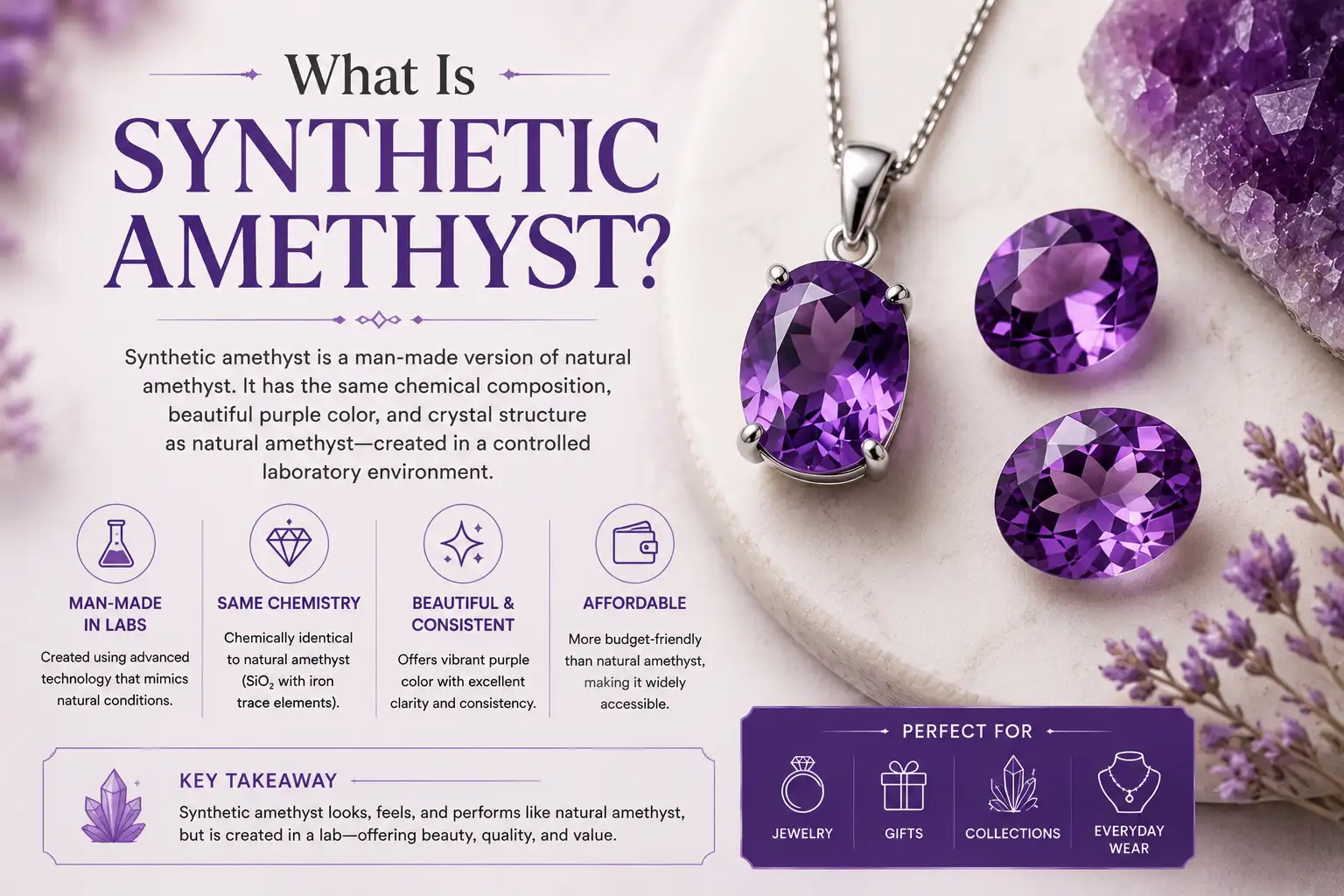
If you have ever seen two amethysts with the same purple color and a price gap that made no sense, chances are that one of them was a synthetic amethyst. It is a real quartz grown inside a lab, and it matches the natural amethyst so closely that even trained eyes struggle with it.
The stone is everywhere in the market today, and most of the buyers cannot tell when they are holding one. That is reason enough to know it properly.
Here in this blog, we will talk about what the synthetic amethyst is, how it gets made, and how it stands against the natural one, so you can make an informed call the next time.
So, let's get started.
The labs grow the synthetic amethyst through a process called the hydrothermal method, and the name sounds heavier than the idea behind it. The process copies what the earth does underground, it just does the same thing faster and inside a sealed steel container.
The lab takes a small piece of quartz called the seed and hangs it inside that container, which stays filled with a water solution carrying the dissolved silica, the material the quartz is made of. The container is then put under high heat and high pressure, and the dissolved material starts settling on the seed layer by layer, the way the dust settles on a table, just far slower and in a crystal form.
The stone takes weeks to grow to a usable size. The purple color comes from the iron present in the mix, and the labs then treat the grown crystal with radiation to bring that purple out fully, the same way nature colors its own amethyst underground.
The word fake does not sit right on this stone, and the reason is the chemistry of it. A synthetic amethyst carries the same composition as the natural one, both of them are quartz through and through, so a lab report reading the material alone would call both of them an amethyst.
A fake stone is a different thing altogether. The purple glass and the purple plastic sold as amethyst are the fakes, as they only copy the look and carry none of the quartz in them, and the trade calls these pieces imitations.
So the honest way of saying it is this, the synthetic amethyst is a real amethyst with an unnatural birth. The problem starts only when a seller hides that birth and charges the natural price for the lab stone, and that part is a seller problem, the stone itself has done nothing wrong there.
The first difference is the time the two stones take to exist. The natural amethyst forms underground over millions of years, and the synthetic one gets made inside the container in a few weeks, so one carries the age of the earth, and the other carries the age of a season.
The look also gives a hint if you know where to look. The natural amethyst mostly carries the small marks inside it, the tiny inclusions, and the uneven patches of purple that came from its underground life, and the lab stone comes out too clean and too even in the color, as nothing disturbed it while it grew.
The price gap follows from all of this. The synthetic amethyst costs a fraction of what the natural one does, and this gap stays even though the two look the same on the counter, because the market pays for the story and the rarity, and the lab stone has neither of the two with it.
The jewelry business runs on the numbers nature cannot always promise. A brand that sells thousands of the same purple ring needs every stone in the batch to carry the same shade of purple, and the natural amethyst never comes out of the ground that evenly, one mine gives a deep purple and the other gives a washed-out one.
The labs solved this with the synthetic amethyst, as a controlled process gives the same color and the same clean stone every single time, and the supply never stops on top of it.
The cost worked in the same direction too. A lab stone comes cheaper than the mining, the cutting waste, and the sorting that the natural stones ask for, so the fashion jewelry side of the market moved towards the synthetic amethyst on its own. That's all this stone was made for, the steady supply at the steady price.
If you take a synthetic amethyst and a natural one to a jewelry counter, chances are that the person behind the counter will not be able to tell you which one is which. The jewelers themselves send their doubtful pieces to the gem labs for this answer, and that sending costs money and takes its own days too.
The labs do have a way of finding it, they read the growth pattern sitting inside the crystal, and the quartz that came from the ground grows in a way the lab containers have not managed to copy so far. But the amethyst is a cheap stone for the most part, and the lab test can cost more than what the stone itself costs, so the small pieces never end up getting tested by anyone.
So for a buyer, the whole thing comes down to the seller you are buying from. The sellers who label their lab-grown stones clearly are the ones worth buying from, and a stone that is being sold as the natural one at a price lower than the usual market rate is most probably a lab stone wearing the wrong tag.
The synthetic amethyst has been serving the market for decades now, and the fashion jewelry side runs on it more than the buyers realize. The stone carries the real quartz in it, the color stays even across the batches, and the price stays where the everyday buyers can reach it.
The natural amethyst keeps its own place on the higher shelf, and the buyers who want the story of the earth keep paying for it. Both of the stones have their own buyers, and the trouble only starts when one gets sold wearing the tag of the other.