7 Days Shipping in “Ship Now” Collection
WORLDWIDE SHIPPING EXCEPT INDIA
Minimum Order Value: $1000
25 October, 2026

Amethyst Necklace Meaning Benefits Healing Properties Spiritual Meaning and Rarity
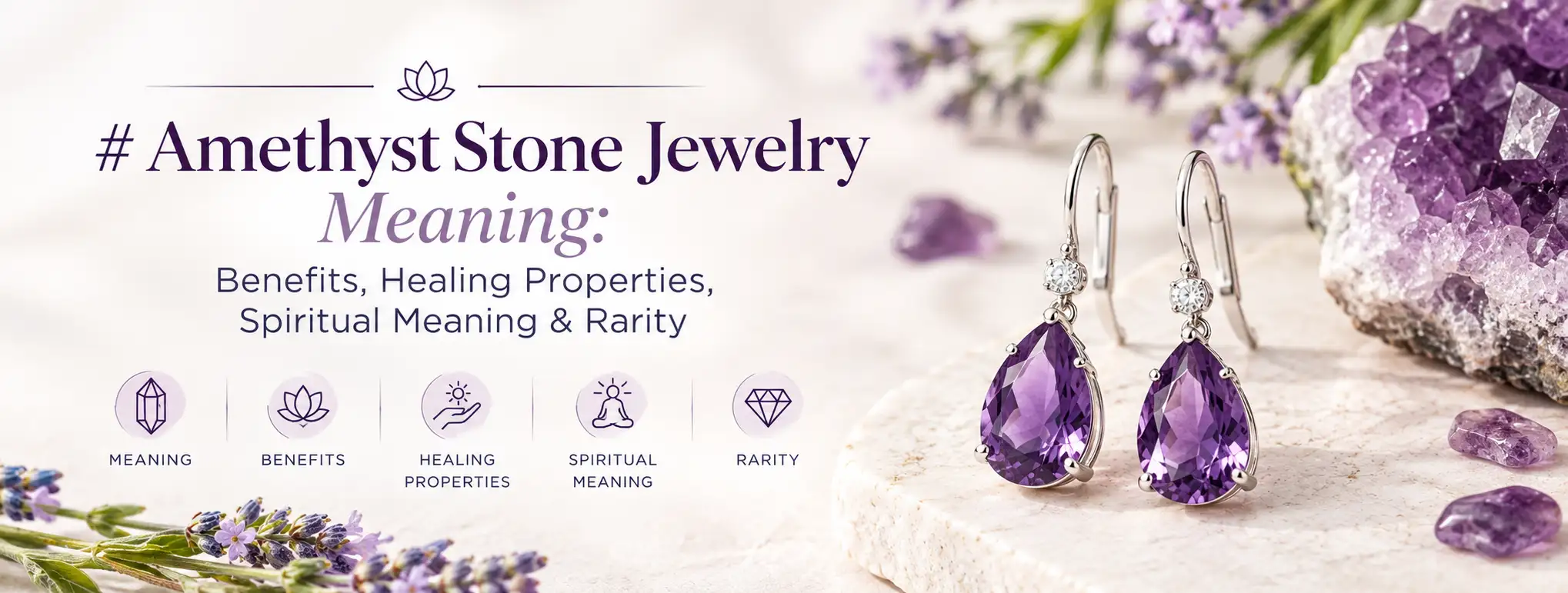
amethyst stone jewelry meaning benefits healing properties spiritual meaning and rarity
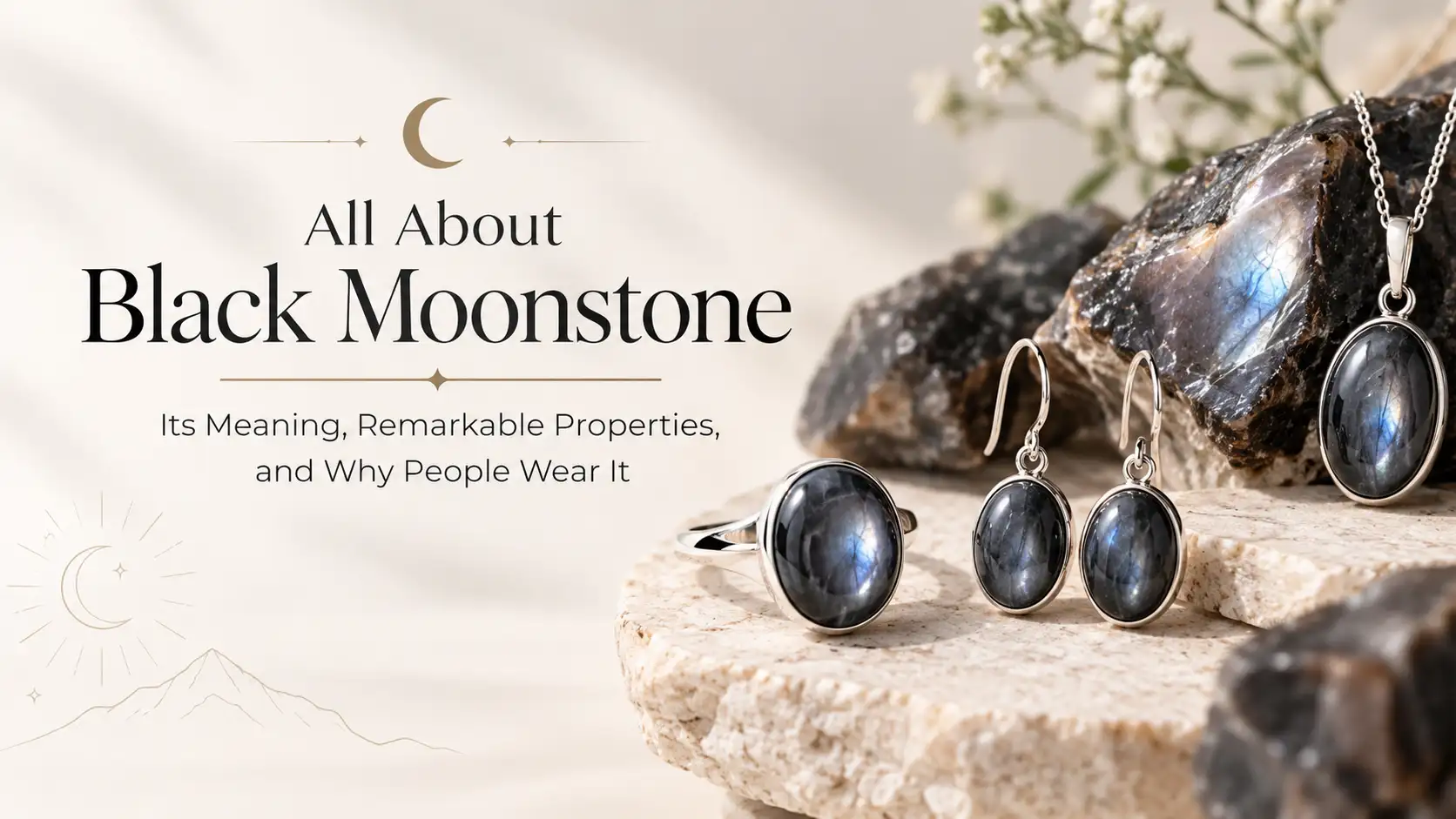
All About Black Moonstone its Meaning Remarkable Properties and Why People Wear It
top 10 wholesale 14k gold earrings suppliers in the usa
Amethyst once sat beside rubies and emeralds in royal jewel boxes. Today a pair of amethyst studs can cost less than a nice dinner out. Both facts are true, and the gap between them explains most of what's worth knowing about this stone.
If you're looking at a pair of amethyst earrings, for yourself or for someone with a February birthday, you probably have three questions. What do they mean? Does the healing stuff hold up? And how do you tell an ordinary purple stone from a genuinely special one?
We'll answer all three, honestly. That means the history and symbolism, what crystal traditions believe, and what science says about those beliefs. It also means the part most guides skip: what makes one amethyst rarer and pricier than another, especially when you need two that match.
The short version: Amethyst earrings stand for calm, a clear head and protection. The name comes from the Greek amethystos, "not intoxicated," and for thousands of years the stone has been tied to sobriety, wisdom and royalty.
Crystal traditions link it to the crown and third-eye chakras, which is one reason people like wearing it close to the head. Amethyst itself isn't rare. Deep, evenly colored stones are, and a well-matched pair is rarer still.
Amethyst is purple quartz, from the same mineral family as clear rock crystal, citrine and smoky quartz. Its color comes from tiny amounts of iron in the crystal, slowly altered by natural radiation in the surrounding rock (National Museum of Scotland). Some older guides still credit manganese. That theory is outdated.
Most of the world's amethyst grew inside volcanic rock. Around 130 million years ago, gas bubbles got trapped in lava flows across what is now southern Brazil and northern Uruguay. Mineral-rich groundwater later seeped into those hollows and lined them with crystals.
A 2024 University of Göttingen study found the Uruguayan crystals formed at surprisingly low temperatures, roughly 59 to 140°F. Some of these geodes are big enough to stand inside.
Three properties matter most once the stone is hanging from your ears:
It's tough. At 7 on the Mohs scale, amethyst is harder than glass, opal, turquoise and pearl. Everyday wear is fine.
Heat changes it. Heated to several hundred degrees, amethyst turns yellow or orange. A lot of the citrine sold today started out as amethyst. A hot car won't do that, but a jeweler's torch can.
Strong light can fade it. GIA notes that some amethyst fades after prolonged exposure to strong light. Normal wear is fine. Years on a sunny windowsill, or every day at the beach, is not.
Almost everything amethyst "means" today traces back to a few old beliefs. Most are well documented. One famous story is far younger than people assume.
The name. Amethystos is Greek for "not drunk." Greeks and Romans believed the stone kept a drinker clear-headed, and some reportedly held it in their mouths at feasts (International Gem Society). It was also thought to keep its wearer quick-witted in battle and in business (GIA).
The myth that isn't ancient. You've probably read the tale of Bacchus, a maiden named Amethyst, and the wine that stained her crystal body purple. It's a lovely story, but no Greek or Roman wrote it. The French poet Rémy Belleau invented it in 1576. The belief that amethyst guards against drunkenness is the genuinely ancient part.
Protection and faith. Ancient Egyptians carved amethyst into small animal figures and amulets; the Met holds a tiny amethyst monkey from Egypt's Middle Kingdom, nearly 4,000 years old and drilled so it could be worn. In the Bible, amethyst sits in the high priest's breastplate (Exodus 28:19) and forms the twelfth foundation stone of the New Jerusalem (Revelation 21:20).
Medieval bishops wore it in their rings, which earned it the nickname "the bishop's stone."
Love. Legend says St. Valentine wore an amethyst ring carved with an image of Cupid. Renaissance Europeans believed the stone calmed lovers swept away by passion. Together, those ideas give amethyst its particular take on love: devoted, steady and clear-eyed.
Royalty. Purple meant power for centuries, and amethyst came along for the ride. Catherine the Great of Russia wore amethyst necklaces and earrings. The Duchess of Windsor wore a famous Cartier amethyst and turquoise bib necklace to a 1953 gala at Versailles. In Britain's Crown Jewels, the cross on the Sovereign's Sceptre with Cross sits on an orb cut from a large faceted amethyst.
The price collapse. Amethyst was once one of the "cardinal gems," alongside diamond, ruby, sapphire and emerald. Russia supplied much of it until the 19th century, when huge deposits were found in Brazil. According to GIA, a gem that had been as rare as ruby or emerald suddenly became plentiful. That's when amethyst went from royal to reachable.
Amethyst earrings stand for:
A clear head. This is the oldest meaning, straight from the Greek name. Today it reads less like "won't get drunk" and more like self-control, good judgment and not getting pulled into other people's chaos.
Calm. Amethyst is the stone people reach for when life feels loud. Wearing it is a small, visible reminder to slow down.
Protection. From Egyptian amulets to battlefield charms, amethyst has long been worn as a shield. Against what depends on who you ask: harm, bad decisions or bad energy.
Wisdom and devotion. Bishops and monarchs gave it dignity. St. Valentine's legendary ring gave it a softer side: faithful, grown-up love.
Rings get knocked around and necklaces hide under collars. Earrings sit right beside your face at eye level, which makes them the most seen jewelry you own. That suits a stone whose meaning is about how you carry yourself.
There's a spiritual reason too. Chakra traditions place amethyst at the crown (the top of the head) and the third eye (between the brows). Many crystal lovers prefer earrings because they keep the stone near that area all day.
A pair also carries a quiet meaning of its own: two stones chosen to match, one on each side of you, is a nice image of balance. Fair warning, that last bit is our own reading, not ancient tradition.
In modern crystal practice, amethyst is the go-to stone for quieting the mind and sharpening intuition. Here's what practitioners believe it does, and how people actually use it. Crown and third-eye chakras. The crown chakra (Sahasrara) sits at the top of the head and is tied to spiritual connection. The third eye (Ajna), between the brows, is tied to intuition and insight. Violet is the color most often assigned to both, and amethyst is the classic violet stone. If chakras are new to you, our guide to chakra jewelry covers the basics.
Protection. Believers describe amethyst as an energetic filter. The idea is that it doesn't just block negativity, it turns it into something calmer. People going through a hard job, a breakup or a big move often choose it for exactly that reason. Meditation and dreams. Amethyst is a classic meditation stone, held in the hand or placed near the head. It's also linked to peaceful sleep and vivid, meaningful dreams, which is why so many people keep a piece on the nightstand.
Ritual and witchcraft. In modern witchcraft and other ritual traditions, amethyst is mostly used for protection, psychic work and dream work. It turns up on altars, in protection charms and beside tarot decks. Some readers keep a piece with their cards to clear them between readings.
Transformation. Because it's tied to sobriety, clarity and fresh perspective, amethyst is often worn through transitions: a new job, a recovery milestone, a fresh start.
If you'd like your earrings to carry an intention, not just a look, try this. It takes less time than finding your other shoe.
Before you put them on, hold the pair in your palm for a moment.
Pick one word for the day: calm, focus, patience, courage. Whatever you need.
Put them on and take one slow breath.
Later, when you catch your reflection or touch an earring, let it bring that word back.
Three different things usually get blended together here: what crystal traditions believe, what science has actually tested, and the benefits you can count on whatever you believe. Let's keep them apart.
Calms stress and overthinking. This is amethyst's signature claim. Practitioners say it quiets mental chatter and takes the edge off anxious moments.
Helps with sleep. It's the classic nightstand stone, linked to restful sleep and fewer nightmares.
Supports emotional healing. Many people reach for it during grief, heartbreak or a big life change.
Sharpens focus. Some believe it clears mental fog and helps with decisions.
Supports sobriety. A direct echo of its Greek name. Some people in recovery wear it as a personal reminder.
Physical traditions. Folk healing links amethyst to headaches, hormone balance and the immune system. These are traditions, not medical findings.
No controlled study has shown that amethyst, or any crystal, heals anything. The best-known test came from psychologist Christopher French at Goldsmiths, University of London. In 2001, his team gave 80 volunteers either a real quartz crystal or a convincing fake to hold while meditating, after describing sensations they might notice. Both groups reported similar sensations, such as tingling, warmth and vibrations. People who already believed in the paranormal reported the strongest effects (TIME).
That doesn't make the experience fake. It means the feeling comes from you: your expectations, your attention, the pause you choose to take. Placebo researchers point out that those effects can be real and worth having. So if touching an earring during a tense meeting helps you breathe, that's a genuine benefit.
It lasts. Hardness 7 means your earrings handle everyday wear far better than opal or pearl.
It's gentle on skin. Quartz is chemically inert. If your ears react, the metal is the culprit, not the stone.
It's affordable. You get rich, saturated purple for a fraction of what purple sapphire or spinel costs.
It flatters. Purple works with warm and cool skin tones, and with gold or silver.
It means something. Few gifts come with a story that's thousands of years old.
You'll see claims that amethyst eases PMS, balances hormones or helps with menopause symptoms. What amethyst earrings do offer is symbolic: a daily cue to slow down, a small act of self-care, and a birthstone or anniversary gift with genuine history behind it. That's plenty.
Amethyst as a mineral is common. Fine amethyst is not. And a truly matched pair of fine amethysts is genuinely hard to find.
Until the 1800s, amethyst was a luxury. GIA notes it was once as rare as ruby or emerald. Then miners found enormous deposits in Brazil, and prices never recovered. Today it's one of the world's most popular colored gems, set in everything from mall jewelry to one-off designer pieces.
Color, above all. The International Gem Society says amethyst's value depends almost entirely on color. The ideal is a strong reddish purple or purple, saturated and fairly dark, with no brown or gray. According to GIA, brownish tints or visible color zoning lower the value dramatically. Too dark is a problem too: the stone can look black in dim light.
The "Siberian" grade. Russia's Ural Mountains once produced the finest amethyst, a deep purple with flashes of red and blue. Today "Siberian" is a quality grade, not a location. It describes that top color wherever the stone was mined, often Zambia or Uruguay. If a seller uses the word, ask whether they mean the grade or an actual Russian origin.
Even color. Amethyst grows in zones of lighter and darker purple. A stone that looks evenly colored face-up is worth more than one with visible stripes. Color and clarity together. Most faceted amethyst is eye-clean. GIA notes that deeply colored Zambian material tends to carry more inclusions, so a deep stone that's also clean is a real find.
Scarce sources. Some localities produce so little that supply alone sets them apart. Arizona's Four Peaks mine, the best-known US source, sits in rugged mountains northeast of Phoenix. Its owner told ABC15 that about a ton of rough leaves the mine each year, yielding only around 50 pounds of gem material.
This is the part most guides miss. Earrings need two stones that sit side by side on your face, so any difference in hue, depth or sparkle shows. Because amethyst varies so much in color and zoning, finding two that truly match often means cutting both from the same piece of rough or sorting through large parcels. Sotheby's notes that for paired gems, the quality of the match is a value factor in its own right.
What that means for you:
Expect to pay more per carat for a well-matched pair than for two random stones.
Small calibrated studs (4 to 6 mm) are easy to match. Large, deep-colored pairs are where the real scarcity lives.
Before buying, compare the pair side by side in daylight and again under warm indoor light. A good pair stays matched in both.
Price follows color far more than size. These are approximate per-carat ranges for natural, faceted amethyst:
Size doesn't push the price up the way it does for sapphire or diamond; IGS notes that amethyst's per-carat value climbs gradually, not exponentially. A pair of 6 mm studs holds only about 1.3 to 1.5 carats of amethyst in total. So in gold earrings, you're often paying more for the metal and craftsmanship than for the stones.
Lab-grown (synthetic) amethyst has been made since the 1970s and has the same chemical and physical properties as the natural stone (GIA). Faceted synthetics often sell for just a few dollars per carat (JCK).
Most "is it real?" tips online can catch glass and plastic. None of them can catch lab-grown amethyst, because it is real quartz, just grown in a lab. Here's what a home check can and can't tell you.
Bubbles and swirls. Look through the stone with your phone camera zoomed in. Round gas bubbles or swirly flow lines point to glass.
Suspicious perfection. Natural amethyst usually shows some color zoning, with slightly lighter and darker patches. A large, deep, flawless, perfectly even stone at a bargain price deserves a second look.
Temperature. Quartz feels cool and takes a moment to warm in your hand. Plastic warms almost instantly.
Worn edges. Glass is softer than quartz, so imitations often show scratched or rounded facet edges after a little wear.
Separating natural from lab-grown amethyst takes lab equipment. Gemologists look for internal growth features, such as a twinning pattern common in natural stones, and use infrared spectroscopy. GIA notes that many in the trade skip testing because it can cost more than the stone is worth.
Skip the old trick of scratching glass with the stone. It can chip a faceted edge, and it proves nothing about natural versus lab-grown anyway.
Some trade names hide what you're actually buying (International Gem Society):
"Green amethyst" is prasiolite, a green quartz usually made by heating amethyst.
"Madeira topaz" or "Spanish topaz" is heated amethyst, not topaz.
"Oriental amethyst" is violet sapphire, a different gem entirely.
Is this amethyst natural or lab-grown?
Has it been treated (heated, or more rarely dyed or fracture-filled)?
Will you put that in writing on the receipt?
What happens if an independent lab says otherwise?
Studs are the everyday workhorse. They go from the gym to dinner without a second thought, and the stone sits close to the ear where it's well protected.
Halo studs surround the amethyst with small diamonds or white sapphires. The bright frame makes the purple look richer and the earring look bigger.
Drops and dangles add movement and catch light every time you turn your head. Pear and oval shapes are the classic choices.
Hoops and huggies with amethyst accents feel modern and easy. They're a great pick for a second or third piercing.
Chandelier and cluster earrings are for big nights out. Check the weight before you buy; amethyst is light for its size, but large statement pieces can still tug on your lobes.
Amethyst is lighter than diamond or sapphire, so a 6 mm amethyst weighs noticeably less than a 6 mm sapphire. Approximate weights for round stones:
Bezel settings wrap the stone in a rim of metal. They protect the edges best and suit an active life.
Prong settings show more of the stone and let in more light, so the color looks brighter. Have a jeweler check the prongs once a year.
Backs: screw backs are the most secure for studs you'd hate to lose, push backs are fine for everyday pieces, and lever backs keep drops from slipping out.
Yellow gold warms amethyst up and makes deep purple look regal. It's the classic royal pairing.
Rose gold flatters pale, pinkish Rose de France stones for a soft, romantic look.
White gold, platinum and sterling silver cool the stone down and bring out bluish-purple tones.
If your ears are sensitive, take nickel seriously. The American Academy of Dermatology estimates that more than 18% of people in North America are allergic to it, and names earrings and earring backs among the biggest culprits. The AAD and Mayo Clinic point to safer choices such as platinum, titanium, surgical-grade stainless steel, sterling silver, 18-karat or higher yellow gold, and nickel-free white gold. Plenty of white gold contains nickel, so ask before you buy. Check the backs too; they're sometimes made from a cheaper metal than the earring itself.
Deep purple has the most impact and holds its color best in evening light.
Medium purple is the most versatile and the easiest to match with your wardrobe.
Lilac or Rose de France is soft, romantic and usually the most affordable.
A simple stylist's rule: if silver flatters you and your veins look blue, try bluish purple in white metals. If gold flatters you and your veins look green, try reddish purple in yellow or rose gold. Break the rule whenever you like.
February birthstone. Amethyst has been February's stone on the official American list since August 1912, when the National Association of Jewelers (now Jewelers of America) met in Kansas City to standardize birthstones (Wikipedia). It has never changed. A pamphlet of birthstone verses published by Tiffany & Co. in 1870 summed up the meaning neatly:
The February-born shall find / Sincerity and peace of mind, / Freedom from passion and from care, / If they an amethyst will wear. You'll find every month's stone on our birthstone chart.
Anniversaries. Amethyst is the gem for the 6th wedding anniversary, and the American Gem Society suggests it for the 17th as well.
Zodiac signs. In Western astrology, amethyst belongs most closely to Pisces (February 19 to March 20). Many lists also give it to Aquarius (January 20 to February 18), since most of February falls under that sign, and some add Virgo and Capricorn. Vedic astrology sees it differently: amethyst is linked to Saturn and often suggested as a gentler, more affordable alternative to blue sapphire, especially for Capricorn and Aquarius. For more pairings, see our guide to gemstones for every zodiac sign.
What amethyst means in love. Between St. Valentine's legendary ring and the Renaissance belief that it cooled runaway passion, amethyst stands for steady, faithful love rather than a passing crush. It's a quietly romantic Valentine's Day choice for someone you plan to keep.
Someone with a February birthday. The obvious choice, and a welcome change from flowers.
Your partner, on your 6th anniversary or on Valentine's Day.
Someone starting something new: a graduation, a new job, a cross-country move. The "clear head" meaning fits.
Someone going through a hard season. Amethyst has long been a stone of comfort in grief.
Someone marking a sobriety milestone, if they've shared that part of their life with you. Given the stone's Greek name, it's hard to think of a more fitting gift.
Yourself. No occasion required.
Use warm water, a drop of mild dish soap and a soft toothbrush. Rinse well and pat dry. GIA and the International Gem Society both recommend this method.
Skip steam cleaners. GIA advises against steam for amethyst.
Think twice about ultrasonic cleaners. GIA says they're usually fine, but the International Gem Society warns that stones with inclusions can crack in them. Our advice: wash by hand and you'll never have to wonder.
Keep bleach and other harsh cleaners away, along with pool and hot tub chlorine, which can also attack gold alloys.
Put your earrings on last, after hairspray, perfume and lotion, and take them off first.
Take them out for swimming, workouts and cleaning day.
Don't leave them on a sunny dashboard or windowsill.
If they ever need repair, remind the jeweler that amethyst is heat-sensitive.
Normal wear outdoors is fine. Long, direct exposure is what can slowly fade the color, so don't store amethyst in a sunny window or "charge" it in sunlight for hours, a common crystal-care tip that does more harm than good.
Give each pair its own soft pouch or compartment. Diamonds, sapphires and rubies can scratch amethyst, and amethyst can scratch softer gems like pearl and opal.
Moonlight, sound from a singing bowl or bell, and smoke are all gentle on the stone. With smoke, just keep the earrings away from the heat of the flame. Skip saltwater soaks, which can dull metal and settings, and skip long sun baths. For a full-moon routine, see our guide to charging crystal jewelry under the full moon.
Have a jeweler check the prongs and backs. It takes a few minutes and can save a stone.
Calm, clear thinking, protection and steady love. The Greek name means "not drunk," so self-control and a clear head sit at the heart of it. Worn near the face, amethyst earrings are a daily reminder of those ideas.
In crystal practice, amethyst is believed to quiet the mind, deepen meditation, sharpen intuition and guard against negative energy. It's linked to the crown and third-eye chakras. These are spiritual beliefs rather than scientific findings.
In Western traditions, anyone can. The stone itself is inert quartz, so for earrings the real concern is the metal: people with nickel allergies should choose sterling silver, 14k or higher yellow gold, or nickel-free white gold. In Vedic astrology, some astrologers suggest that people whose charts are ruled by the Sun or Mars, such as Leo, Aries and Scorpio, consult an astrologer first. And nobody should use amethyst in place of medical care.
Pisces first, then Aquarius. Many lists add Virgo and Capricorn. In Vedic astrology, it's most often recommended for Capricorn and Aquarius, the two signs ruled by Saturn.
Yes. With a hardness of 7, amethyst handles daily wear well. Take your earrings off for swimming, workouts and cleaning, and keep them out of long, direct sun.
Small, secure studs will usually survive it, but it isn't ideal. Soap film dulls the stone, and pillows can bend posts and loosen backs. Never sleep in drops or hoops.
Some amethyst can fade slowly after long exposure to strong light or high heat. Everyday wear won't do it. Storing your earrings on a sunny windowsill might.
Usually it's amethyst with red hematite inclusions near the crystal tips, best known from Thunder Bay, Ontario. Arizona's Four Peaks mine also markets its deep purplish-red material as "Siberian Red." Amethyst itself is always some shade of purple, so if a seller offers a bright red "amethyst" with no explanation, ask exactly what it is.
Most amethyst is affordable, typically a few dollars to a few dozen dollars per carat. Deep, even, clean stones with Siberian-grade color sit at the top, and a well-matched pair costs more than two random stones.
Both can be purple, but sapphire is much harder (9 versus 7 on the Mohs scale), denser and far more expensive. Some sellers call violet sapphire "oriental amethyst," which is a misleading name.
Amethyst earrings carry one of the oldest meanings in jewelry: keep a clear head, stay calm, protect what matters. Whether the stone does that work or simply reminds you to, the meaning holds up. What doesn't hold up is the idea that all amethyst is the same. The mineral is common.
Deep, even color is not, and a pair that truly matches is rarer still. Judge the color first, ask whether the stones are natural, pick a metal your ears are happy with, and keep them out of the sun. Do that, and you'll own a pair that looks good, means something and lasts for decades.
Stocking amethyst earrings for your store? JewelPin manufactures amethyst earrings in all gold karats and 925 sterling silver for boutiques and online retailers with deep African and lighter Brazilian amethyst options. Browse our gold amethyst collection and silver gemstone earrings, or ask about custom designs.