7 Days Shipping in “Ship Now” Collection
WORLDWIDE SHIPPING EXCEPT INDIA
Minimum Order Value: $1000
05 October, 2026
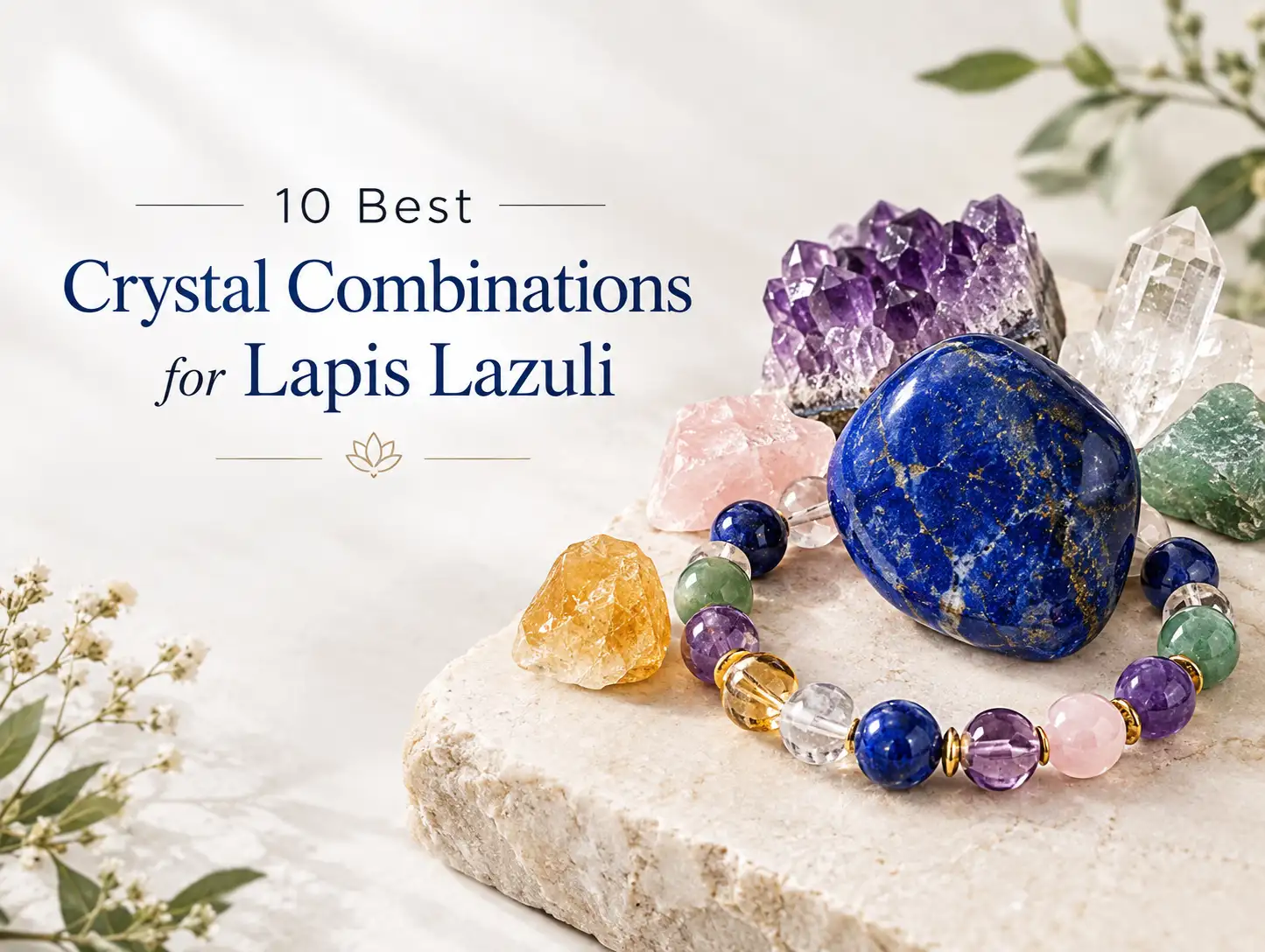
Lapis lazuli pairs best with pyrite for confident action sodalite for clear communication clear quartz for amplification amethyst for meditation labradorite for transitions carnelian for creative drive hematite for focus black tourmaline for protection rose quartz for honest conversations about love and citrine for optimism.
Lapis lazuli isn't a single mineral. It's a rock a blend of three main ingredients:
which supplies the deep blue. Trade convention holds that a stone needs a meaningful proportion of lazurite before it can honestly be sold as lapis.
the soft white mineral that shows up as pale veins or cloudy patches. Calcite is soft and reacts to acids.
the brassy gold specks. Not gold despite what people assume. Iron sulfide is the same mineral sold in chunks as fool's gold.
Before the list it helps to understand the logic. Every good pairing runs on one of three principles.
You put two stones with similar associations together and the shared quality intensifies. Lapis plus clear quartz is the cleanest example. You aren't adding a new flavor; you're turning up the volume on what lapis already does. Use when: you know exactly what you want and just want more of it.
You pair lapis with something that occupies different ground and the two hold each other steady. Lapis is a mentally oriented dupper-chakra stone. Pair it with hematite or black tourmaline and the grounding stone keeps the insight tethered to your actual life instead of floating off into abstraction. Use when: one quality in you is already strong and needs a counterweight.
Some pairings work in an order. Lapis and sodalite is a two-step: lapis helps you figure out what you actually think and feel and then sodalite helps you articulate it cleanly. Reverse the order and you get confident well-worded statements about something you haven't examined yet. Use when: the goal has a natural before-and-after reflect then speakdecide then actheal then open up.
Pyrite already grows inside lapis as those gold flecks so combining them as separate stones doubles down on a relationship that formed underground. In tradition reads lapis as inward wisdom and honest self-assessment and pyrite as nerve confidence and material follow-through. Together they connect knowing what you think to being willing to do something about it.
Third eye and throat (lapis) meeting solar plexus and root (pyrite). Insight anchored in will power.
Salary negotiations pitching a project career decisions you've been circling for months for any resolve that has to survive other people pushing back.
Keep both on your desk pyrite to your dominant-hand side. Before a difficult conversation hold lapis for a minute and get clear on what you actually want then hold pyrite while you rehearse saying it out loud. In a bracelet stackwear them on your right wrist the projecting side in most traditions when the goal is outward action.
Pyrite rusts. Never cleanse this pair in water. Moonlight or sound only.
Two deep blue stones that look similar enough that beginners routinely mix them up but they do different jobs. Tradition associates lapis with inner truth and deep self-knowledge sodalite with logical calm and plain-spoken communication.
Both throat-chakra stones with lapis reaching into the third eye.
Writers teachers podcasters therapists anyone who has been putting off a hard conversation public speaking difficult feedback you need to deliver.
Do it in order. Sit with lapis first journal or just sit quietly until you can name the actual thing you feel. Then hold sodalite while you draft the email script, the conversation or outline the talk. For daily wear a lapis pendant near the throat with a sodalite tumble in your pocket.
Sodalite is usually a more uniform navy with white calcite veining and essentially no pyrite. Lapis runs a richer, more violet-leaning blue and almost always carries gold flecks.
Clear quartz is treated in tradition as an amplifier that strengthens whatever sits beside it without redirecting it. With lapis you don't get a new quality you get more lapis. Sharper clarity, deeper reflection, stronger pull toward honesty. It's the most versatile pairing on this list precisely because it adds nothing of its own.
All chakras (quartz) support the third eye and throat (lapis).
Meditation you want to go deeper crystal grids any time a lapis practice feels like it's stalled or gone flat.
In a grid put lapis at the center and clear quartz points at the four cardinal positions tips facing inward. For meditation lapis in your receiving hand (usually the left)quartz in the dominant hand. For a desk setup one small quartz point beside the lapis aimed at it.
Quartz is a 7 on the Mohs scale and lapis is around 5. These two must not be stored loose in the same pouch the quartz will scratch the lapis. Separate compartments or a cloth divider.
Amethyst is the quiet one. Tradition reads it as calmingmentally settling and protective of spiritual practice. Lapis brings discernment and the refusal to lie to yourself. Together they suit the kind of contemplation that's genuinely reflective rather than just relaxing meditation with some edge to it.
Third eye and crown both stones. This is the most upper-chakra pairing on the list, heady inward unconcerned with the physical.
Meditation practice dream work study that requires both calm and precision processing, something you've been avoiding.
Nightstand pairing or held during seated meditation with one in each hand. If you journal before bed, keep both beside the notebook. Because this combination sits so high in the body's energy mapsome people find it ungrounding.
Amethyst is quartz-family so the same storage separation applies. Amethyst also fades in prolonged direct sunlight; don't leave this pair on a windowsill.
Labradorite is the stone of transitions and inner knowing the flash of iridescence standing in for something glimpsed rather than stated. Lapis insists on truth. Put them together and you get support for the private reckoning that comes before any announcement the moment you admit to yourself what you already know about a job, a relationship or a direction.
Third eye both. Intuitive rather than communicative.
Major life changes decisions you keep re-litigating moments when being comfortable and being honest point in different directions.
This is a solitary pairing not a social one. Hold both during a long walk. Keep them together in a bedside dish while you're actively weighing something. Once you've decided, switch to the lapis-and-sodalite pair to communicate it or lapis-and-pyrite to act.
Labradorite is harder than lapis (roughly 6–6.5) and visually complements it which is why this is one of the most popular combinations in beaded bracelets.
Lapis is cool blue and cerebral. Carnelian is warm orange and physical tradition ties it to creative fire motivation and vitality. This is a balanced pairing in the most literal sense: temperature color and chakra position all sit opposite each other. Lapis supplies the concept; carnelian supplies the willingness to start before you feel ready.
Third eye and throat (lapis) balanced against sacral and root (carnelian).
Creative professionalsanyone whose ideas outnumber their finished projects breaking a procrastination cycle launching something.
Desk pairing during working hours. Carnelian nearer your dominant hand. If you keep a project notebook, tuck a carnelian tumble inside the cover and wear the lapis. Some practitioners hold carnelian for two minutes before beginning a work block specifically as a start signal with lapis staying on the desk for the duration.
Hematite is dense metallic and heavy in the hand and tradition reads it as grounding and stabilizing above all else. Lapis on its own can be mentally scattering for some people a lot of insight arriving at once. Hematite gives that insight somewhere to land. The physical weight of the stone is part of the effect. it's a genuinely tactile pairing.
Third eye (lapis) tethered to root (hematite).
Studying exam prepdeep work sessions anyone who reads as anxious or scattered empaths who pick up too much in crowded environments.
Hematite in your non-dominant hand or in your pocket lapis on the desk or worn. For a study session place hematite between you and the door lapis beside your notes. Hematite is also comfortable to hold and turn over which makes it a good fidget anchor during long focused stretches.
Hematite can leave a faint reddish residue and shouldn't be soaked either. Dry cleansing for this whole pair.
Black tourmaline is the standard protective stone in modern practice, a shield that tradition says blocks and grounds negativity. Pair it with lapis and you get the combination for saying something true in an environment that may not want to hear it. Lapis handles the honesty; black tourmaline handles the aftermath.
Throat and third eye (lapis) protected and anchored at the root (tourmaline).
Setting boundaries in difficult family dynamics workplaces where honesty carries risk whistle blowing-adjacent situations to anyone who gets emotionally flattened after conflict.
Black tourmaline near the entry to your home or work space lapis carried or worn on you. If you're heading into a specific confrontation keep both in the same pocket. Afterward put the tourmaline down first the protective stone has done its job and continuing to hold it can keep you braced longer than you need to be.
Most guides frame this as "love and compassion" and stop there which undersells it. Rose quartz is the gentlest stone in common circulation; lapis is one of the most uncompromising. The combination isn't about softening lapis, it's about being able to tell someone the truth without it landing as an attack. Honesty and warmth are hard to hold simultaneously. This pairing is for that.
Heart (rose quartz) with throat and third eye (lapis).
Relationship conversations apologies that need to be real rather than performative self-honesty about your own patterns telling a friend something they won't enjoy hearing.
Hold rose quartz over your heart and lapis at your throat for a few minutes before the conversation. In jewelry a rose quartz bracelet with a lapis pendant. For self-work keep both beside a journal and write the honest version of the thing you've been narrating kindly to yourself.
Rose quartz is quartz-family. Store separately from lapis.
Lapis can be a serious stone. It points you toward things you've been avoiding and that isn't always a pleasant process. Citrine sunny warmth associated in tradition with abundance and confidence keeps the honesty from tipping into bleakness. This is the pairing for people who are good at seeing clearly and less good at staying hopeful about what they see.
Solar plexus (citrine) lifting third eye and throat (lapis).
Job searching recovering from a set back entrepreneurial work any long project where morale matters as much as judgment.
Workspace pairing. Citrine somewhere you'll see it in your peripheral vision lapis somewhere you'll physically touch. Many practitioners like citrine in a wallet or cash box with lapis on the desk.
Most inexpensive "citrine" on the market is heat-treated amethyst identifiable by the strong orange concentration and white base. Natural citrine is a paler, more even yellow. Either works in practice but you should know what you're buying.
Every stone here is upper-chakra. Stacking four of them tends to produce the crystal equivalent of drinking four coffees. A lot of mental activity with nowhere to put it. If you want a large combination, include at least one grounding stone.
Energetically this is a popular pairing and it looks stunning. But raw unpolished malachite is toxic if dust is inhaled or if it's used in water and its copper content makes it a poor candidate for any water-based cleansing. If you use this pairinguse polished malachite only keep it dry and wash your hands after handling raw pieces.
Selenite dissolves in water. Lapis shouldn't be soaked. Pyrite rusts. This trio is a perfect example of why blanket "cleanse your crystals weekly under running water" advice is bad advice.
Not an energetic issue, a hardness issue. Anything above a 6 on the Mohs scale will abrade lapis over months of wear. If you want a mixed bracelet, put softer stones next to the lapis or use metal spacer beads to keep hard stones from making direct contact.
the left side receives and the right side projects. Wear lapis on the left when the work is inward developing intuitionself-honestymeditation. Wear it on the right when the work is outward speaking negotiating leading teaching. The same logic applies to which hand holds which stone in a two-stone meditation.
Lapis's strongest traditional association is with honest speech which makes a pendant the most natural way to wear it. If you only own one piece of lapis jewelry make it something that sits near the collarbone.
Lapis suits writing, studying and analytical work. Place it where you'll physically touch it, not just see if the contact is part of the practice.
Lapis at the center four or six supporting stones at the points clear quartz points aimed inward. Keep the grid somewhere it won't be disturbed and leave it for at least a few days.
Once you've assigned two stones to a purpose, store them together (with a cloth divider if hardness is an issue). It reinforces the association and practically means you never have to hunt for the second stone.
Crystal work is cumulative and subtle. A few days to a couple of weeks is a reasonable window before deciding whether a pairing is doing anything for you.
The calcite in lapis is soft and reacts to acids. The pyrite oxidizes with moisture. Brief contact with a damp cloth is survivable; soaking running water and water-based "cleansing rituals" are not. Over time water contact dulls the polish and rusts the gold flecks.
Salt is abrasive and accelerates everything above. Dry salt burial is also a risk because of the abrasion.
They'll damage the stone and dissolve any wax or resin treatment.
No household cleaners alcohol or jewelry dips
Acids attack calcite directly.
Lapis is around 5–5.5 on the Mohs scale. Quartz is 7. Keep lapis in its own soft pouch or a lined jewelry box compartment away from quartz amethyst citrine topaz and garnet.
Extended UV exposure can fade the blue particularly in dyed or lower-grade material.
Moonlight overnightsound (a singing bowl or tuning fork)smoke selenite contact burying in dry rice for a few hours or simply wiping with a dry soft cloth and setting a fresh intention. All of these work and none of them will hurt the stone.
Lotion perfume, hair spray and sunscreen all shorten the life of a lapis piece. Dress your hair and skin care then put the lapis on.
Pyrite for most people and most purposes. The two already occur together in the same rock and the combination joins lapis's clarity with pyrite's willingness to act. For communication specifically sodalite is the stronger choice.
Yes, with care. Because it's a relatively soft stone at 5 -- 5.5 on the Mohs scale, daily wear works best for pendants and earrings rather than rings which take more knocks. Put it on after skincare and perfume and take it off before swimming, showering or exercising.
Two or three is usually the sweet spot. Beyond that, intentions tend to blur and it gets hard to tell what's doing what. If you want a larger set make sure the group includes at least one grounding stone.
No. It contains calcitewhich is soft and acid-reactiveand pyritewhich oxidizes when damp. Use moonlightsoundsmokeor dry methods instead.
Traditionally the throat and third eye communication and insight. That's why its most natural partners are either other blue stones that work the same ground or grounding stones that balance its upward pull.
Energetically yes physically be careful. Quartz is harder and will gradually scratch lapis where the beads touch. Use metal spacer beads between them or wear them on different wrists.
There's no traditional prohibition on any combination. The practical precautions are physical: don't store or stack it against harder stones, don't include it in water-based cleansing routines with pyrite or selenite and use polished rather than raw malachite if you pair the two.
Sodalite is a navy blue with white veining and essentially no pyrite. Lapis runs richer and slightly more violet and almost always shows gold pyrite flecks. In practice sodalite is associated with logic and plain communication; lapis with deeper truth and inner wisdom.
The reason to pair crystals isn't that one stone is insufficient. It's that most real goals have more than one part to them. Wanting to speak honestly means first knowing what's true then finding the words then surviving the response three different jobs which is why lapis works so well with sodalite with rose quartz and with black tourmaline depending on which part you're stuck on.
Start with the goal. Pick the pairing that matches it. Give it a couple of weeks. Then when you know the three principles well enough, build combinations nobody has written about yet.