7 Days Shipping in “Ship Now” Collection
WORLDWIDE SHIPPING EXCEPT INDIA
Minimum Order Value: $1000
25 October, 2026
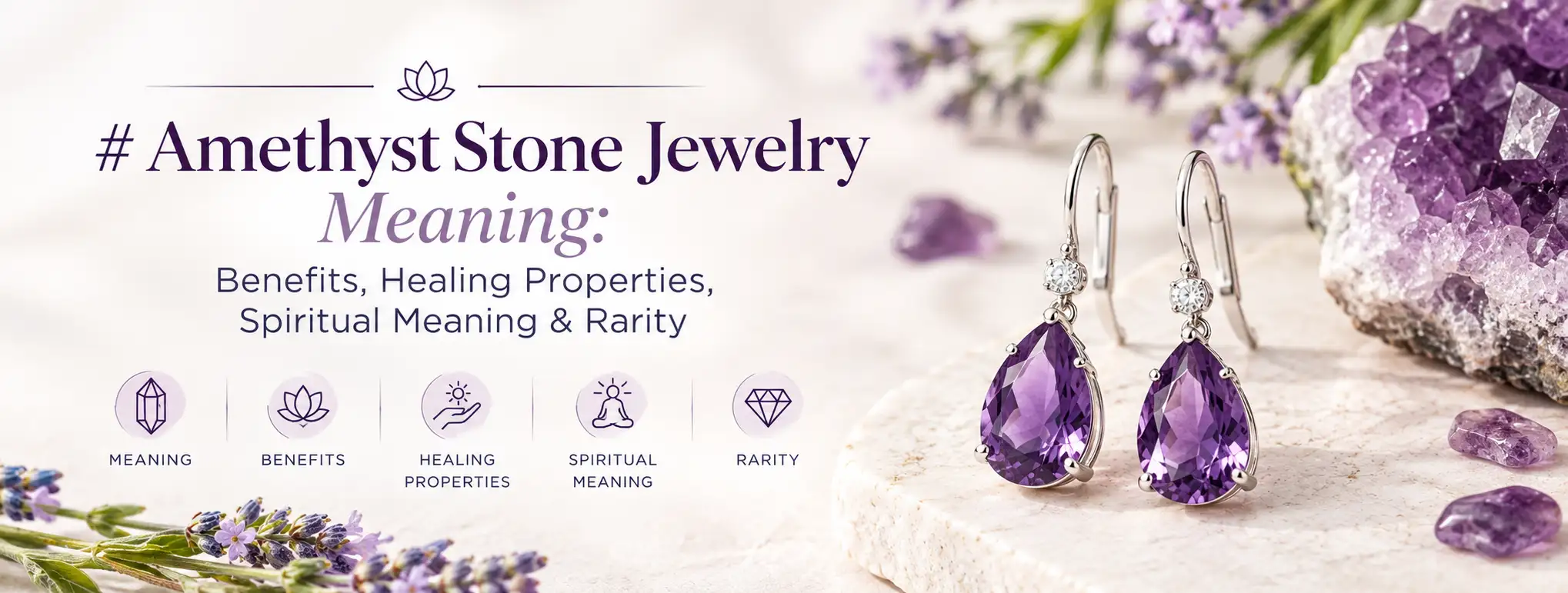
amethyst stone jewelry meaning benefits healing properties spiritual meaning and rarity
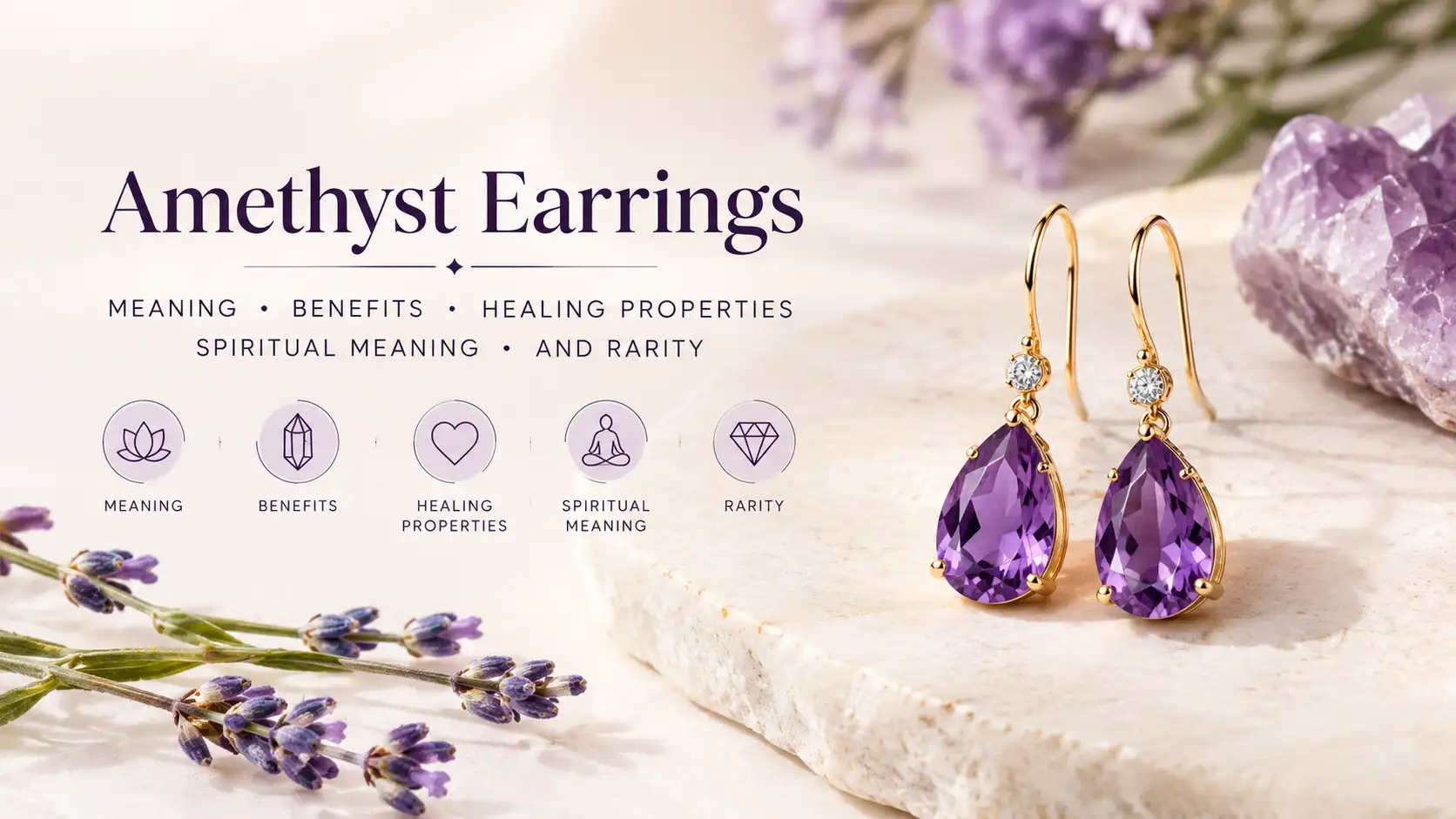
Amethyst Earrings Meaning Benefits Healing Properties Spiritual Meaning and Rarity
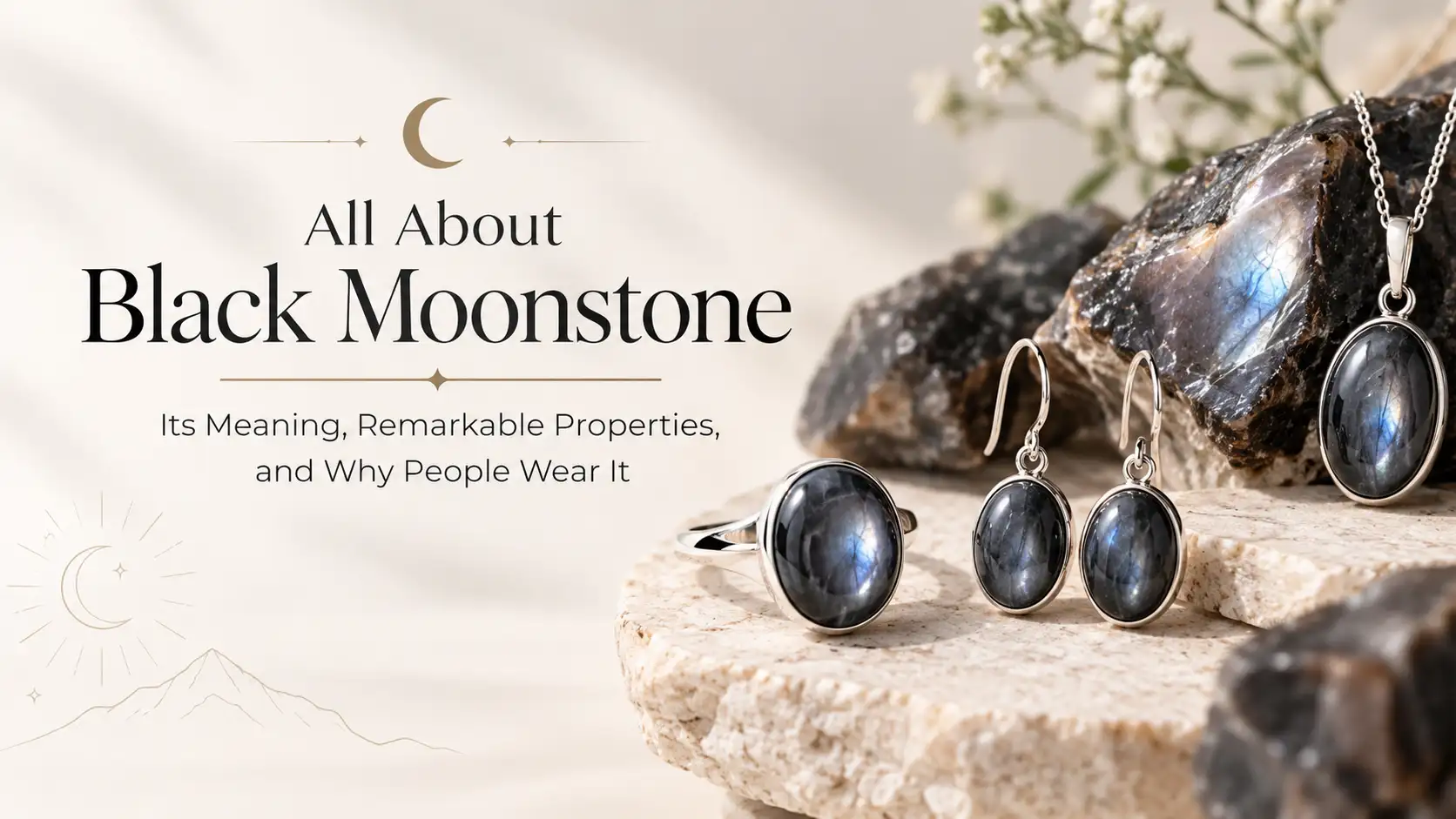
All About Black Moonstone its Meaning Remarkable Properties and Why People Wear It

top 10 wholesale 14k gold earrings suppliers in the usa
An amethyst necklace stands for a calm, clear head. The stone's name comes from the ancient Greek amethystos, meaning "not intoxicated," and people have worn it as a guard against excess, poor judgment and bad energy for close to 4,000 years.
That's the short answer. The longer one is more interesting, because amethyst lives two lives. It's a crystal-shop staple tied to the crown and third eye chakras, and it's also a real gemstone that once sat beside ruby and emerald in royal collections.
We make gemstone jewelry in Jaipur, India, one of the world's major colored-stone cutting centers, and the Valentine group behind JewelPin started out trading emeralds in the 1920s. So alongside the folklore, you'll get what a jeweler knows: how rare amethyst really is, how to spot a fake strand, and why it fades on a sunny windowsill.
At its heart, an amethyst necklace means self-possession: keeping a clear head when everything around you gets loud. Every other meaning people attach to the stone grows out of that one idea.
Amethystos means "not drunk" in ancient Greek. The Greeks believed that carrying the stone let you drink without losing your senses, and some even held it in their mouths at parties.
The belief soon stretched beyond wine. Old legends say amethyst kept its wearer clear-headed and quick-witted in battle and in business. Swap the battlefield for a hard week at work, and that's still why most people buy one.
You've probably read the story: Bacchus chases a maiden named Amethyste, the goddess Diana turns her into white stone, and the remorseful god pours wine over it until it turns purple. Nearly every crystal site calls it Greek mythology.
It isn't. The French poet Rémy Belleau wrote that tale in 1576. The sobriety belief is genuinely ancient; the romantic origin story is about 2,000 years younger than people assume.
Necklaces have always been the talisman format. They sit at the throat and over the chest, where you can see the stone and touch it without thinking.
That habit is very old. The Worcester Art Museum in Massachusetts holds a strand of graded amethyst beads from Egypt's Middle Kingdom, made around 1980 to 1760 BCE. It measures 24¼ inches, almost exactly what a jeweler today would call a matinee length.
A popular legend says St. Valentine wore an amethyst ring carved with Cupid's likeness. Medieval Europe prized steady, faithful love over wild passion, and amethyst fit that ideal neatly.
It's also the traditional gemstone for the sixth wedding anniversary, and the American Gem Society suggests it for the 17th as well. So between partners, an amethyst necklace says "calm, loyal, clear-eyed love" rather than fireworks.
Amethyst is the February birthstone, so a birthday is the obvious occasion. But the stone's real message travels well beyond February.
A sobriety milestone. Given what the name means, some people in recovery wear amethyst as a quiet daily reminder.
A big transition. A new job, a move, a divorce or a first year of college all call for a level head.
Grief or a hard season. It's a gentle way to say "stay steady, I'm thinking of you."
An anniversary. The sixth, traditionally, though nobody will complain about it on the fifth.
Spiritually, amethyst is the stone of a quiet mind. In modern crystal practice it's tied to the crown and third eye chakras, to protection, and to intuition and peaceful sleep.
The crown chakra sits at the top of the head and is linked to spiritual connection and awareness. The third eye sits between the brows and governs intuition. Amethyst is assigned to both, partly for its violet color and partly for its calming reputation.
Pairing stones with chakras by color is a modern crystal-healing practice, not something from the classical yoga texts. That doesn't make it meaningless; it just helps to know where the idea comes from.
If you follow chakra work, chain length matters more than most guides admit. A pendant on a 16-inch chain rests near the throat, while 20 to 24 inches lets it fall toward the heart. Pick the spot that matches your intention (there's a full length chart in the buying guide below).
Amethyst has been a protective stone for as long as it's been worn. Egyptians carved it into amulets against harm, and Greek soldiers trusted it to keep them sharp in battle. Today people describe the same idea in softer terms: an energetic boundary. That idea appeals to anyone who spends all day absorbing other people's stress, from nurses to teachers.
Many tarot readers keep an amethyst with their deck, and it's one of the most common stones in mala beads used for meditation. It's also the classic "dream stone," said to bring calmer sleep and clearer dreams.
Christianity. Early Christians read amethyst's purple as purity and its reddish flashes as Christ's suffering. Bishops still wear it, it appears in British coronation regalia, and it's counted among the emblems of the twelve apostles. The Bible lists it in the high priest's breastplate (Exodus 28:19) and as the twelfth foundation stone of the New Jerusalem (Revelation 21:20).
Vedic astrology. In India, amethyst is called jamunia or katela and belongs to Saturn (Shani). Astrologers treat it as a gentler, more affordable stand-in for blue sapphire. It's traditionally set in silver, put on for the first time on a Saturday, and usually recommended for Capricorn and Aquarius ascendants.
Crystal astrology isn't standardized, so lists vary from one source to the next. If the stone speaks to you, your sign shouldn't stop you.
The benefits people describe fall into five groups: calm, sleep, focus, breaking habits and, in folk medicine, physical relief. Below is each one as the tradition tells it, then what the research says.
A quick note before we start: we make jewelry, not medicine. Nothing here replaces a doctor or a therapist.
Calm is the benefit people mention most. Crystal practitioners say its energy slows racing thoughts and takes the edge off anxiety. A necklace has a practical edge here. The pendant sits right where your hand drifts when you're tense, so touching it becomes a cue to stop and breathe.
Amethyst is the classic "dream stone," said to quiet the mind at night and keep nightmares away. Most people who use it this way set it on the nightstand or tuck it under the pillow.
One jeweler's tip: don't sleep in a chain necklace. Chains kink, clasps snap and fine links catch hair. Take it off and let it sit by the bed instead.
This one comes straight from the Greek idea of staying "not drunk" on anything, whether that's wine, anger or panic. People wear amethyst to exams, job interviews, negotiations and long creative sessions.
Given its name, amethyst has long been a symbol of sobriety. Some people in recovery wear it as a private reminder of a promise they made to themselves, and it's become a meaningful gift for sobriety anniversaries.
Folk healers have linked amethyst to headache relief, hormone balance and immune support. Medieval Europeans used it on wounds, and one old remedy called for rubbing a moistened amethyst on pimples.
Amethyst isn't rare as a mineral, but top-color amethyst is. Deep, evenly colored stones are a small slice of what gets mined, and a few sources, like Arizona's Four Peaks mine, sell at a clear premium.
Most amethyst guides skip this part, so here's the full picture.
Until the 1800s, Russia was the world's main source of amethyst. Then huge deposits turned up in Brazil and, in GIA's words, a stone once as rare as ruby or emerald was suddenly everywhere. Some Brazilian geodes are big enough to stand inside.
Before that, amethyst was royal jewelry. Catherine the Great wore amethyst necklaces and earrings. As late as 1953, the Duchess of Windsor wore a Cartier bib necklace of 28 step-cut amethysts, a heart-shaped amethyst, turquoise and diamonds to a gala at Versailles.
Color, above all. Value depends almost entirely on color. The prized shade is a deep purple with red or blue flashes, which the trade calls "Siberian" no matter where the stone was mined.
Evenness. Brazilian rough is often lighter and patchy. Stones with rich, even color all the way across are much harder to find.
Size with quality. Amethyst comes in big sizes, but clean stones over 100 carats are scarce. The Smithsonian's giants include a 1,362-carat Brazilian stone and a 202.5-carat stone from North Carolina.
Origin. Arizona's Four Peaks mine is the only US source of high-quality amethyst, and its deep purple-red stones sell above African and South American material.
You'll see "African amethyst" among the stone options in our own amethyst collection. Stones from Zambia and its neighbors tend to run deeper than typical Brazilian material.
Siberian: a grade, not a passport. Dark purple with red and/or blue flashes.
Rose de France: very pale, pinkish lilac. The International Gem Society calls the name a clever bit of marketing, but it's lovely in rose gold.
Chevron amethyst: purple banded with white quartz, mostly sold as beads and tumbled pendants.
Ametrine: amethyst and yellow citrine in one crystal, mainly from Bolivia.
"Green amethyst": really prasiolite, usually amethyst heated to 400–500°C. The stone is real; the name is a misnomer.
"Madeira," "Palmyra" or "Spanish" topaz: heat-treated amethyst sold under a pricier gem's name. Topaz is a different mineral entirely.
So if a seller calls every amethyst "rare," be skeptical. If they show you a deep, evenly colored stone that flashes red in the light, the word is earned.
You could be buying one of three things: natural amethyst, lab-grown amethyst (the same mineral, made in a lab), or an imitation like glass or dyed quartz. Spotting an imitation takes a few minutes. Telling natural from lab-grown takes a lab. Fakes cluster at the cheap end of the market, especially bead strands sold by the inch. Here's how to check.
Do the price math. Amethyst is affordable, but not free. If a full strand of 8 mm faceted beads costs less than lunch, be suspicious.
Look inside. Use a 10x loupe or your phone's zoom. Round bubbles and swirly lines mean glass. Natural amethyst shows feathery "thumbprint" marks, fine lines or tiny crystals instead.
Check the edges. Cut quartz has crisp facet edges. Molded glass often has soft, rounded edges and sometimes a faint seam.
Watch the drill holes. On beads, dye collects in cracks and around holes, looking darker there than anywhere else. On a loose bead, a cotton swab with nail polish remover will often pick up dye. Never try this on a strung necklace, since solvents can weaken the thread.
Feel the temperature. Quartz feels cool and warms slowly in your hand, while plastic warms almost at once. Glass sits in between, so treat this as a hint, not proof.
The scratch test. Dragging a stone across glass can chip its facets, and it proves little. Lab-grown amethyst is real quartz and passes easily.
The color-zoning rule. Plenty of blogs say "real amethyst is never evenly colored." Natural amethyst often shows zoning, but the finest natural stones are prized for being even. Color alone can't settle it.
A jeweler with a polariscope or refractometer can separate glass from quartz in a minute or two. It's worth asking before an expensive purchase.
Lab-grown amethyst has been around since the 1970s and has the same chemical and physical properties as the natural stone. Separating the two often needs advanced lab testing, which most sellers skip because amethyst is a relatively inexpensive gem.
In the US, the FTC Jewelry Guides require sellers to label lab-made stones with a term like "laboratory-created" or "synthetic." They also bar calling those stones "natural" or "genuine."
So ask the seller to write "natural amethyst" on the receipt. For a high-value piece, such as a large Siberian-grade stone, a report from GIA or another respected lab is money well spent.
Start with how you'll wear it, then settle the style, chain length, metal, stone size and color in that order. Get those right and the necklace will feel like yours on day one.
Solitaire pendant. One faceted stone on a chain. The most versatile choice and the easiest gift.
Halo pendant. Amethyst ringed with diamonds or white stones. More sparkle for evenings.
Bead strand. A continuous row of beads with a relaxed, boho feel. Hand-knotting between beads is a sign of quality, because it stops them rubbing and keeps them from scattering if the strand breaks.
Raw or crystal-point pendant. The crystal-shop look. Lovely, but rough points can snag sweaters.
Station necklace. Small stones spaced along a fine chain. Made for layering.
Amethyst and pearl. A classic pairing. Pearls are much softer than amethyst, so clean them gently.
Chakra necklace. Seven stones in a row, with amethyst at the crown position. Browse our chakra collection to see how they're usually arranged.
Neck size and height change everything. The easiest fix is to measure a necklace you already love wearing.
Sterling silver (stamped 925). Cool, modern and affordable. It makes bluish-purple stones look crisp. It does tarnish, so store it in a zip bag.
Yellow gold. Warms up reddish-purple stones and makes deep colors glow. In the US, nothing under 10 karat can legally be sold as gold, so look for a 10K, 14K or 18K stamp.
Rose gold. The best friend of pale Rose de France stones and lilac shades.
Gold vermeil. Sterling silver with a thick gold layer, at least 2.5 microns under FTC rules. A good middle ground on price.
Browse our silver necklaces and silver pendants to compare how each metal looks with purple stones.
Weights are our estimates for well-proportioned faceted ovals. Deeper cuts weigh more.
Deep purple. The most valuable, but very dark stones can look almost black in a dim restaurant. That's why some dark amethyst is gently heated to lighten it.
Medium purple. The sweet spot for value. It stays lively in any light.
Lilac and Rose de France. Soft and romantic. Lovely with rose gold and pastels.
Showroom spotlights flatter every stone. Look at it near a window in daylight and again under a warm lamp before you decide, because amethyst can shift bluer or redder.
Bezel settings wrap the stone in metal and protect its edges. Best for everyday wear.
Prong settings let in more light. Make sure the prongs are snug, and have them checked once a year.
The bail is the loop the chain runs through. Make sure it's wide enough to fit other chains you own.
The clasp should be a lobster clasp for anything heavier than a small pendant. Spring rings wear out faster.
Knotted strands loosen with wear, so plan to have them restrung every year or two if you wear them often.
These are approximate US retail ranges as of 2026. Metal weight and stone quality move them a lot.
Amethyst has a long masculine history, from Greek soldiers who carried it into battle to the bishops who still wear it today. Men's styles are simpler than most people think.
Bead necklaces. 8 to 10 mm beads, often mixed with onyx, tiger's eye or lava stone, on a 20 to 22 inch strand.
Raw point or tumbled stone. Hung on a leather cord or a sturdy 2 to 3 mm chain at 22 to 24 inches.
Bold sterling silver pendants. A square or hexagonal bezel with a darker stone. Oxidized silver keeps it understated.
Faith pieces. A cross or saint medal with an amethyst accent, a nod to the bishop's-ring tradition.
Darker stones tend to pair best with dark clothing, and men's chains usually run longer, at 20 to 24 inches. Plenty of men wear dainty pendants too; these are just common starting points.
Wear it where you'll notice it, and dress around the purple rather than against it. A few simple habits keep it looking good for years.
Purple pops against white, cream, gray, navy, black, olive and denim. Lavender on lavender looks deliberate and chic, but a busy print right behind the stone will swallow it.
Match the length to the neckline:
Crew neck: a 16 or 18 inch pendant that sits above the fabric.
V-neck: an 18 to 20 inch pendant that echoes the V.
Strapless or off-the-shoulder: a 16 inch pendant or a bold collar piece.
Turtleneck: a long 24 to 30 inch pendant worn over the knit.
Start with a plain 16 inch chain, add the amethyst pendant at 18 or 20 inches, and finish with a longer chain at 22 or 24. Leave about two inches between layers so they don't tangle.
Mixing silver and gold is fine. Just repeat each metal at least twice so it looks intentional.
If you wear amethyst for its meaning, keep the ritual simple. Set an intention as you fasten the clasp in the morning, and touch the pendant when you need to reset during the day. No kit required.
Before bed. Chains kink and clasps snap overnight.
In the shower, pool or hot tub. Soap dulls the stone, chlorine is hard on metal, and water weakens silk-strung beads.
At the gym. Impact chips stones, and sweat speeds up tarnish.
On long beach days. Strong sun can fade amethyst over time.
Jewelers have a rule for this: last on, first off. Put the necklace on after lotion, perfume and hairspray, and take it off before anything messy.
Clear quartz, said to amplify amethyst's calm.
Rose quartz, for a softer, heart-centered combination.
Black tourmaline or onyx, for grounding and protection.
Moonstone, for intuition and dreamwork.
Labradorite, for transitions. Our guide to labradorite necklace meaning covers it in depth.
Lapis lazuli, a classic meditation partner, as we explain in the best crystal combinations for lapis.
Curious about the other side of the coin? Here's our take on which crystals don't work well together.
Keep it out of strong sun and heat, clean it with mild soap and water, and store it on its own. That covers almost everything.
Sunlight. Some amethyst fades with long exposure to strong light. GIA's own advice is that this isn't a stone to wear to the beach every day. Don't leave it on a sunny windowsill or dresser either.
Heat. High heat can bleach amethyst, and sudden temperature swings can crack it. Skip saunas and hot tubs with it on.
Repairs. If a jeweler needs to solder the chain or bail near the stone, ask them to protect it or remove it first. A torch's heat can fade or crack the stone.
Chemicals. Amethyst can be damaged by alkaline solutions and some fluoride compounds, found in products like oven cleaners and rust removers. Take it off before you clean the house.
Dust. Household dust is largely quartz, the same hardness as your amethyst. Rinse the stone before you wipe it, or a dry cloth can slowly dull the polish.
Mix a few drops of mild dish soap into a bowl of warm water.
Brush the stone and setting gently with a soft toothbrush, paying attention to the back where grime collects.
Rinse in clean warm water, never hot, and pat dry with a lint-free cloth.
GIA says ultrasonic cleaners are usually safe for amethyst, but stones with inclusions can crack, so we'd skip them at home. Steam cleaning isn't recommended at all.
Bead strands on silk need a gentler routine. Don't soak them. Wipe each bead with a damp cloth and let the strand dry flat before you hang it up.
Give the necklace its own pouch or compartment. Diamonds, sapphires and rubies will scratch amethyst, and amethyst will scratch softer gems like pearls and opal. Hanging chains, or fastening them before storing, keeps them from knotting.
Moonlight. Leave it where moonlight reaches it overnight, especially at a full moon, and move it before the morning sun arrives. Our guide to charging crystal jewelry with full moon energy walks through it.
Sound. A singing bowl, bell or tuning fork held near the stone for a minute.
Smoke. Pass it through sage or incense smoke, keeping the chain well away from the flame.
Selenite. Rest the dry necklace on a selenite plate overnight. Selenite is damaged by water, so never set a damp piece on it.
Two popular methods to avoid: charging in sunlight, which can fade the stone, and salt-water soaks, which corrode metal and weaken thread.
Almost anyone can wear amethyst. It's ordinary quartz, chemically stable and safe against the skin, so the stone itself poses no physical risk.
People born in February, and Pisces or Aquarius signs.
Anyone who wants a daily reminder to slow down, stay sober or keep a level head.
Crystal beginners. Amethyst is often called the classic first crystal.
Couples marking a sixth anniversary.
Metal allergies. The stone won't cause a reaction, but cheap base-metal chains often contain nickel, and some white gold does too. Sterling silver and yellow gold are usually the safer picks.
Babies and toddlers. Bead necklaces are a choking and strangulation risk, and the FDA has warned parents against teething necklaces for exactly that reason.
Vedic astrology followers. Astrologers tie amethyst to Saturn and say it can amplify Saturn's influence, which they don't consider right for every chart. If that's your tradition, get a chart reading first.
Anyone skipping real care. Amethyst can sit beside therapy, medication or a recovery program. It should never replace them.
Some people also say an amethyst on the nightstand gives them unusually vivid dreams. If that's you, keep it in another room overnight.
A lot of amethyst information online gets copied from site to site, errors included. These are the ones we see most often.
Traditionally, people wear an amethyst necklace for calm, better sleep, clearer thinking, protection from negativity and help breaking habits. Many wearers find the stone works as a daily reminder to slow down.
In crystal practice, amethyst is linked to the crown and third eye chakras. People use it for meditation, intuition and dreamwork, and as a protective "energy boundary" against other people's stress.
Physically, amethyst is safe for almost everyone. In Vedic astrology it's tied to Saturn, so astrologers suggest a chart reading first. People with nickel allergies should avoid cheap base-metal chains, and bead necklaces aren't safe for babies or toddlers.
Pisces and Aquarius are the classic matches, and many guides add Capricorn and Virgo. Vedic astrologers usually recommend it for Capricorn and Aquarius ascendants.
Not as a mineral. Pale and medium shades are plentiful, but deep, evenly colored stones with red or blue flashes are scarce, and Arizona's Four Peaks stones sell at a premium. Before huge Brazilian deposits were found in the 1800s, amethyst was valued like ruby and emerald.
Usually not. Bead strands start around $25 and sterling silver pendants around $40, while gold and top-color stones cost more. Because price per carat rises gradually, even large amethysts stay affordable.
Yes. At 7 on the Mohs scale, amethyst handles daily wear well. Keep it out of long, strong sun and heat, and take it off for the gym, the pool and housework.
It's best not to. Soap film dulls the stone, water weakens silk-strung beads, and chains can kink or snap overnight. If you like it close while you sleep, set it on the nightstand.
Look for bubbles or swirl lines, which point to glass, and for dye pooling around bead holes. Be wary of prices that seem too low. Telling natural from lab-grown takes a gem lab, so ask the seller to write "natural amethyst" on your receipt.
Long exposure to strong light or heat can fade amethyst. It isn't a bad omen, but the color usually won't come back, so store it away from sunny windows.
It says "stay steady, I'm with you." It's the February birthstone and the traditional sixth-anniversary gem, and it's a thoughtful gift for a sobriety milestone, a new job or a hard season.
Steady, faithful, clear-eyed love rather than wild passion. Legend says St. Valentine wore an amethyst ring carved with Cupid's likeness.
An 18 inch chain suits most people and most necklines. Choose 16 inches to sit at the collarbone, or 22 to 24 inches to rest near the heart.
An amethyst necklace is one of the few pieces of jewelry that's easy to afford, easy to wear and comes with a story worth telling. Pick the shade that looks good in your real life, keep it out of the sun, and let it do what it has done for 4,000 years: remind you to keep a clear head.
JewelPin is a gemstone jewelry manufacturer in Jaipur, India, supplying boutiques and retailers across the US and UK. The Valentine group behind us has worked with colored gemstones since the 1920s.