7 Days Shipping in “Ship Now” Collection
WORLDWIDE SHIPPING EXCEPT INDIA
Minimum Order Value: $1000
04 August, 2026
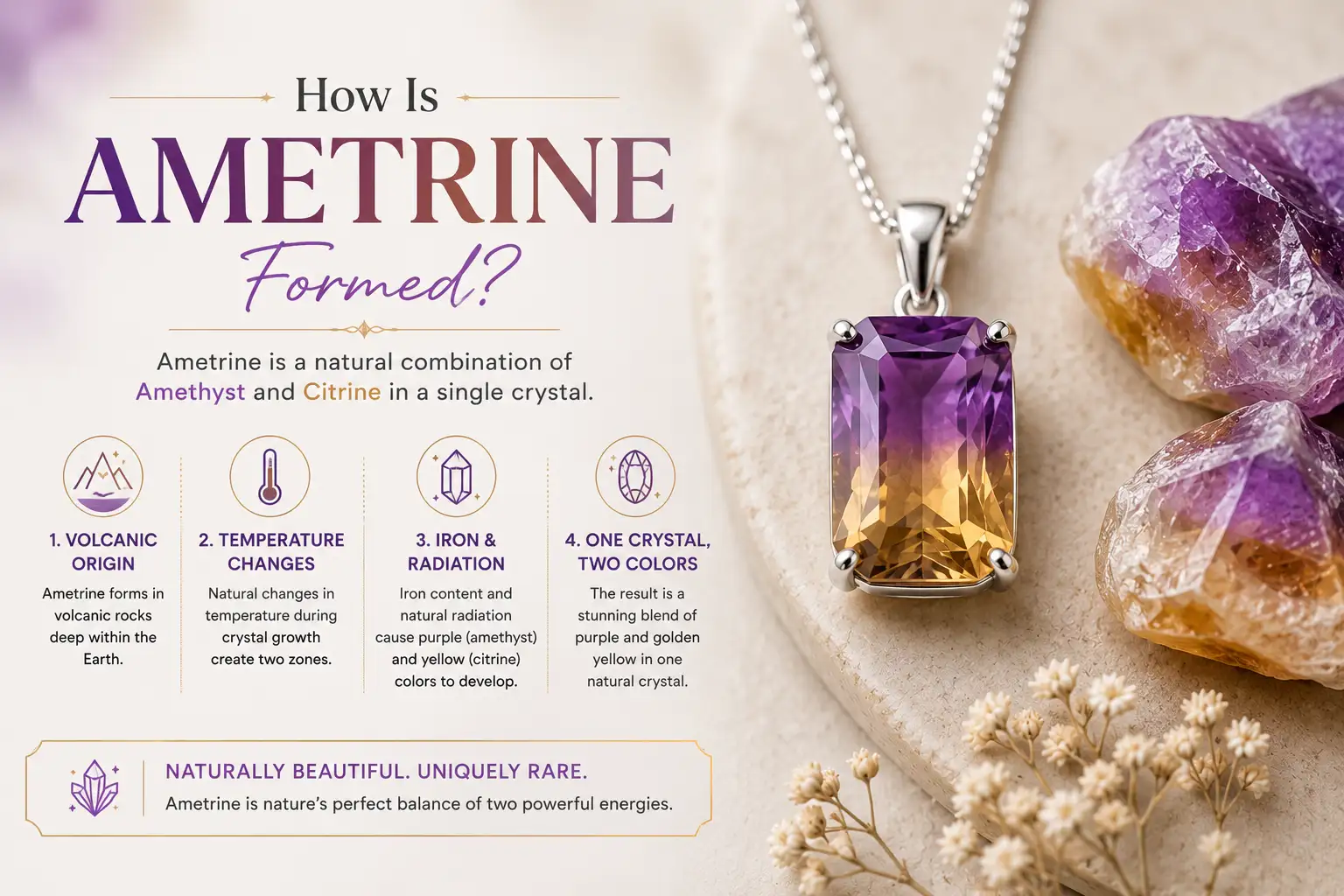
Ametrine is formed inside the earth when a quartz crystal grows with iron in it, and the heat around the crystal does not stay the same on every side. The purple half and the yellow half of the stone come from this uneven heat only, and the whole thing takes millions of years to happen.
Now, you might be wondering how one stone ends up carrying two colors when the crystal is one. The iron has a role in it, so does the heat, and the place where this stone forms matters too, most probably more than you think.
Here in this blog, we will talk about the full formation of the ametrine step by step, so you can know how this stone really gets made.
So, let's get started.
The recipe of the ametrine starts the way the recipe of every quartz starts. Hot water carrying the dissolved silica keeps moving through the cracks of the earth, and when this water finds a place to settle, the silica starts building a crystal there, layer over layer.
A pure quartz built this way comes out clear, and that clear one is the rock crystal you see in the shops. The colors come only when something extra enters the crystal while it grows, and in the case of the ametrine, that extra thing is the iron.
The iron enters the growing crystal in small amounts, and this one ingredient sits behind both of the colors of the stone. The purple of the amethyst side comes from the iron, and the yellow of the citrine side also comes from the same iron. The difference between the two sides comes later, and that difference is what the next section is about.
The iron inside a growing quartz can end up giving the purple color or the yellow color, and the heat around the crystal is what decides which of the two a portion is going to get.
When the crystal grows at a lower heat, the iron in it gives the purple color, the natural radiation under the ground helps it along, and that portion of the crystal becomes the amethyst.
The portions that grew at a higher heat go through a change on the top of this, as the heat rearranges the way the iron sits inside the quartz there, and the purple never gets to develop in those parts, so they come out carrying the citrine yellow, and this is how the same iron ends up giving a second color inside the same stone.
An ametrine forms in the rare case where a single crystal kept growing with one of its ends in a hotter zone through most of its growing years, and the stone that comes out of this carries the purple portion and the yellow portion together with a visible border running between them.
Now, you can guess how rare this setting is, since the heat inside the earth mostly stays even across something as small as a crystal, and that is the reason most of the crystals come out as a full amethyst or a full citrine rather than a mix of the two. The ametrine needs that uneven heat to stay steady for a very long time, and the next section talks about the one place on the planet that managed to give it.
The one place doing this job is the Anahi mine, which sits in the Santa Cruz region of Bolivia close to the Brazilian border. The quartz there grows inside the veins and the pockets of dolomitic limestone, and the hot water moving through that limestone has been feeding the crystals everything we talked about above, the silica, the iron, and the uneven heat.
The proof of that uneven heat is sitting in the mine's own production. The same mine also gives the plain amethyst and the plain citrine, and the studies on this mine have shown that the ametrine makes up only around a third of what comes out, with the amethyst taking a bigger share and the citrine taking a smaller one. So the crystals that sat fully in the cooler zones became the amethyst, the ones in the hotter zones went the citrine way, and the ones caught between the two zones came out as the ametrine.
Some ametrine findings have been reported from a few other countries too, but the amounts have stayed too small to feed the market, so this one Bolivian mine keeps supplying nearly all of the natural ametrine the world sells.
The earth does not build these crystals on any schedule you can relate to. The hot water keeps adding the silica onto the crystal layer over layer, a crystal grows by amounts too small for anyone to measure in a lifetime, and the geologists put the full forming of such quartz in the range of millions of years.
The uneven heat has to hold through that whole stretch on top of it. A crystal that starts with one end in a hotter zone needs that zone to stay hotter through the ages, as a shift in the underground conditions midway would change the colors of the layers that come after it, and some ametrine pieces do show those uneven bands from the shifts that happened during their growth.
So when you hold a natural ametrine, the purple and the yellow in it are a record of the millions of years that stayed steady enough to finish the stone. The lab version of the same look gets done in some weeks, and that gap in the time is the real difference between the two.
The labs grow their own ametrine, and the method is the same hydrothermal growing this whole blog has been about, done inside a sealed steel container instead of the ground. A small seed of quartz goes into the container along with a silica solution carrying the iron, the heat and the pressure stay on for some weeks, and the crystal keeps building on that seed till it reaches a size the cutters can work with.
The labs also manage the two colors on purpose, since they control the temperatures and the treatments inside the container, and a controlled setting can leave one zone of the crystal purple and the other one yellow in the same way the mine's uneven heat does it.
A lab piece still differs from the mined piece in the ways the earlier sections covered. The growing time sits in weeks against the millions of years, and the border between the two colors mostly comes out cleaner in the lab pieces, so a gem lab can separate the two whenever someone pays for the checking.
So the forming of a natural ametrine needs a growing quartz with some iron entering it, and a heat that stays uneven across the crystal and holds like that for millions of years, and the Anahi mine in Bolivia is the place where all of this kept happening together.
Most of the crystals, even at that mine, come out as a plain amethyst or a plain citrine. The ametrine remains the smaller share that grew caught between the two heat zones.
That's all there is to the making of this stone. The rest of what the market sells is the lab copy of the same process, done in weeks.