7 Days Shipping in “Ship Now” Collection
WORLDWIDE SHIPPING EXCEPT INDIA
Minimum Order Value: $1000
24 September, 2026
Amethyst is one of the most popular purple gemstones in jewelry and the crystal market. But because of this popularity, fake amethyst also started becoming common very quickly. Therefore, it is a must to distinguish between real vs fake amethyst crystals, to ensure you get the genuine one for your money.
Some fake stones look too clean, while others might look unnaturally bright. Sometimes, even pricing itself gives the first warning sign. But chances are that most buyers don't know what exactly to check before purchasing.
So, if you also want to identify genuine amethyst crystals properly, this guide will make things much easier for you.
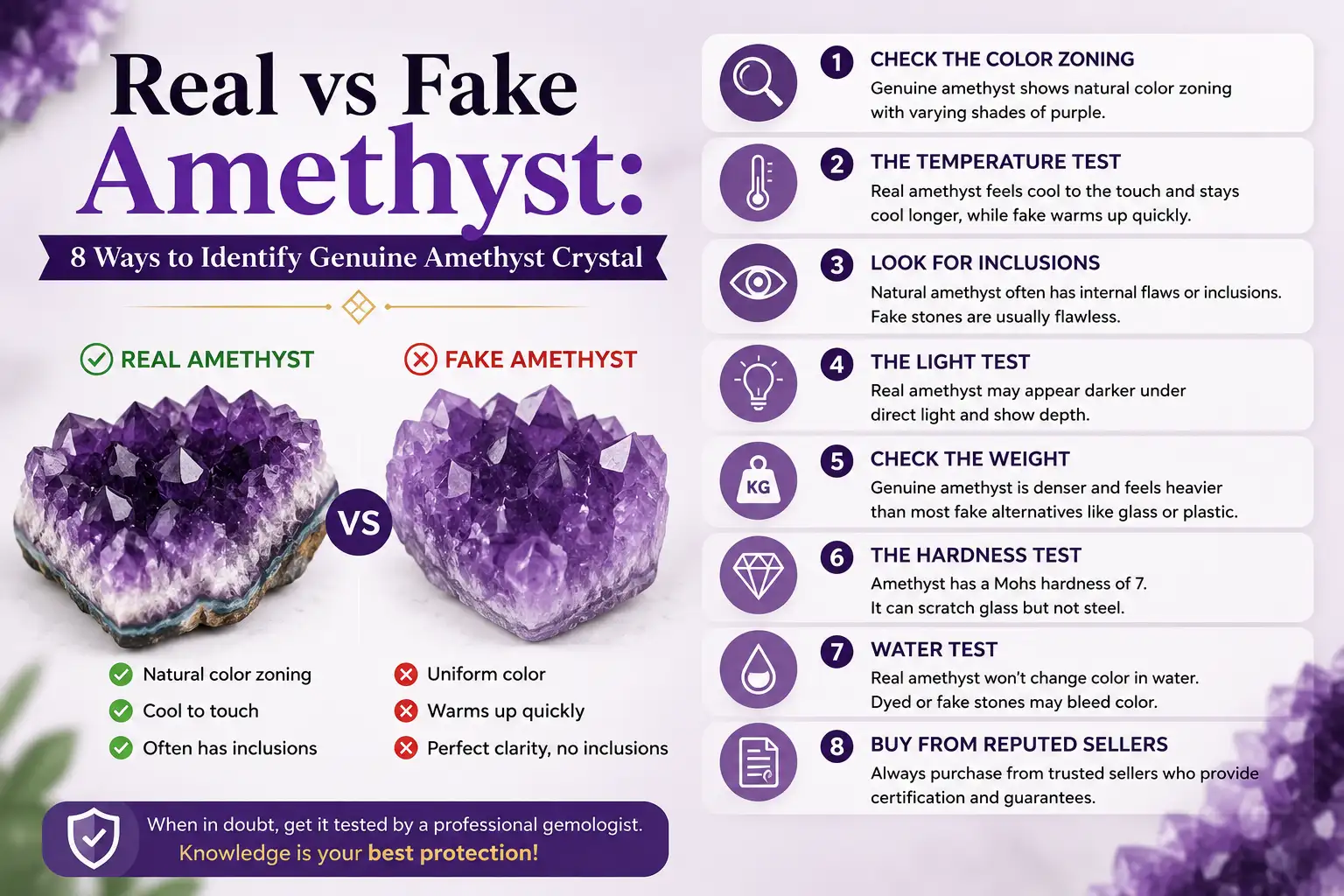
An amethyst is a natural stone, so imperfections must be there. If you are expecting to buy a perfect-looking amethyst, then you might end up getting a fake one. So, you can consider the uneven purple color inside the stone to be the most obvious identification of real amethyst.
Some parts may look darker. While at the same time, another side suddenly feels lighter once the light hits it. Additionally, the crystal may even change a little depending on where you are standing.
Cut short, the uneven look of the amethyst crystal is normal. Fake amethyst often misses this completely. The whole stone becomes one same purple shade everywhere. So, if you see an even purple color, it is best to be suspicious. Especially those crystals online that almost glow purple in photos, chances are that heavy editing or artificial coloring is involved there somewhere.
Also, natural amethyst usually has depth in color. While fake stones sometimes look like purple color is just sitting on top of the glass instead of naturally existing inside the crystal. Small difference. But once people notice it properly, it becomes difficult to ignore later.
When you see the stone, hold it in your hand, and try to focus your attention inside the stone. Indeed, the color should be the first point, but this point also has equal importance. For example, many fake amethyst stones made from glass contain very tiny bubble marks trapped inside.
Also, they have little round shapes, which look similar to air that got stuck there. Natural amethyst can also have lines and marks inside, but those usually look random and rough naturally. However, it should not have clean, round bubbles.
This is where many buyers get confused the first time. Because, from far away, fake glass crystals still look attractive enough. Additionally, the purple color is also there. Shine is there too. But once light enters properly, the inside starts revealing a different story. So, the crystals looking too clean from the inside sometimes create more doubt instead of trust.
This is another simple way many people use to identify real amethyst crystals. When you hold a genuine amethyst stone in your hand, chances are that it will feel slightly cold at first. You might experience the same even after holding it for some time; the crystal usually keeps that cool feeling longer than fake materials.
Let me make it clear that cold stone isn't the only point to look for real amethyst identification. However, the fake amethyst made from plastic or cheap resin usually becomes warm very quickly once it touches your skin. This difference becomes easier to notice when you compare two stones side by side.
The fake one often adjusts to hand temperature too fast. While natural amethyst keeps that slightly cold feeling for a longer time. So, if you are a first-time buyer, ignoring this point, focusing only on appearance, is not the best practice; touch and feel should also be there.
One thing many sellers do online is show extremely clean and flawless amethyst crystals. And honestly, this is where many buyers get trapped. Natural amethyst forms inside the earth over long periods. So, small imperfections inside the crystal are completely normal.
Sometimes you may notice tiny lines, cloudy areas, rough textures, or natural marks inside the stone. Fake amethyst often looks too smooth on the inside. Almost like it was manufactured in a factory instead of naturally formed underground.
Now, this does not mean genuine amethyst should look damaged or poor quality. But if the crystal starts looking overly perfect from every angle, chances are that it deserves extra attention before buying. Especially when the pricing also looks suspiciously cheap at the same time.
Honestly, pricing itself reveals many things sometimes. If someone is selling a large dark-purple amethyst crystal at an extremely low price, chances are that either the stone is fake or heavily treated.
Genuine amethyst still carries proper value depending on color, clarity, and size. Now, amethyst is not the most expensive gemstone in the market. But at the same time, natural high-quality crystals are not supposed to look unrealistically cheap either.
This becomes even more common online. Some sellers use edited photos, artificial lighting, and unrealistic discounts to attract buyers very quickly. The crystal looks premium in photos. But once people receive it physically, the quality starts looking completely different. So, if the pricing feels too good to be true, it is best to stay a little careful before purchasing.
Rotate the crystal under the light instead of checking it from only one angle.
If the purple color looks too even everywhere, stay little careful.
Tiny rough lines inside the stone are normal. Perfect round bubbles usually are not.
Compare the crystal with another amethyst side by side, if possible.
Overly shiny and extremely clean crystals sometimes deserve extra attention.
Touch the crystal properly instead of only looking at photos.
Fake resin or plastic stones usually become warm very fast in the hand.
Very cheap, large crystals with dark purple color should not be trusted immediately.
Try checking the crystal in normal daylight once instead of only store lighting.
If online photos look heavily edited or unnaturally glowing, chances are that the actual crystal may look different physically.
Honestly, most fake amethyst crystals start revealing small signs once people stop focusing only on color. Sometimes the problem appears in the texture. Sometimes inside the stone. And sometimes the pricing itself starts looking suspicious.
Real amethyst usually feels more natural overall. The color may look uneven. Small imperfections may exist, too. But that is exactly what natural crystals are supposed to look like in many cases.
At JewelPin, we have seen many buyers getting confused because fake crystals continue improving visually every year. Especially online. But once someone starts observing smaller details properly, the differences slowly become easier to notice. So, before buying an amethyst crystal, it is always better to inspect the stone a little carefully instead of trusting appearance alone.