7 Days Shipping in “Ship Now” Collection
WORLDWIDE SHIPPING EXCEPT INDIA
Minimum Order Value: $1000
24 October, 2026
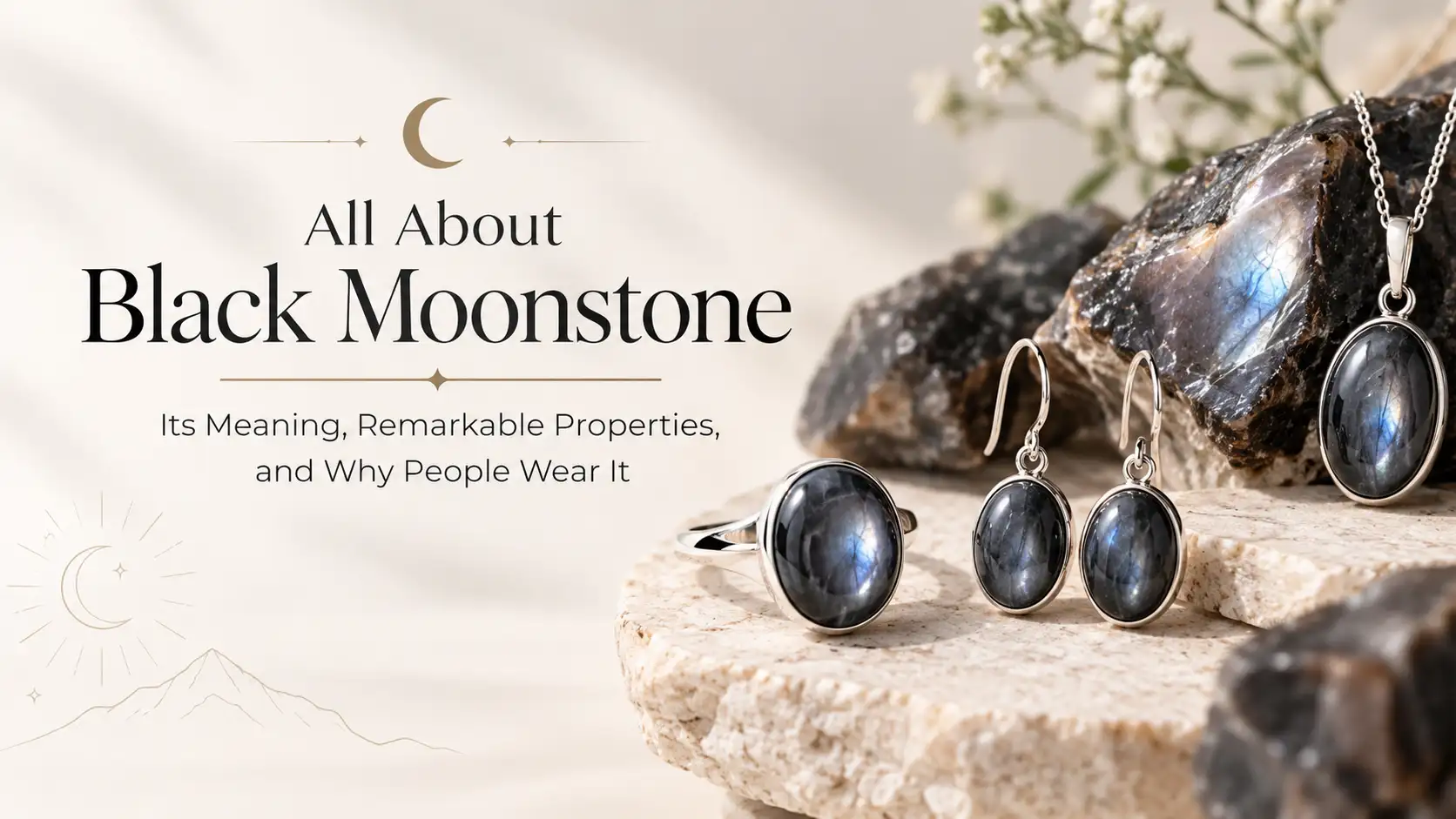
Hold a piece of black moonstone flat under a ceiling light and it can pass for a plain gray pebble. Tip it toward a lamp, and a silvery glow slides across the surface, then fades as you keep turning it. That little reveal is a big part of why people fall for this stone.
Black moonstone has gathered a lot of meaning in a short time. Crystal lovers call it the new moon stone, and jewelry buyers like it because it's dark, a little moody and easy to wear with almost anything.
If you've already read a few guides, you've probably noticed they disagree on almost everything, from its chakras to what mineral it actually is. So let's clear that up. We're a gemstone jewelry manufacturer based in Jaipur, India, and moonstone is one of the stones we set in silver and gold. This guide covers what black moonstone really is, its meaning and properties, how to spot look-alikes, what it should cost and how to care for it so it keeps that glow for years.
Black moonstone is a dark gray to black feldspar with a soft, silvery sheen (called adularescence) that glides across the stone as it moves. In crystal traditions it's the new moon stone, tied to fresh starts, grounded intuition, emotional protection and calm. It rates 6 to 6.5 on the Mohs hardness scale and can split from a hard knock, so it's happiest in pendants, earrings and bezel-set rings.
Here are the key facts in one place. Physical details come from GIA's moonstone guide; the spiritual associations are the ones most guides agree on.
Black moonstone is a dark variety of feldspar that shows the same floating sheen as classic moonstone. The name, though, covers more than one exact mineral, which is why guides disagree.
Start with regular moonstone. According to the Gemological Institute of America (GIA), it's a variety of the feldspar mineral orthoclase. As it forms, orthoclase and albite separate into thin alternating layers, and light that falls between them gets scattered.
That scattered light is the glow you see, and gemologists call it adularescence. The layers are tiny, about the size of a wavelength of light, which is why the effect looks soft and milky instead of sparkly.
Black moonstone works the same way on a dark background. Fine dark inclusions tint the body gray to black, and that backdrop makes the silvery sheen look stronger. Think of a flashlight beam at night compared with one at noon.
"Black moonstone" is a trade name, not a separate mineral species. The dark feldspar sold under that name doesn't all test the same way. Some pieces sit close to classic orthoclase moonstone, some lean toward plagioclase (the family that includes labradorite), and some look like a mix of both.
That's why one website lists orthoclase while another prints a plagioclase formula. None of this makes black moonstone fake. It just means the name describes a look more than a single, tidy mineral.
It's also a newcomer. Moonstone has been worn for centuries, but the dark material only became common in shops in recent decades, largely through exports from Madagascar. Its spiritual meanings took shape over the same stretch of time, which explains a lot of the disagreement online.
Most black moonstone sold today comes from Madagascar, and India is the other origin you'll see listed most often. Moonstone in general turns up in many places. GIA names India and Sri Lanka as the most important sources, plus Brazil, Madagascar, Myanmar, Tanzania and even New Mexico, North Carolina and Virginia.
No, and that's good news for your budget. Feldspar minerals make up more than half of the Earth's crust, and black moonstone is easy to find as tumbled stones, beads and simple jewelry.
What's genuinely scarce is a clean piece with a strong, even sheen, big enough for a statement ring. GIA notes that moonstone is rare in top qualities, and the same goes for the dark variety. If a seller calls an ordinary piece "extremely rare" to justify a big price, be skeptical.
These four get mixed up constantly. Here's how they differ:
A simple way to remember it: moonstone glows, labradorite flashes. For the lighter varieties, see our guide to rainbow moonstone vs. blue moonstone. For its flashier cousin, there's our labradorite necklace guide.
Black moonstone is the stone of the new moon: beginnings that have started but haven't shown results yet. The easiest way to see it is to set it beside white moonstone.
White moonstone has long stood for the full moon, bright and fully lit. Black moonstone is the new moon, the dark night at the start of the cycle when nothing shows yet but the next month has already begun.
That's the heart of its meaning. It's a stone for the new job that hasn't paid off, the move that still feels strange, the habit you're three days into. People who work with it say it helps them trust a process before there's proof.
Here's what black moonstone is most often associated with:
Fresh starts. It's a favorite for new moon intention setting and for any chapter that's just getting going.
Intuition with its feet on the ground. White moonstone can feel dreamy to some people. Black moonstone is described as pairing gut feeling with common sense.
Emotional protection. Many carry it in draining situations, so they can stay kind without soaking up everyone else's stress.
A pause before reacting. It's linked with stepping back, seeing a situation clearly and responding instead of snapping.
Shadow work. Its darkness ties it to looking honestly at the parts of yourself you'd rather ignore. Uncomfortable, and often useful.
Moonstone lore goes back a long way. GIA notes that Hindu mythology describes moonstone as solidified moonbeams, and that the gem was tied to Roman and Greek lunar deities. Legends also said it brought luck, and that holding one in your mouth under a full moon let you see the future.
Jewelry history adds to the story. Art Nouveau designers René Lalique and Louis Comfort Tiffany set moonstone in their pieces, and it came back in the 1960s flower child era and again with New Age designers in the 1990s.
Black moonstone's own meanings are much newer. They grew out of modern crystal books and shops as the dark material became widely available, borrowing heavily from that older lunar symbolism.
A bit of trivia for American readers: moonstone is Florida's official state gem. Lawmakers chose it in 1970 to honor the Apollo moon landings, which launched from Kennedy Space Center. Funny enough, moonstone isn't found naturally in Florida, or on the moon.
Spiritually, black moonstone is used as a new moon stone for setting intentions, trusting intuition and staying grounded while something new takes shape. People hold it in meditation, keep it close during shadow work, or wear it as a reminder to slow down and listen to themselves. Most practitioners also treat it as a protective stone that keeps other people's moods from becoming their own.
Many people reach for black moonstone during a rough patch: a breakup, a hard season with family, or supporting someone they love through something difficult. The idea is that you can keep your heart open without taking on all of their pain. Others keep it close if they tend to overreact. Touching the stone becomes a small cue to breathe first and answer second.
You'll find websites claiming black moonstone cures insomnia, balances hormones or treats depression.
What a stone can do is act as a physical reminder: something you touch when you want to pause, set an intention or calm down. For many people that's plenty. If you're dealing with sleep trouble, anxiety or a health issue, let a crystal sit alongside proper care, never in place of it.
Most sources link black moonstone to the Root and Crown chakras, to Cancer, Scorpio and Libra, and to the Moon. Beyond that, they disagree a lot.
If you've compared a few guides, you've seen it. One says Crown and Third Eye, another says Root, Sacral and Third Eye, and the numerology numbers run from 4 to 7. Here's how the associations shake out across the most popular black moonstone guides online:
Why so much disagreement? These correspondences are modern and still settling, and every writer leans on a slightly different system. There's no official rulebook for chakras or crystal numerology.
Our take: the Root and Crown pairing fits black moonstone's reputation best, since it's described as linking practical grounding with spiritual insight. If your own practice places it on the Third Eye, that's fine too. If you like working with chakras through jewelry, our chakra collection is a good place to browse.
In Western crystal practice, no sign is told to avoid moonstone. Cancer, ruled by the Moon, is its most natural match, and Scorpio and Libra are commonly listed as well.
The "should not wear" idea comes from Vedic (Indian) astrology. There, pearl is the Moon's main gemstone and moonstone serves as its substitute. Whether either suits you depends on your full birth chart, especially your ascendant (rising sign), not your Sun sign.
A common rule of thumb is caution when the Moon rules one of the chart's difficult houses: the 6th, 8th or 12th. That happens for Aquarius, Sagittarius and Leo ascendants, so people with those rising signs are usually told to get a chart reading first. If you simply love the stone and wear it as jewelry, none of this needs to stop you.
You don't need an altar or a ritual kit to work with black moonstone. These are the simple habits people actually stick with.
On the night of the new moon, write down one thing that's just beginning for you. Keep it specific: "finish my portfolio" beats "be more creative."
Hold the stone for a minute while you read it, then keep both where you'll see them. About two weeks later, at the full moon, check in on how it's going.
A pendant keeps the stone near your heart, and earrings are the lowest-risk way to wear it every day. For rings, crystal tradition usually favors the non-dominant hand (the left, for most people), seen as the "receiving" side.
In crystal circles, moonstone is often linked with dreams and rest. Many people keep black moonstone on the nightstand, sometimes next to a dream journal, especially through a tired or quiet stretch of life.
Hold it in your palm and tilt it slowly under a lamp. Watching the sheen appear and fade is a surprisingly good way to settle a busy mind.
Try this one while holding the stone: "I don't have to see the whole path to take the next step." Say it out loud, or write it on the note you keep with it.
White or rainbow moonstone. The full moon to its new moon, so wearing both represents the whole cycle.
Labradorite. A feldspar cousin with bolder flashes; the two look great stacked.
Black tourmaline. For anyone who wants extra grounding and protection.
Sunstone. Another feldspar, often paired with black moonstone as a sun-and-moon balance.
Smoky quartz. Calm, grounding and tougher (7 on the Mohs scale), so it's easy to wear every day.
Selenite. A popular plate for resting stones between uses. Keep it dry, because water damages selenite.
The best black moonstone jewelry protects the stone: pendants, earrings and bezel-set rings in a metal that suits your style. Most guides skip this part, and it's where most buying mistakes happen.
Black moonstone is lovely to wear, but it isn't as tough as quartz or sapphire. GIA rates moonstone 6 to 6.5 on the Mohs scale with poor toughness, so a sharp knock can crack or split it. The right style and setting make a real difference.
Pendants and necklaces are the safest choice. They rarely get knocked, and they sit where people can see the sheen move. Browse silver pendants for design ideas.
Earrings are nearly as safe. Studs and small drops work well for everyday wear.
Rings take the most abuse. A black moonstone ring can last for years, but take it off for the gym, gardening, cleaning and moving furniture.
Bracelets bump into desks and doorframes all day. Beaded styles are inexpensive and easy to replace; a bezel-set cuff protects the stone better.
A bezel setting, where a thin wall of metal wraps around the whole stone, guards its edges far better than a few prongs. For rings, it's the setting we'd pick almost every time.
Shape matters too. In jewelry, black moonstone is usually cut as a cabochon (a smooth dome), and a medium to high dome shows off the sheen best. Flat, thin stones tend to look dull.
Sterling silver is the classic match. Its cool shine echoes the silvery glow, it keeps the price friendly, and in Vedic tradition silver is the Moon's own metal. Oxidized (blackened) silver pushes the look moodier and more vintage.
Gold changes the mood. Yellow gold gives a warm contrast that makes even a small stone look rich, while rose gold softens it for romantic or bridal pieces. Our gold jewelry shows the setting styles that work.
Compare pieces in this order:
The sheen. It should be easy to spot, move smoothly as you tilt the stone, and sit near the center of the dome. This matters more than anything else.
Body color. A deep, even tone usually looks best. Brown or taupe streaks are natural, and some people love them.
Clarity. Small inclusions are normal, including the tiny tension cracks GIA calls "centipedes." Avoid cracks that reach the surface, especially in rings.
Cut and polish. Look for a symmetrical dome and a glassy finish with no flat spots or dull patches.
Black moonstone is one of the more affordable gemstones. These are ballpark US retail prices as of October 2026; size, sheen and workmanship move them up or down.
It can be, with clear expectations. The symbolism suits a marriage (a beginning that's still unfolding), and the look appeals to couples who want something less traditional.
Daily wear is the challenge. Choose a bezel setting, consider a wedding band that sits slightly higher to guard it, and expect a repolish down the line.
If you love the June birthstone idea but need everyday toughness, look at alexandrite, another June birthstone. GIA rates it 8.5 on the Mohs scale with excellent toughness. Our labradorite engagement ring guide covers similar trade-offs.
June birthdays. Moonstone is one of June's three birthstones, with pearl and alexandrite. Our birthstone chart covers the rest of the year.
Cancer and Scorpio birthdays.
Anyone starting over: a new job, a new home, a new baby or a fresh start after a breakup.
Men who want something subtle. A dark stone in a silver ring or cufflinks reads understated, not flashy.
Real black moonstone shows a soft glow that floats under the surface and moves as you tilt it. Because the name is a loose trade term, the market is full of look-alikes, some sold under the same label. You don't need lab tools to protect yourself.
Do the tilt test. Hold the stone under one light source, like a desk lamp or your phone's flashlight, and rotate it slowly. Genuine black moonstone shows a glow that seems to float just beneath the surface and drifts as you turn it. A sheen that sits right on top like a coating, or no sheen at all, is a red flag.
Look for natural variation. Real stones have small differences in tone, faint layering and the odd inclusion. A strand of perfectly identical, flawless black beads is suspicious.
Check the price. As noted above, rock-bottom strands are rarely what they claim to be.
Ask three questions. What mineral is it? Where is it from? Has it been treated or coated? Under the FTC's Jewelry Guides, sellers should disclose treatments that aren't permanent, need special care or significantly affect value. Online sellers are expected to say so in the product description.
Skip the scratch test. Some sites suggest scratching glass with the stone. Its cleavage means you can chip or split a finished piece that way, so leave hardness testing to a gemologist.
Clean black moonstone with warm, soapy water and a soft brush, and keep it away from heat and hard knocks. That covers most of it. GIA notes that moonstone may crack in high heat and advises against ultrasonic and steam cleaners.
Mix a few drops of mild dish soap into a bowl of warm (not hot) water.
Dip the piece briefly and brush gently with a soft toothbrush, including the back of the setting where lotion and dust collect.
Rinse under lukewarm running water. Plug the sink first.
Pat dry right away with a soft, lint-free cloth instead of letting it air-dry.
Ultrasonic and steam cleaners. Vibration and heat can crack the stone.
High heat. Keep it away from stovetops, saunas and hot car dashboards. Tell your jeweler it's moonstone before any repair that uses a torch.
Harsh chemicals. Bleach, chlorinated pools and hot tubs, and strong household cleaners can dull the polish and damage metal settings.
Long soaks, especially in salt water. Quick rinses are fine. Overnight salt baths, a common crystal-cleansing tip, aren't.
Baking in the sun. Brief sunlight won't hurt it, but don't leave it on a sunny windowsill for days.
Store each piece in its own soft pouch or lined compartment. Quartz, sapphire and diamond are all harder and can scratch it, and loose chains can tangle around it. Follow the old jeweler's rule: last thing on, first thing off. Put black moonstone on after lotion, hairspray and perfume, and take it off before workouts, swimming and cleaning. If the surface does get scuffed, a jeweler can usually repolish a cabochon.
Black moonstone suits gentle methods: an evening under the new or full moon, a pass through incense or herb smoke, the sound of a singing bowl, or a night on a selenite plate. Skip salt and long water baths. For a step-by-step moonlight method, see our guide to charging crystal jewelry under the full moon.
If you run a boutique or an online shop, black moonstone is an easy stone to love and an easy one to describe badly. A few suggestions from the manufacturing side:
Label it honestly. Call black moonstone a feldspar, and don't sell larvikite or labradorite under the black moonstone name.
Disclose treatments and coatings in the product description, as the FTC's Jewelry Guides recommend.
Frame meanings as beliefs. "Traditionally associated with new beginnings" works; health promises don't.
Favor protective designs. Bezel-set pendants, studs and rings hold up best, and celestial motifs play up the moon story.
JewelPin manufactures gemstone jewelry in sterling silver and gold for retailers in the US and worldwide. Browse our moonstone jewelry and celestial collection, or send a custom order request if you'd like black moonstone set into a specific design. First-time buyers can also request a sample order.
Most people use it for new beginnings, intention setting, grounded intuition and emotional protection. As jewelry, it's simply a beautiful, wearable dark stone with a silver glow that moves.
It's a real, natural feldspar, and much of it shows the same adularescence as classic moonstone. "Black moonstone" is a trade name, though, and some material sold under it is closer to labradorite in mineral terms.
No. It's widely available and affordable. Top-quality pieces with a strong, even sheen are much harder to find.
June. Moonstone shares the month with pearl and alexandrite, so black moonstone makes an unexpected June birthstone gift.
Yes, briefly. A rinse or a gentle wash in warm, soapy water is fine. Avoid long soaks, salt water, hot tubs and chlorinated pools.
Yes, especially as a pendant or earrings. For rings, choose a bezel setting and take it off for workouts, chores and anything rough.
Absolutely. Its dark color and quiet sheen suit men's rings, pendants and cufflinks, and it never reads as flashy.
Crystal practitioners usually suggest the non-dominant hand, the left for most people, to "receive" its energy. In Vedic tradition, the Moon's gems are set in silver and often worn on the little finger. Otherwise, wear it wherever it fits and feels right.
Black moonstone shows a soft, silvery glow that floats across the stone. Labradorite shows brighter patches of blue, green and gold that switch on at certain angles. Both are feldspars.
No. It's a feldspar and is safe to handle and wear as jewelry.
If you like jewelry that rewards a second look, black moonstone is hard to beat. It's affordable, it suits almost any outfit, and its meaning (trusting a beginning before you can see where it leads) is one most of us need now and then. Buy it from a seller who tells you what it is and where it's from, pick a setting that protects it, and keep it away from heat and hard knocks. Do that, and it'll keep its quiet glow for years.