7 Days Shipping in “Ship Now” Collection
WORLDWIDE SHIPPING EXCEPT INDIA
Minimum Order Value: $1000
05 October, 2026
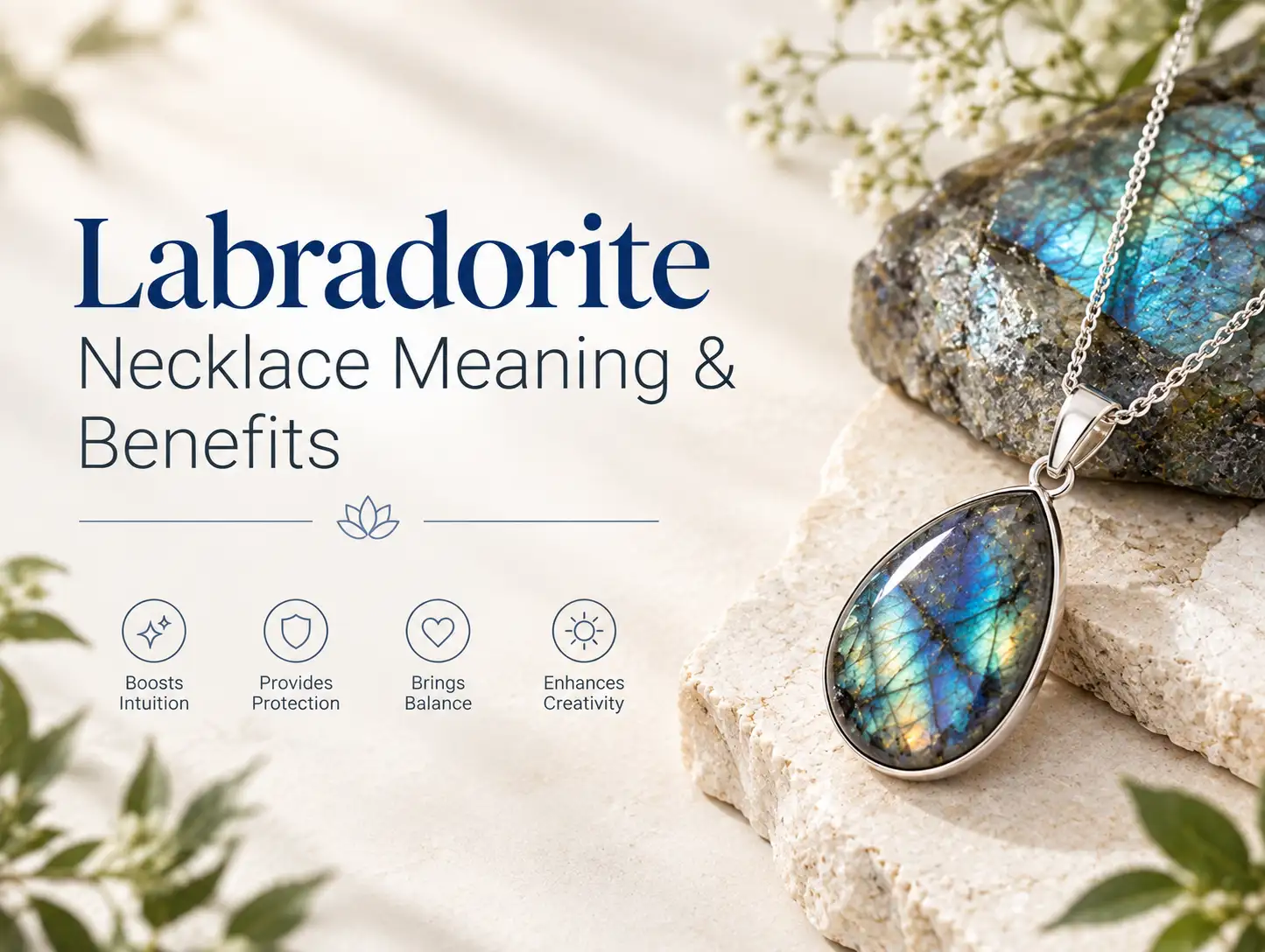
A labradorite necklace symbolizes transformationprotectionand intuition. The stone looks plain gray until light hits it and releases a flash of blue green or gold which is why it became a symbol for hidden potential and change. Worn as a necklace it sits between the throat and heart the two areas crystal traditions link to honest expression and emotional steadiness. Most people wear one during a transition: a new job, a move , a breakup, a rebuild.
Labradorite is a plagioclase feldspar in the same mineral family as moonstone sunstone and amazonite. Feldspar is one of the most common mineral groups on Earth but labradorite earns its own name for one reason: labradorescence, the flash of color that appears and vanishes as you move the stone.
It was first described around 1770 on the Labrador coast of Canada by Moravian missionaries living among the Inuit. Today most labradorite in American jewelry comes from Madagascar with Finland Russia Ukraine Canada and Mexico supplying the rest. Its physical stats matter more than most articles admit:
Inside the stone are microscopic layers of slightly different feldspar composition stacked from the way the mineral cooled and separated. Light enters bounces off those internal boundaries and the reflected waves interfere with each other canceling some colors and amplifying others.
The spacing of those layers decides which color you see. Wider spacing tends toward gold and orange, tighter spacing toward blue and violet. The angle decides whether you see it at all.
This is the meaning that shows up everywhere and the metaphor is almost too neat. A stone that looks like an ordinary gray pebbleuntil the light movesand then it isn't ordinary at all.
People reach for labradorite at hinge points. Leaving a marriage. Starting a company. Getting sober. Moving across the country with a car full of boxes. The stone doesn't cause the change it marks. A necklace you put on the first morning of something new becomes a small wearable commitment.
In crystal practice labradorite is described as sealing the aura creating a boundary so you stop picking up everyone else's mood. Whether or not you take the energetic model literally this is why nurses, teachers , therapists , bartenders and customer-service workers gravitate to it.
The third association is intuition trusting the read you already have on a situation instead of arguing yourself out of it. The symbolic logic is the same as before: you have to turn the stone to see what's inside it. You have to turn a situation over too.
Across Inuit and Innu tradition labradorite was linked to the aurora and to the boundary between worlds. That "in-between" quality is why it turns up in protection amulets, divination sets and travel talismans. It's a stone for the part of life where you've left one thing and haven't arrived at the next.
A pendant lands between the throat and the heart. the two centers that crystal traditions tie to truthful expression and emotional balance. Labradorite is associated with the throat and third eye chakras so a necklace places it closer to its traditional seat than any other piece.
A ring is in your peripheral vision constantly and stops registering within a week. A pendant you catch in the mirror in a window in a Zoom tile. It stays a reminder longer.
This is the underrated one. With perfect cleavage at 6–6.5 hardness labradorite chips when it takes an impact. A pendant hangs free. Statistically it will outlive the same stone set in a ring by years.
A pendant warms to body temperature and stays there. Crystal practice reads that as the stone attuning to you. At minimum it's the reason a necklace stops feeling like an object and starts feeling like yours.
The most common one by far. Not calm exactly, more like a handhold. Something to touch when the ground moves.
Labradorite is often called on for the 2 a.m. spiral. The traditional claim is that it settles circling thoughts without dulling them.
Especially reported by empaths HSPs and people in caregiving work. The necklace becomes a physical stand-in for "this is where I end."
Writers, designers and artists have used labradorite as a desk and studio stone for decades. The association is with imagination that still lands in reality.
Less second-guessing. More willingness to say the thing.
Marking a change with an object makes it feel decided rather than drifted into.
Don't discount this. A stone that catches sunlight at a red light and flashes electric blue is a small good moment repeated.
Four things separate a $20 pendant from a $200 one:
Does the flash cover most of the stone or is it one small patch? Broad coverage is worth paying for.
Tilt it. A good stone flashes across a wide arc of movement. A weak one lights up only at one exact angle which means it will look gray most of the time you're wearing it.
Darker gray-to-black bases make the flash pop harder. This is a preference not a quality grade but it's the reason "black labradorite" pendants photograph so well.
Look for scratches, dull patches, uneven doming and chips along the edge where it meets the setting.
brief contact is fine. Prolonged soaking is not fine. Water works into the internal cleavage planes and fractures over time and it will strip your chain's finish. Rinse doesn't soak.
take it off. Soap film dulls the polish and shampoo residue in a bezel setting and is genuinely hard to get out.
short exposure is harmless and shows the flash beautifully. Months on a sunny windowsill can fade darker specimens. Store it in a drawer and charge it under moonlight instead.
ultrasonic cleanerssteam cleanersjewelry dips bleachor acetone. Ultrasonics can drive existing internal fractures straight through the stone.
put your necklace on last after all of it has dried.
separate soft pouch or a lined compartment. Never loose in a jewelry box with quartz topaz sapphire or diamond every one of those will scratch it.
soft cloth lukewarm water and a drop of mild dish soap dry immediately.
No flash no labradorite: Turn it under a light. If nothing shifts at any anglewalk away.
The flash must move: Real labradorescence appears and disappears as you tilt. Painted or foil-backed fakes glow from every angle identically.
Check the veins: Real labradorite shows natural black veining and inclusions. Splotchycolor-filled cracks usually mean dye.
Look for bubbles: Under magnification tiny round bubbles mean glass or resin. Real stone doesn't have them.
Scratch logic: Labradorite at 6–6.5 shouldn't be scratched by a copper penny but will be scratched by quartz or a steel file.
Red "labradorite" : sold cheaply is often andesine copper-diffusion treated stone. Not the same thing.
"Rainbow moonstone" : is technically a white labradorite sold under the moonstone name by trade convention.
Wipe it with a soft damp cloth or hold it briefly under cool running water and dry it immediately. You're clearing what it picked up before it reached you.
Hold it and name specifically what you're wearing it for. Not "good energy." Something like: I'm wearing this while I figure out whether to leave this job. Specificity is what makes the object work as a reminder.
Touch it deliberately at two moments each day. before something you're dreading and after something that went well.
Chains break during sleep and clasps catch on hair and bedding. Crystal practitioners are genuinely split on labradorite at night: some say it deepens dream recall, others say it's too stimulating for sleep. Try it once and judge for yourself but use a cord you don't mind replacing.
Set it on a windowsill overnight. Full moon for completion, new moon for beginnings. Even reading purely as a habitat monthly ritual that makes you check in on your intention is not a waste of time.
It symbolizes transformation protection and intuition. Worn at the throat and heart it's most often chosen during a period of change as a wearable reminder of a decision or intention.
emotional steadiness in upheaval clearer thinking stronger boundaries against other people's moods creative inspiration and confidence.
Yes. At 6–6.5 hardness it handles daily wear well as a pendant far better than as a ring. Remove it for showers swimming the gym and sleep.
Brief contact is fine. Don't soak it; water penetrates the internal cleavage planes over time. Dry it right away.
Better not to. Soap and shampoo leave film that dulls the polish and collects in the setting and hot water is hard on the chain.
Practically no chains break and clasps snag. Some say it boosts dream recall others find it too stimulating for sleep.
Primarily the third eye with strong throat associations and a secondary crown link. Chain length changes what it sits closest to.
No. It isn't a traditional or modern birthstone. Modern crystal authors most often link it to Scorpio and Pisces with Leo Libra and Sagittarius also claimed.
$30–$70 gets you a good sterling silver pendant with solid flash. Above $150 you're paying for exceptional color playlarger stonesor precious metal. Under $20expect a small stone and a plated chain.
It must flash and the flash must shift and disappear as you tilt it. No movement means it isn't labradorite. Check for round bubbles under magnification (glass) and color-filled cracks (dye).
Both are feldspars. Labradorite shows labradorescence sharp directional flashes of blue green and gold over a gray base. Moonstone shows adularescence a soft glow floating under a milky surface. Confusingly"rainbow moonstone" is technically white labradorite.
Spectrolite is labradorite with exceptional full-spectrum color play originally from Finland. It's the same mineralgraded higher.
Wipe with a soft damp cloth or rinse briefly in cool water and dry immediately. For energetic cleansing moonlight selenite sound or smoke all work and none risk the stone. Avoid prolonged water and never use ultrasonic cleaners.
Moonlight overnight is the traditional method and it's also the safest unlike sunlight which can fade darker specimens over long exposure.
Amethyst and clear quartz for third-eye workmoonstone for intuition and cyclesblack tourmaline or obsidian for heavier protection and sunstone for balancing labradorite's cool tone with warmth. Visually its gray base works with silver gold and rose gold alike.
LAB-ruh-duh-rite. Same first two syllables as the dog.
Turn the stone. That's the whole test and it's the whole meaning too. Labradorite gives you nothing from the front. You have to move it, catch it at the right anglelet the light in sideways. and then it hands you something that looked like it was never there. Choose a bezel setting if you plan to wear it daily. Take it off before the shower.