7 Days Shipping in “Ship Now” Collection
WORLDWIDE SHIPPING EXCEPT INDIA
Minimum Order Value: $1000
11 May, 2026
The Difference Between Black Obsidian And Black Tourmaline
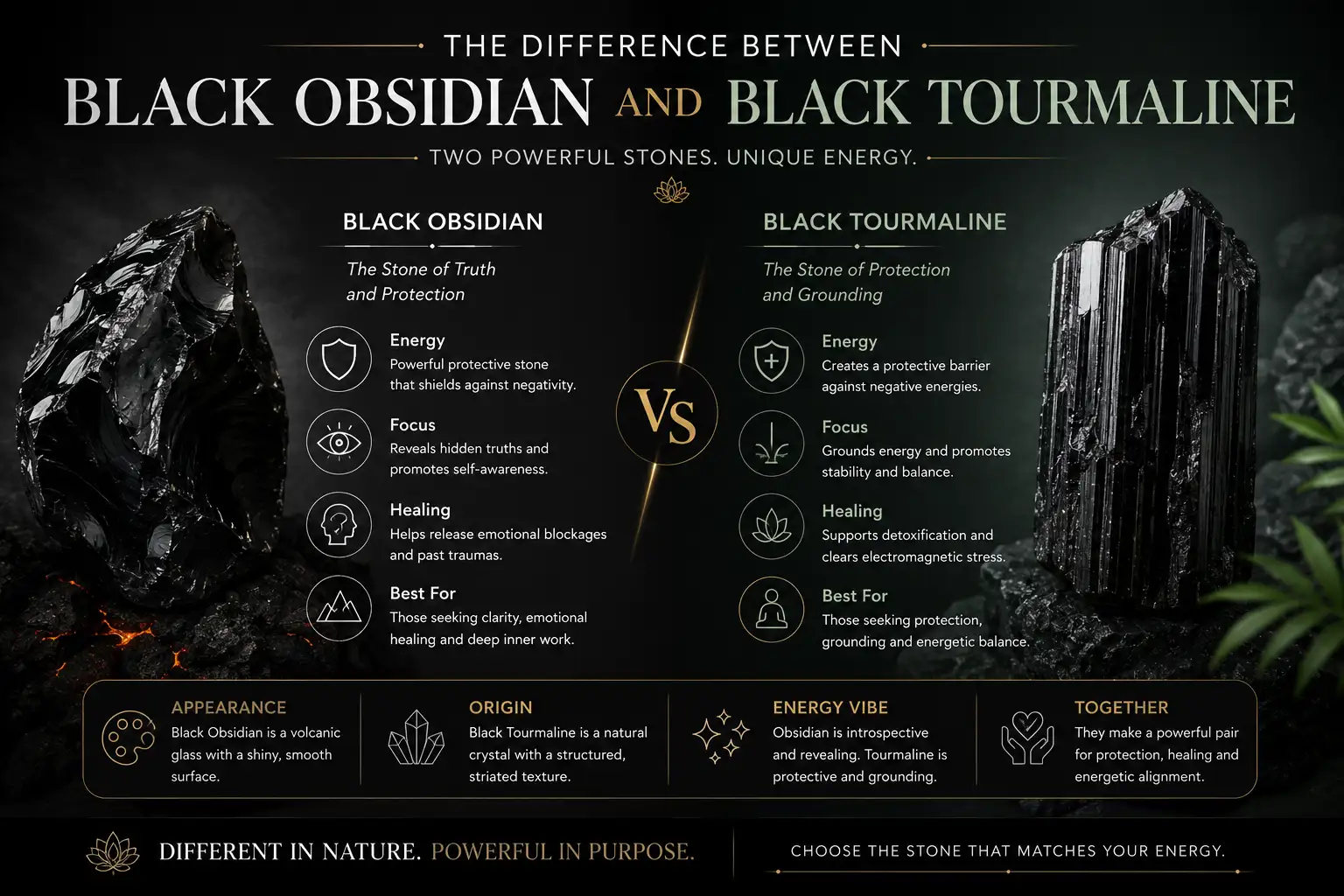
Black obsidian and black tourmaline are two stones that may look similar, but they are two different stones.
At first glance, you might see that both look deep black and opaque, resulting in assumptions that they are the same. Thus, to identify the difference between black obsidian and black tourmaline, you have to understand how each stone forms and what physical traits they have.
For example, black obsidian is volcanic glass, while black tourmaline is a crystalline mineral. This difference directly impacts their structure, durability, appearance, and how they are used in jewelry.
This blog will help you know about the discrepancy between black obsidian and black tourmaline, along with how they form, look, durability, and how to easily tell them apart when used in jewelry.
Black obsidian is a naturally occurring volcanic glass created when molten lava cools so quickly that crystals cannot form. Since the cooling process is very fast, the atoms inside the material harden and create a glass-like substance.
You can consider the rapid cooling process as the defining factor of this gemstone. This is because natural gemstones often grow slowly, while obsidian forms within moments of volcanic activity.
As said earlier, it is volcanic glass; therefore, its properties resemble glass more than stone. Additionally, its hardness is scaled between 5 and 5.5 on the Mohs scale, making it more fragile than many crystalline gemstones. The material also shows conchoidal fracture, meaning it breaks into curved, shell-like surfaces.
Black obsidian usually appears jet black and opaque, similar to polished glass.
Black tourmaline, also called schorl, belongs to the tourmaline mineral group.
As said earlier, it is a crystalline mineral that forms through gradual mineral crystallization inside the Earth. Due to this process, it has an internal crystal structure, which makes it harder and more durable compared to volcanic glass.
Black tourmaline has a hardness of around 7 to 7.5 on the Mohs scale; therefore, it can be used in manufacturing everyday usable jewelry. Additionally, it has a high density and internal bonding, enhancing its durability.
Black tourmaline is widely utilized in bead bracelets and necklaces. Its hardness allows it to handle regular wear.
Black obsidian and black tourmaline may show up as equivalent at first glance. Both stones exhibit deep black and are generally used in jewelry. However, their origin, structure, and physical properties are very different.
The table below outlines the key differences between the black obsidian and black tourmaline:
When you look at both gemstones, they might appear deep black to you. However, if you are keen to understand the details, then you will see the differences as follows:
Black obsidian’s surface appears to be sleek and often looks like polished glass. Additionally, when it breaks the surface curves in semicircular ruptures, creating a velvety surface.
On the other hand, black tourmaline has a textured surface due to its natural crystals that often have vertical grooves called striations. These grooves run along the length of the crystal, making it look completely smooth.
Black obsidian has a strong glassy luster through which light reflects clearly from its surface. Additionally, it also creates a shiny and reflective appearance.
If you ask simply, the best identification of black obsidian is that it almost looks like black glass.
On the other hand, black tourmaline has a vitreous to slightly resinous luster; this shine is softer than obsidian. Put simply, its surface appears to be darker and less reflective.
Black obsidian has no crystal patterns because its internal structure is amorphous. Because of this, obsidian often looks like a round fragment or simply a smooth, polished shape.
On the other hand, black tourmaline forms elongated prismatic crystals, which often grow as long vertical columns.
The most common difference is that black obsidian is softer than black tourmaline.
Black obsidian is measured between 5 to 5.5 on the Mohs hardness scale. Therefore, it can be easily chipped or fractured due to a strong impact.
Black tourmaline is harder and durable, measured between 7 to 7.5 on the Mohs scale. Therefore, it is more resistant to scratches, so it can be worn daily.
Black obsidian has a lighter density, which is around 2.3 to 2.6 g/cm³. Therefore, it often feels lighter in the hand. Additionally, the surface feels smooth and feels like touching glass.
Black tourmaline is denser and heavier when compared to obsidian, weighing around 3.0 to 3.3 g/cm³. Therefore, it feels heavier and solid.
Black obsidian is usually opaque, but delicate edges can sometimes show small transparency when kept against light. Furthermore, the light often echoes because of its glassy luster, making a bright and reflective sparkle when lustrous.
Black tourmaline, on the other hand, is fully opaque, making it difficult or unfeasible for light to pass through. Additionally, it has a crystal structure, making the light reflection darker or less reflective.
The easiest and effective way to identify the black obsidian and black tourmaline gemstones is by looking at their surface.
If you see a glass-like gemstone, then it might be black obsidian. Its surface, as said earlier, appears to be polished and reflective.
If you see vertical grooves or natural ridges, it is most likely black tourmaline.
Another identification is their shine. Black obsidian has a glossy shine, and black tourmaline has a darker and less reflective shine.
In simple terms:
Smooth and glassy =Black Obsidian
Grooved and crystalline = Black Tourmaline
If you are planning to buy a black obsidian or black tourmaline gemstone, at JewelPin, we have a collection of jewelry manufacturing using them. Let us know your needs, and we will help you with the right jewelry item for your needs.