7 Days Shipping in “Ship Now” Collection
WORLDWIDE SHIPPING EXCEPT INDIA
Minimum Order Value: $1000
31 October, 2026
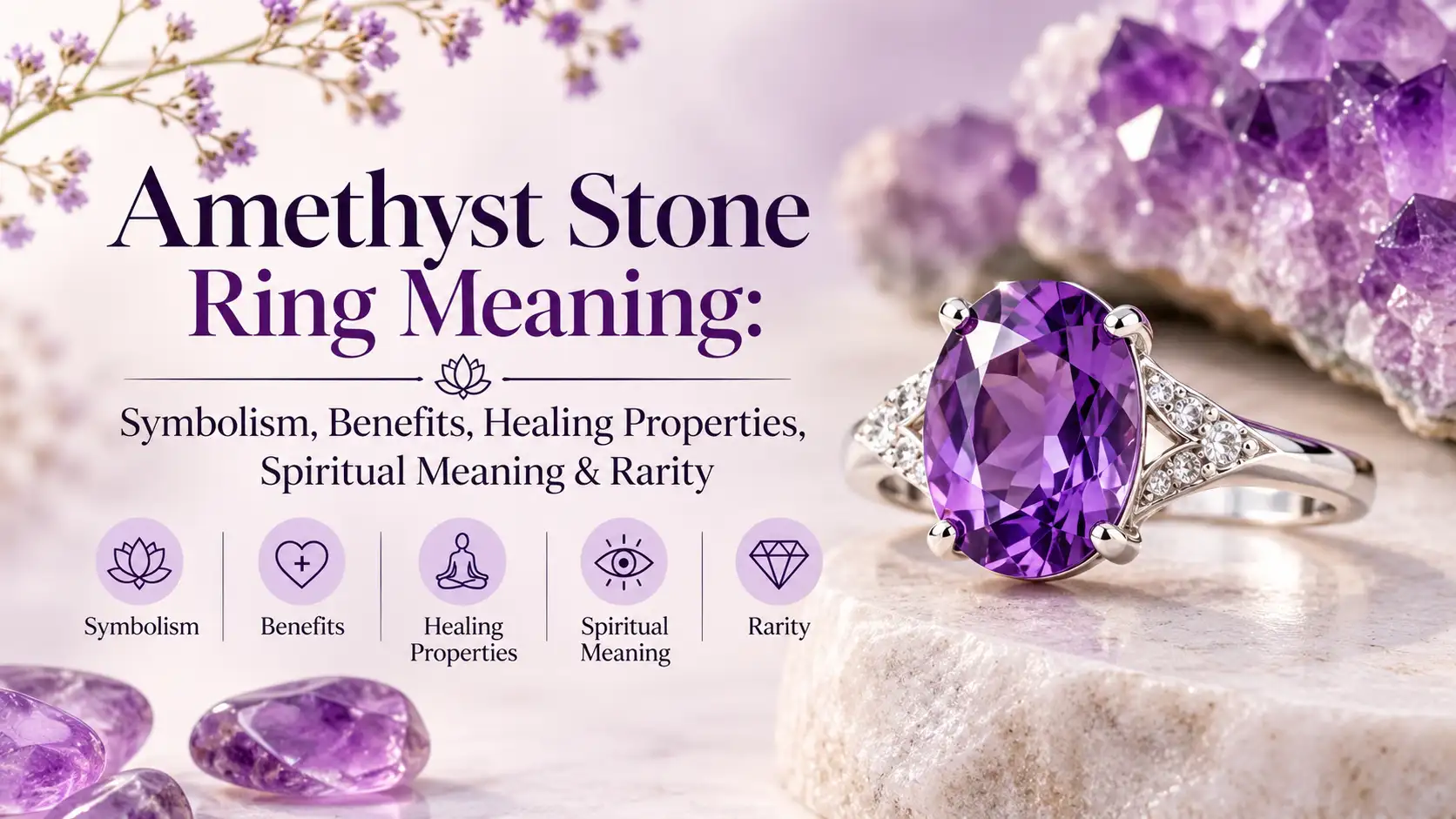
amethyst stone ring meaning symbolism benefits healing properties spiritual meaning and rarity
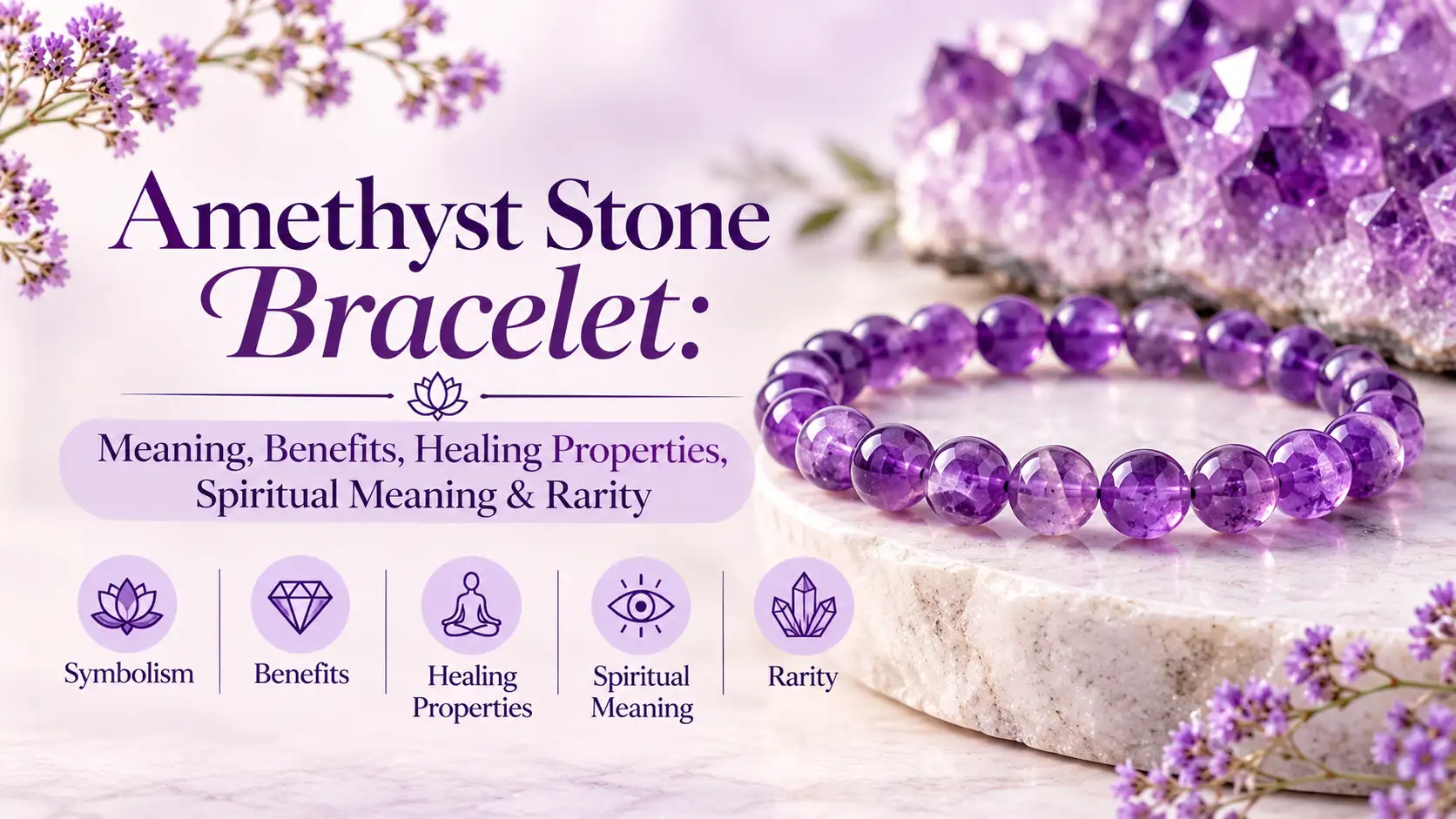
amethyst stone bracelet meaning benefits healing properties spiritual meaning and rarity
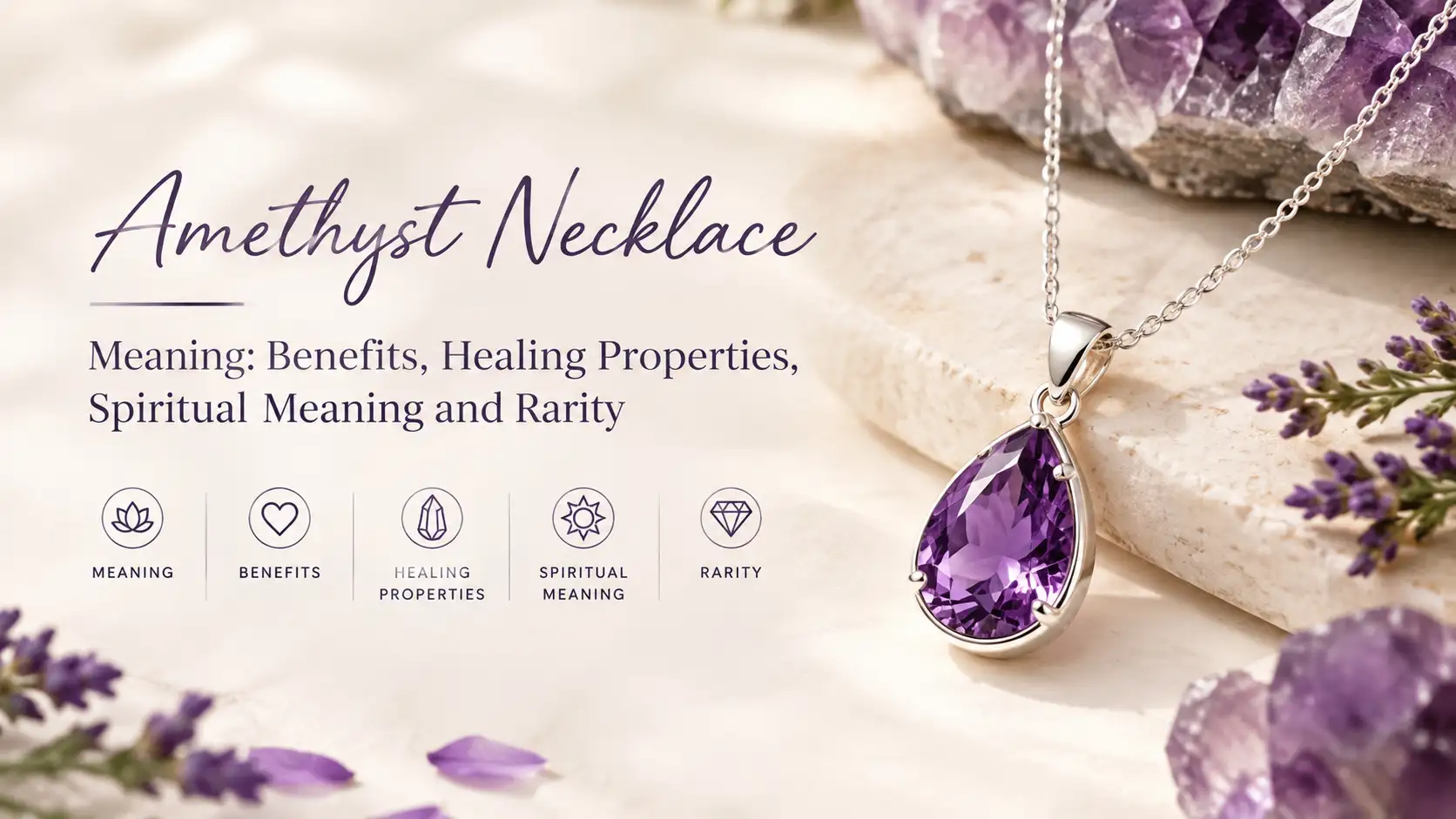
amethyst necklace meaning benefits healing properties spiritual meaning and rarity
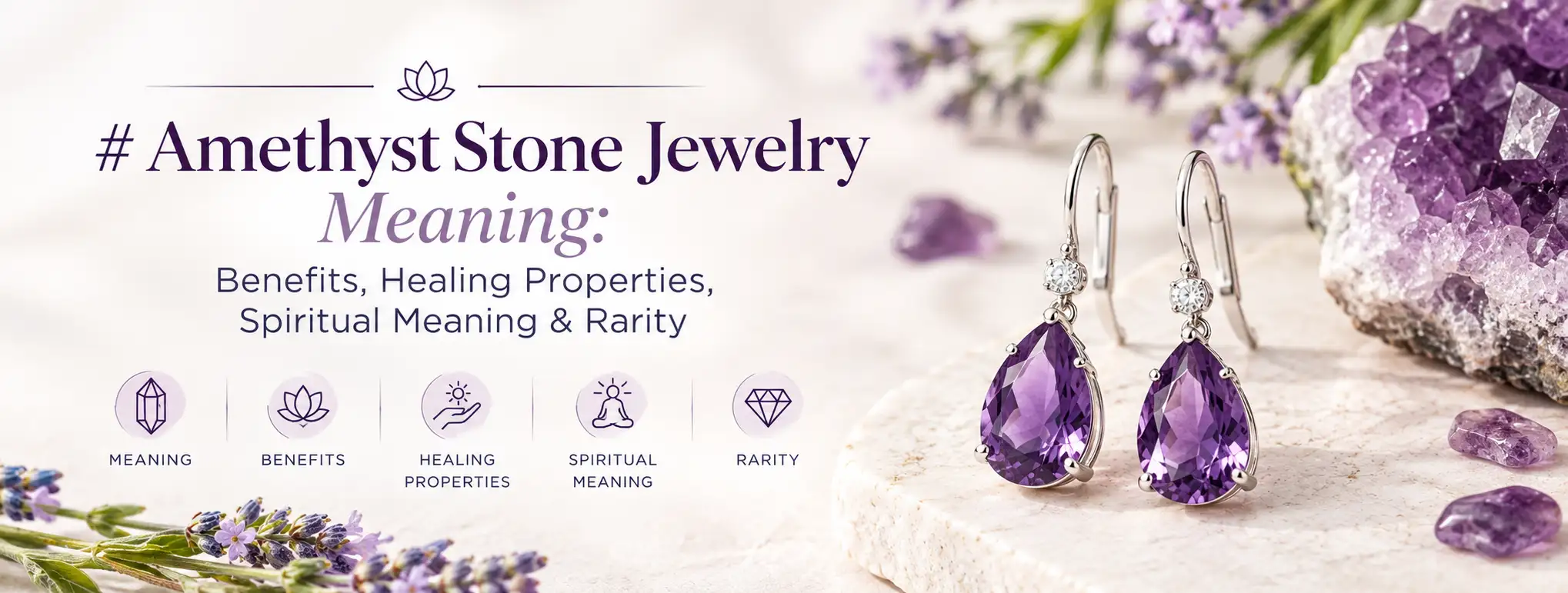
amethyst stone jewelry meaning benefits healing properties spiritual meaning and rarity
In the ancient Mediterranean, purple dye was squeezed out of sea snails. It took thousands of them to make a few grams, so purple became the color of emperors and almost no one else. Amethyst gave people a way to wear that color in stone, and for centuries it sat in crowns and bishops' rings beside rubies and sapphires.
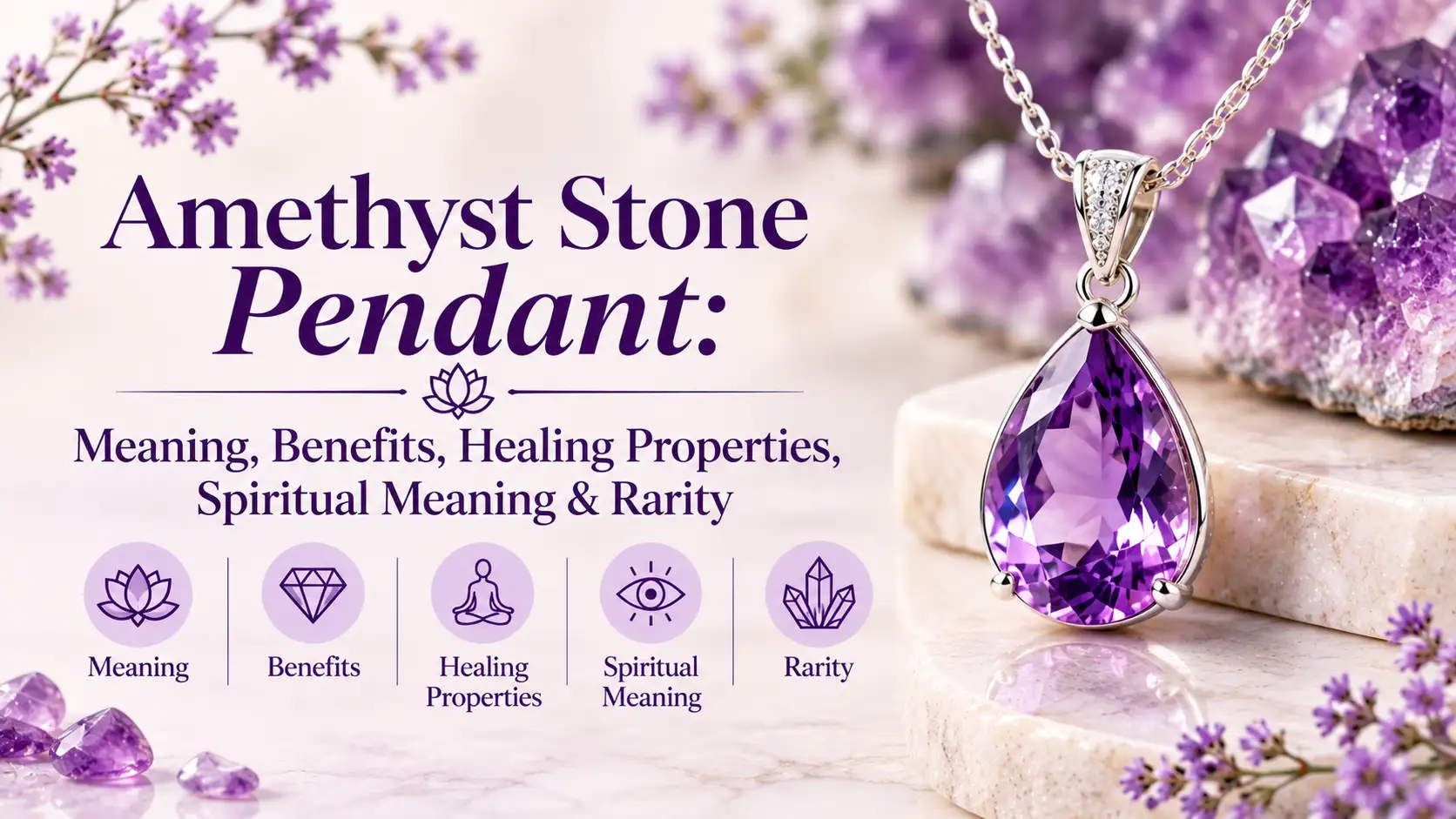
Today an amethyst pendant can cost less than dinner out or more than a used car. The gap comes down to color, cut, and a rarity story that most guides skip or get wrong. Below you'll find what an amethyst stone pendant means, what people believe it does, where those beliefs come from, how rare the stone really is, and how to choose one you'll wear for years. Where folklore and facts part ways, we'll say so.
An amethyst pendant stands for calm, clear thinking and protection. The name comes from the ancient Greek amethystos, "not intoxicated," because people believed the stone kept its wearer sober and sharp. In crystal practice it's tied to the crown and third eye chakras and used for stress, sleep and meditation. It's also the February birthstone. Worn as a pendant, it rests near your heart, where you can see it and reach for it during the day.
Amethyst is purple quartz: hard enough for everyday wear, affordable in most grades, and genuinely rare only at the very top of the color scale.
Hardness, sources, treatment and anniversary details come from the Gemological Institute of America (GIA).
An amethyst pendant means a clear head, a steady heart and quiet protection. That's the short version. Here's where those meanings come from.
The word comes from the ancient Greek amethystos. The Gemological Institute of America translates it as "a remedy against drunkenness." Because of its wine-like color, the Greeks tied the stone to Dionysus, god of wine, and believed it kept the wearer sober.
Over time, the meaning stretched well past wine. Amethyst came to stand for a clear mind in general, the kind that holds steady when stress, temptation or other people's moods pull at you. People wore it to stay sharp in battle and in business, and Renaissance Europeans thought it could calm a lover who had lost all sense.
A pendant sits at the center of your chest, close to your heart. In crystal practice, that's the area tied to emotional balance. Even if crystals aren't your thing, it's where you can see the stone, touch it and feel it through the day.
That small habit is the whole point for many people. The pendant becomes a touchstone, something to hold before a hard conversation or during a slow breath in traffic. It's a quiet reminder of the calm, clear person you want to be.
Pendants are also kind to the stone. Amethyst rates 7 on the Mohs hardness scale, tough enough for daily wear, but rings take far more knocks than necklaces do. Since amethyst can show wear over the years, a pendant keeps it looking crisp for longer.
Amethyst is the February birthstone and the traditional gift for a sixth wedding anniversary. Beyond the calendar, the message is simple: I hope you feel calm, clear and protected.
That makes it a fitting gift for a mother, a friend going through a rough stretch, or a graduate heading into something new. Some people also give amethyst to mark a sobriety milestone, which brings the stone right back to its original meaning.
People have worn amethyst close to the body for roughly 4,000 years, and for most of that time it was a luxury.
In Middle Kingdom Egypt, carvers shaped amethyst into small animal figures. One, a monkey holding its baby from about 1981 to 1802 BCE, has a drill hole and wear marks that suggest it hung from a cord as an amulet, according to the International Gem Society. So people were already wearing amethyst on a cord nearly 4,000 years ago.
The Greeks tied the stone to wine. They believed it kept drinkers sober, and some drank from cups set with amethyst, hoping to stay clear-headed (South Carolina Public Radio). Not everyone bought it. In the first century CE, the Roman writer Pliny the Elder blamed "the falsehoods of the magicians" for the stone's sober reputation, and even for its name. Two thousand years later, people still repeat the claim he waved away.
You'll see a "Greek myth" on many amethyst pages. Bacchus chases a maiden named Amethyste, the goddess Diana turns her into white stone to save her, and a regretful Bacchus pours wine over it, staining it purple.
It's a lovely story, but no Greek or Roman author ever told it. It comes from the French Renaissance poet Rémy Belleau, who wrote it for his 1576 book of poems about gemstones. The version with Bacchus's tigers is French too (background). Enjoy the tale, just know it's a 16th-century poem rather than ancient mythology.
Amethyst became a stone of both church and crown. Bishops wore it in their rings, and it appears twice in the Bible: in the high priest's breastplate in Exodus 28:19 and as the twelfth foundation stone of the New Jerusalem in Revelation 21:20.
Royals loved it just as much. Catherine the Great covered herself in amethyst, and the Sovereign's Orb, made in 1661 for the coronation of Charles II, has an amethyst set right beneath its cross. GIA notes that amethyst was once valued on par with ruby, emerald and sapphire.
Then came Brazil. Large deposits turned up there in the 19th century, and a gem once as scarce as ruby or emerald became abundant. Prices fell, and amethyst moved from royal treasuries into ordinary jewelry boxes.
In August 1912, the National Association of Jewelers (now Jewelers of America) met in Kansas City and set the modern US birthstone list. Amethyst got February and has held it ever since.
South Carolina named amethyst its official state gemstone on June 24, 1969 (South Carolina Encyclopedia). And Arizona's remote Four Peaks mine, about 46 miles from Phoenix, still produces some of the finest dark purple amethyst found anywhere (GIA).
Spiritually, amethyst is the stone of the higher mind. People turn to it for intuition, meditation, prayer and protection from negative energy.
Crystal practitioners link amethyst to two chakras. The crown chakra (Sahasrara), at the top of the head, is tied to spiritual connection and awareness. The third eye (Ajna), between the brows, governs intuition and insight. They're separate energy centers, even though some sources blur them into one.
One honest footnote: the tidy rainbow of chakra colors is fairly new. Older Indian texts did give the chakras colors, just not in rainbow order, and Western teachers arranged them that way in the 20th century, as researcher Kurt Leland explains in Quest magazine. Nearly every crystal practitioner uses that modern system today, which is why violet amethyst sits at the crown.
Christianity: amethyst became a sign of spiritual authority and self-restraint, one reason bishops have worn it in their rings for centuries.
Buddhist and Hindu practice: amethyst is a popular choice for mala beads, used to count mantras during meditation.
Vedic astrology: amethyst, known as jamunia or katela, is the traditional substitute for blue sapphire, the gem of Saturn. It's often worn in larger sizes, usually after consulting an astrologer.
When someone wears amethyst for spiritual reasons, they're usually reaching for one of these:
Protection from negative energy, envy or draining people
Intuition, including clearer and more memorable dreams
Peace before prayer, meditation or sleep
Transformation, especially breaking a habit or starting over
Connection to God, the universe or a higher self, depending on what you believe
Because a pendant rests over the heart and is easy to hold, many people find it the most natural way to keep that intention close.
In crystal healing, amethyst is the go-to stone for stress, sleep and focus. Science hasn't found any energy coming from crystals, but a pendant can still help in practical ways. Here are both sides.
Some crystal books go further and say amethyst relieves headaches, boosts immunity, detoxes the body or balances hormones. Amethyst is not a treatment, so if headaches, insomnia or anxiety keep coming back, talk to a doctor.
The best-known test of crystal power came from psychologist Chris French at Goldsmiths, University of London. His team had 80 volunteers relax for five minutes holding either a real quartz crystal or an expertly made glass fake. Most reported tingling, warmth or similar sensations, and it made no difference which stone they held (Chris French in The Skeptic).
What did predict the sensations was belief: volunteers with stronger paranormal beliefs felt more. The effect came from the mind, not the mineral.
That doesn't make the calm you feel fake. It means the benefit comes from you: the pause, the intention and the habit you build around the stone. A pendant just happens to be a very good tool for that habit.
It's a built-in reminder. A stone you can touch is an easy cue to slow down and breathe.
It's tough. At 7 on the Mohs scale, amethyst handles everyday wear in a pendant.
It's good value. Price per carat climbs slowly with size, so a bold stone stays affordable (GIA).
It's flattering. Purple suits most skin tones and works with yellow gold, white gold and silver.
It carries meaning. Birthstone, anniversary stone and sobriety symbol, all in one.
Everyday amethyst is common, which is why it's so affordable. Fine amethyst is a different story: deep, even color in a clean, good-sized stone is genuinely hard to find.
Until the 1800s, amethyst was a royal gem. Brazil's enormous deposits changed that, and today it's one of the most widely available colored gems in the world.
Value depends almost entirely on color, according to the International Gem Society. And because big crystals are plentiful, price per carat rises gradually instead of jumping with size.
Top color. The finest amethyst is a strong purple or reddish purple with no visible color zoning (GIA). Most stones are lighter, patchier or slightly brownish, and those flaws pull value down fast.
The "Siberian" look. Russia's old Siberian mines once set the standard: rich purple with flashes of red and blue. "Siberian" is now a quality grade rather than an origin, and stones that earn it sit at the top of the price list.
Big and clean. Quartz can grow huge, but clean amethyst over 100 carats is scarce. The Smithsonian holds two famous exceptions: a 1,362-carat stone from Brazil and a 202.5-carat stone from North Carolina.
Rare sources. Arizona's Four Peaks mine yields small amounts of very fine dark purple material, and most of the world's ametrine (amethyst and citrine in one crystal) comes from the Anahí mine in Bolivia (GIA).
"Semi-precious" is a trade habit, not an official grade. It dates from the era when diamond, ruby, sapphire and emerald were singled out as "precious," and amethyst was moved down the list once Brazil made it plentiful.
The label says nothing about the stone in front of you. A fine Siberian-grade amethyst can easily outshine a cloudy, poorly cut "precious" gem.
Strictly speaking, amethyst is purple quartz. Once the color moves outside lilac to deep purple, you're looking at a different kind of quartz with a borrowed name, as the International Gem Society points out. Here's what the names you'll see actually mean.
In crystal practice, yes. Pink amethyst is tied to love and self-compassion, ametrine to balance (amethyst's calm plus citrine's optimism), prasiolite to growth and the heart, and red amethyst to grounding.
"White amethyst" is usually read like clear quartz, a stone of clarity and cleansing. Classic purple amethyst keeps the core meanings in this guide: calm, clarity and protection.
Judge the color first, then the setting, metal and chain length. Clarity and size matter less than most shoppers think.
Look for a medium to medium-dark purple, ideally with a hint of red, and avoid brownish or bronze tints (GIA). Don't go too dark either: very dark amethyst can look almost black in dim rooms, so check the stone under both warm indoor light and daylight.
Even color is the next test. Zones of lighter and darker purple lower the value, and they show best when you look through the side or back of the stone against something white. Pale lilac isn't a flaw, by the way. It's a style choice, and a cheaper one.
Most faceted amethyst is eye-clean, meaning you can't see inclusions without magnification. If a faceted stone shows obvious flaws at arm's length, its price should reflect that. Cabochons and beads often show more inclusions, and that's normal for those styles.
Faceted (oval, round, pear, cushion) gives the most sparkle and suits everyday fine jewelry.
Cabochon is a smooth dome with deeper, moodier color and a vintage feel.
Raw points look natural and are popular for spiritual wear, but the tips chip easily, so choose a design that caps or wraps them.
Bezel: a metal rim around the stone. It's the most protective choice for daily wear.
Prong: lets in more light for more sparkle. Have the prongs checked once a year.
Halo: a ring of small diamonds or white stones that adds sparkle and visual size.
Capped or wire-wrapped: common on raw crystals. Caps are often glued, so keep them out of hot water.
Also check the bail, the loop the chain passes through. It should fit your chain and let the pendant hang straight.
Sterling silver (925): affordable and cool-toned, lovely with lighter lilac. It tarnishes, so store it with an anti-tarnish strip.
14k yellow gold: the classic pairing. Warm gold makes purple look richer, and 14k is durable enough for daily wear.
14k white gold: crisp and modern. Its bright rhodium finish wears over time and can be re-plated by a jeweler.
Rose gold: soft and romantic, especially with Rose de France or pinkish stones.
Gold-plated: fine for fashion pieces, but the gold layer wears through with daily use.
If you have sensitive skin, ask for nickel-free metal. Some white gold and cheap silver alloys contain nickel, a common cause of skin reactions.
If you're wearing amethyst for its meaning, many crystal practitioners prefer the longer lengths so the stone rests over the heart.
These are typical US retail prices we found at major jewelers and marketplaces in October 2026. Sales move them around, but the ranges hold.
Notice that the metal drives most of the price. Because amethyst itself is affordable, a 14k gold pendant with a big, beautiful stone often costs only a little more than one with a small stone.
Is the amethyst natural or lab-created?
Has it been treated, and how?
Is the metal solid or plated?
A good seller answers all three without hesitating.
Three different things get sold as amethyst: natural stones, lab-created stones and imitations. Only the first two are actually amethyst, and only a gem lab can always tell those two apart.
Natural amethyst is mined from the earth.
Lab-created amethyst has the same chemistry and properties as natural. It has been made since the 1970s and can be very hard to identify without advanced testing (GIA).
Imitations are glass, plastic, or cheaper stones dyed purple. GIA notes that even pale amethyst and light quartz are sometimes dyed to look richer.
In the US, the law is on your side. The FTC's jewelry guidelines say a lab-made stone must be labeled with a word like "lab-created" or "lab-grown" right before the gem name, and imitations must say "imitation" or "simulated" (16 CFR 23.25). "Faux" doesn't count as proper disclosure. So "simulated amethyst" means there's no amethyst in it at all.
Look for color zoning. Natural amethyst often shows angular zones of lighter and darker purple. Perfectly even color isn't proof of a fake, since top-grade stones can be very even, but in a large, cheap stone it's a reason to ask questions.
Look for bubbles. Round gas bubbles or swirly lines inside the stone usually mean glass.
Check the edges. Glass is softer than quartz, so its facet edges look rounded or chipped sooner. Molded glass can also show seam lines.
Check beads for dye. Color pooled in cracks or around drill holes points to dyed material.
Run a price check. A big, deep-purple, flawless "natural" stone in solid gold for $30 is not what it claims to be.
Skip scratch tests. They damage your pendant, and they can't separate natural from lab-created amethyst anyway.
For an expensive or heirloom piece, a gem lab can confirm what you have. Many jewelers skip testing because amethyst is relatively inexpensive, so the simplest protection is a seller who states "natural" or "lab-created" on your receipt.
Wear it close to your heart during the day and take it off at night. Beyond that, there are very few rules.
Hold the pendant in your palm and take three slow breaths.
Say one short sentence you want it to remind you of, such as "I stay calm and clear today."
Put it on, and touch it whenever you want to come back to that sentence.
For calm and emotional balance, most practitioners like it over the heart, which means a 22 to 24 inch chain. A shorter chain puts it near the throat, an area crystal practitioners link to calm, honest communication.
Skin contact is often preferred. Still, wearing it over clothes is fine if that's what you'll actually do every day.
Put it on last, after lotion, perfume and hairspray.
Take it off for the pool or hot tub, since chlorine is hard on gold and silver alloys.
Take it off for the gym, housework and bed. Chains tangle and snap overnight.
Never leave it on a sunny windowsill or car dashboard. Strong light can fade amethyst over time.
Pisces (February 19 to March 20): the classic match. Older lists of zodiac stones give amethyst to Pisces (birthstone history).
Aquarius (January 20 to February 18): through the February birthstone connection.
Capricorn and Aquarius in Vedic astrology: both are ruled by Saturn, amethyst's planet. Vedic astrology calculates signs differently, so your Vedic sign may not match your Western one.
Virgo and Sagittarius: both show up in many modern crystal guides.
Honestly, anyone can wear amethyst. Signs are a nice starting point, not a rule.
Amethyst is quartz, which is chemically stable and safe against the skin. The real cautions are practical:
Metal allergies: if your skin reacts, choose nickel-free sterling silver or yellow gold.
Babies and toddlers: no necklaces at all. The FDA warned in 2018 that teething necklaces carry choking and strangulation risks (ABC11).
Followers of Vedic astrology: because amethyst is tied to Saturn, many astrologers suggest checking your birth chart first.
Anyone using it as treatment: amethyst can support a calm routine, but it can't replace medical care.
Not physically. Some people say amethyst near the bed brings unusually vivid dreams or leaves them restless. If that's you, keep the pendant on a dresser across the room.
Skip "gem water" made with raw clusters or dyed stones, which can carry other minerals or dye into the water.
Rose quartz for calm plus self-love
Clear quartz, which practitioners say amplifies other stones
Moonstone for intuition and dreams
Black tourmaline for grounding and protection
Clean it with warm soapy water, cleanse it with anything except sunlight or salt, and store it away from harder gems.
Mix warm water with a few drops of mild dish soap.
Scrub gently with a soft toothbrush, especially behind the stone, where lotion and dust collect.
Rinse well and dry with a lint-free cloth.
If you cleanse your pendant energetically, these methods are safe for the stone:
Moonlight overnight (our full moon guide)
Sound from a singing bowl or bell
Smoke from sage or incense
Resting it on a selenite plate
A quick rinse under cool running water
Store it in a soft pouch or its own compartment. Diamonds, sapphires and rubies are harder and will scratch it.
Add an anti-tarnish strip if the pendant is sterling silver.
Fasten the clasp before storing so the chain doesn't tangle.
Have the prongs and bail checked once a year. After many years of wear, a jeweler can repolish the stone to bring back its shine.
Calm, clarity and protection. The name comes from the Greek for "not intoxicated," so the stone has stood for a clear head for more than 2,000 years. It's also the February birthstone and the gem for a sixth wedding anniversary.
Usually that they want you to feel calm, protected and clear-headed. It's a thoughtful gift for a February birthday, a hard season of life, a new chapter or a sobriety milestone.
Yes. At 7 on the Mohs scale, amethyst handles daily wear well, especially in a pendant. Take it off for swimming, workouts and sleep, and keep it out of strong sunlight.
Water won't hurt the stone, but it's still better to take it off. Soap film dulls the sparkle, sterling silver tarnishes faster, and hot water can loosen glued caps on raw crystals.
In crystal practice, it's used to quiet the mind, deepen meditation and prayer, sharpen intuition and guard against negative energy. It's linked to the crown and third eye chakras.
Everyday amethyst is common and affordable, with sterling silver pendants starting around $30. Deep, even, eye-clean stones are much rarer, and large ones in the top "Siberian" color are genuinely scarce.
The benefits people describe, such as calm, better sleep and clarity, are the same for everyone. Some crystal books claim amethyst balances hormones.
Absolutely. Kings and bishops wore amethyst for centuries. For a classic men's look, try a bezel-set darker stone in oxidized silver or yellow gold on a 20 to 24 inch chain.
Prolonged strong light or high heat can lighten some amethyst. Normal daily wear is fine, so just don't store it in sunlight or leave it in a hot car.
AM-uh-thist, with the stress on the first syllable.
The right amethyst pendant is the one you'll reach for every morning. If you're buying it for meaning, pick a color you love looking at and a chain that lets it rest over your heart. If you're buying it as fine jewelry, spend on color first, then on a protective setting and solid metal.
A quick checklist before you buy:
Medium to deep purple, with no brown tint and fairly even color
Eye-clean, if the stone is faceted
Bezel setting for daily wear, prongs for extra sparkle
Solid 925 sterling silver or 14k gold
18 inches for everyday wear, 22 to 24 inches to sit over the heart
"Natural" or "lab-created" written on the receipt
For jewelry retailers: JewelPin is an RJC-certified manufacturer of natural gemstone jewelry, supplying boutiques and online stores in the US and worldwide. Browse our 14k gold amethyst jewelry, sterling silver pendants and chakra collection, or request a sample order to see the quality for yourself.