7 Days Shipping in “Ship Now” Collection
WORLDWIDE SHIPPING EXCEPT INDIA
Minimum Order Value: $1000
31 October, 2026
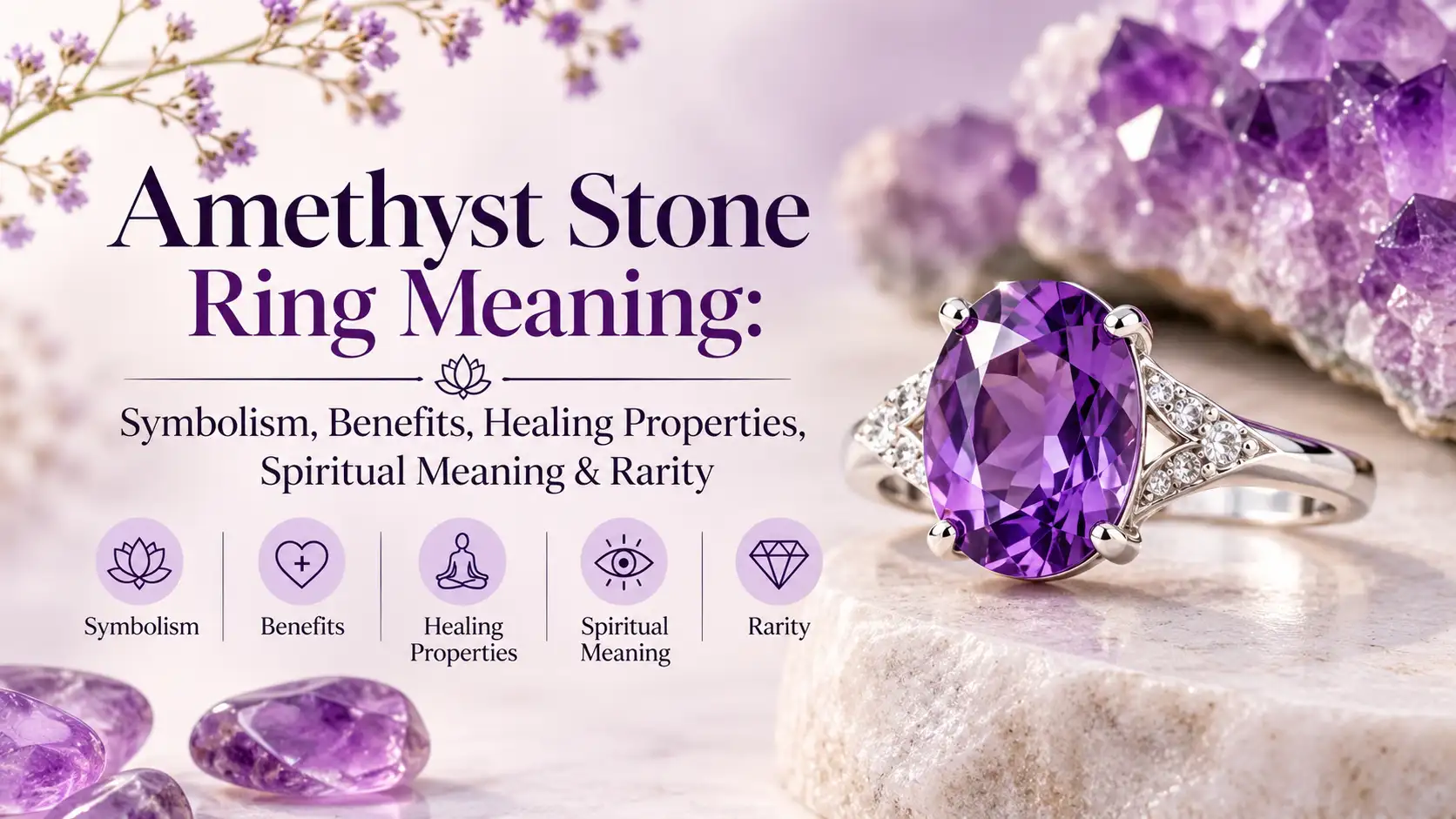
amethyst stone ring meaning symbolism benefits healing properties spiritual meaning and rarity
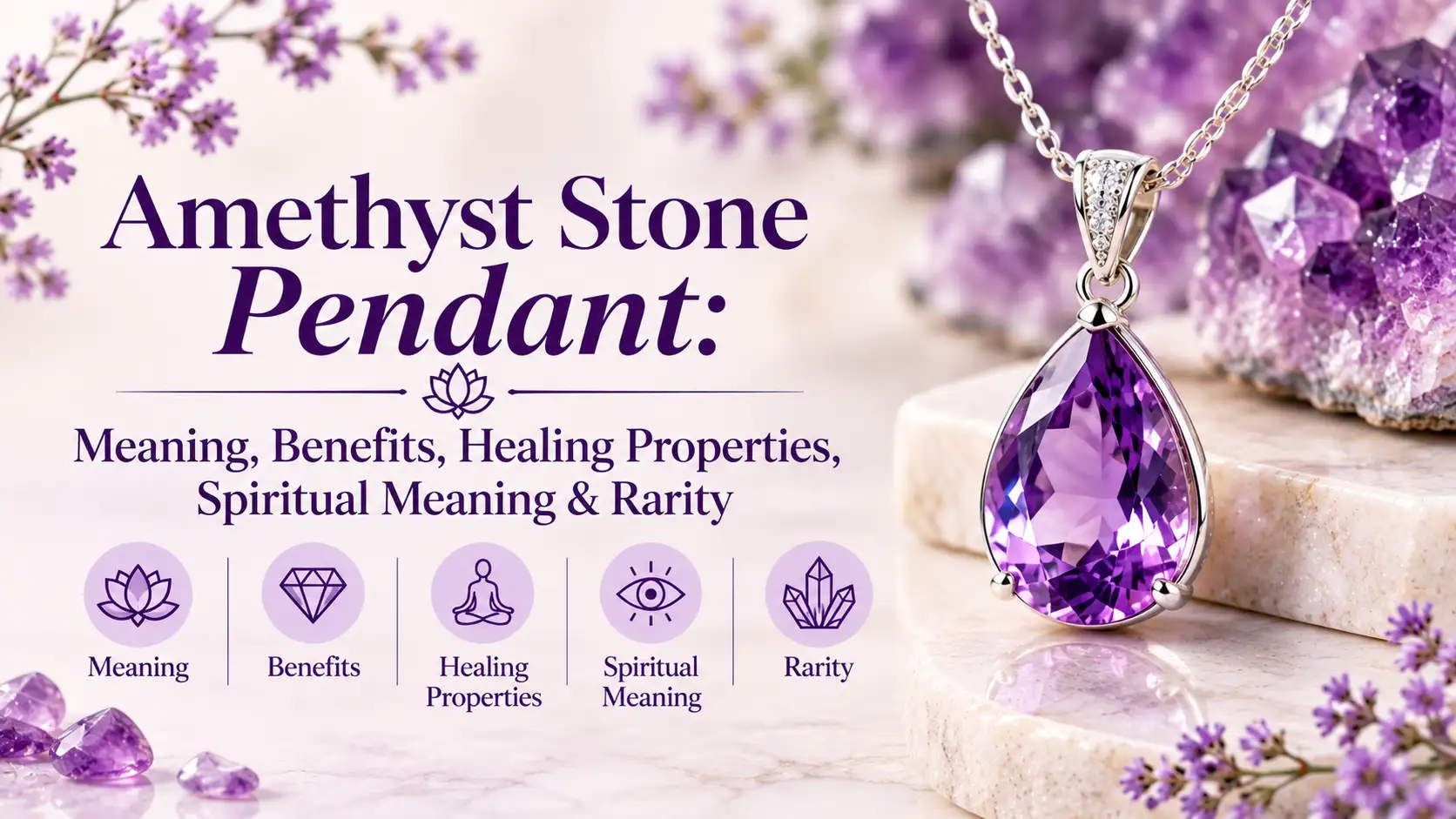
amethyst stone pendant meaning benefits healing properties spiritual meaning and rarity
amethyst necklace meaning benefits healing properties spiritual meaning and rarity
amethyst stone jewelry meaning benefits healing properties spiritual meaning and rarity
Amethyst is the purple stone almost everyone recognizes. It's also the one people most often wear for a reason that goes beyond looks. Some want calm, some want their February birthstone, and some just love how violet looks on the wrist.
At JewelPin we set amethyst in sterling silver, brass and gold, so we see the whole range up close. That includes inky top-grade stones, pale lilac beads, and glass fakes good enough to fool a careful eye. This guide covers all of it, honestly.
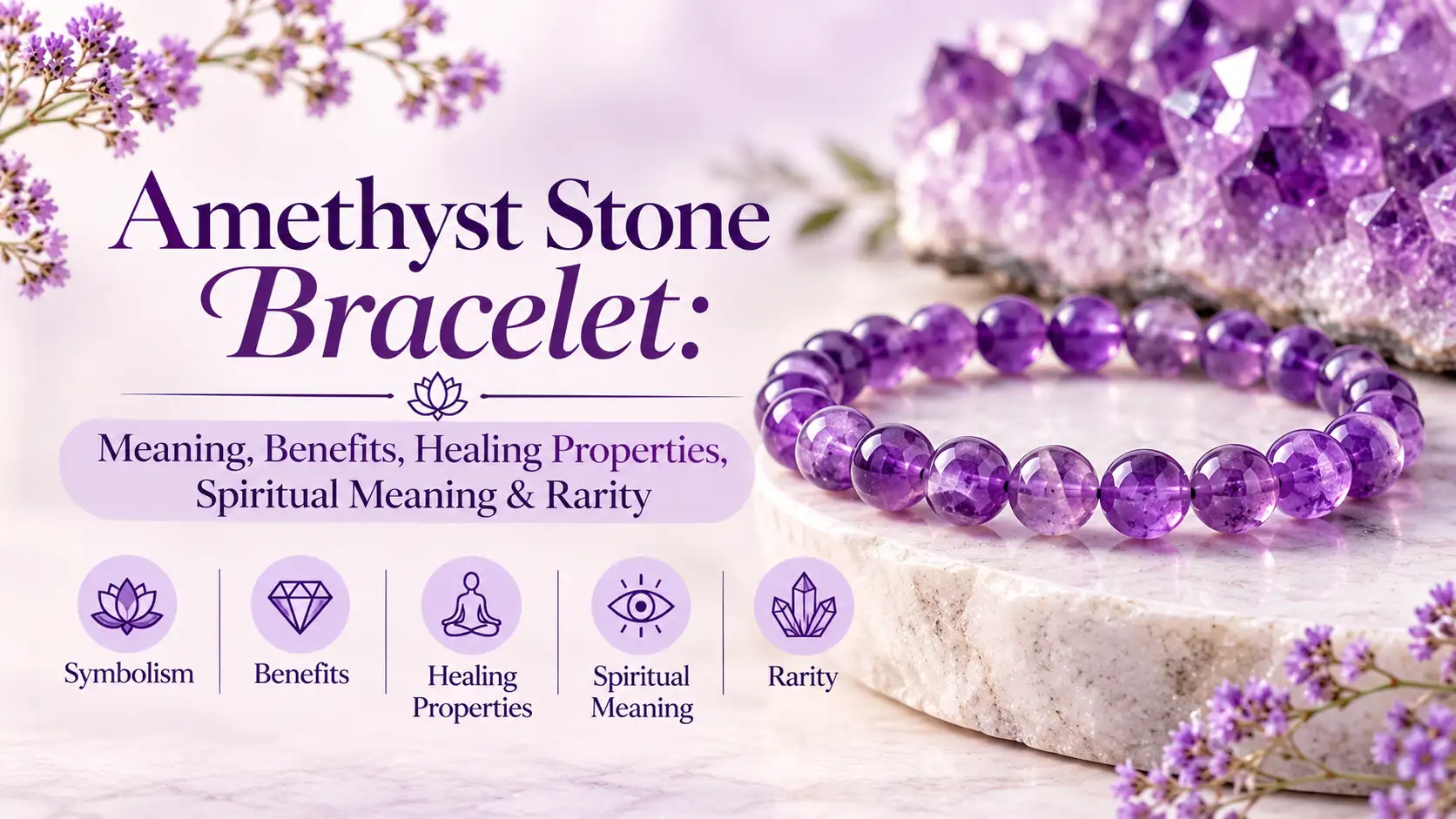
An amethyst bracelet is a bracelet made with purple quartz. Its name comes from the Greek amethystos, "not intoxicated," and it stands for a clear head, calm and spiritual insight. Crystal traditions use it for stress, sleep and meditation. Amethyst was once priced like ruby, until huge finds in Brazil in the 1800s made it affordable. Deep, evenly colored stones are still the rare ones.
Below you'll find what amethyst means, what people believe it does and what research actually says, how rare it really is, how to spot a fake, what a fair price looks like in 2026, and how to wear and care for it.
Amethyst is purple quartz. It's hard enough for everyday wear, and it's still the most valued member of the quartz family.
Sources: GIA, International Gem Society, South Carolina Encyclopedia.
An amethyst bracelet stands for a clear, steady mind. That idea is thousands of years old, though a few of the stories told about it are much younger than they claim.
"Amethyst" comes from the Greek amethystos, built from a- ("not") and a verb meaning "to get drunk." Greeks and Romans treated the stone as a charm against intoxication, and wine cups were sometimes carved from it. Over the centuries, "sober" widened into something bigger: clear judgment, self-control and calm.
A clear head. Early legends held that it kept the wearer clear-headed and quick-witted in battle and in business (GIA).
Faith and humility. Bishops wore amethyst rings for centuries, which is where the trade term for the deepest purple comes from: "bishop grade" (South Carolina Encyclopedia).
Steady love. St. Valentine is said to have worn an amethyst ring carved with Cupid, and Renaissance Europeans believed it calmed lovers carried away by passion (GIA).
Royalty. Catherine the Great adored it, and fine amethyst sits in the coronation regalia of British royalty.
Protection. In medieval England it was thought to guard against disease, and Edward the Confessor reportedly wore it for that reason.
You'll read on many crystal sites that Bacchus, the god of wine, chased a maiden named Amethyste. The goddess Diana turned her into white stone, and a remorseful Bacchus poured wine over it, staining it purple forever.
It's a lovely story, but no Greek or Roman text contains it. The French poet Rémy Belleau invented it in a poem published in 1576 (Wikipedia). The ancient link to wine is real, though: the late-antique poet Nonnus wrote that Rhea gave Dionysus an amethyst to keep wine-drinkers in their right minds.
A bracelet sits where you see it all day: on the keyboard, on the steering wheel, around a coffee mug. Every glance is a small cue to slow down and take a breath. For many wearers, that quiet daily reminder is the whole point of the piece.
In crystal tradition, amethyst is the go-to stone for a busy mind: stress, sleep, focus and cravings. Science hasn't found any healing power in the stone itself, but that isn't the whole story.
Ritual. Putting on a bracelet with an intention is a tiny mindfulness habit. Over time, the stone itself becomes the cue to settle down.
Touch. Rolling beads between your fingers gives restless hands something calm to do. That's the same idea behind worry beads and prayer malas.
Expectation. A placebo response is real in how you feel, even though it can't fix a medical problem.
Beauty. Wearing something you love, in a color you love, is a small daily pleasure. That counts for something.
Spiritually, amethyst is the stone of the quiet inner self: intuition, prayer, meditation and a sense of connection to something larger. Different traditions reach that meaning by different roads.
In the chakra system, amethyst works with the two highest energy centers. The third eye (Ajna) sits between the brows and governs intuition and insight. The crown (Sahasrara) sits at the top of the head and governs spiritual connection.
Violet is the traditional color of the crown chakra, which is how amethyst became its classic stone. If you're new to the system, our guide to chakra jewelry walks through all seven centers.
Amethyst is a favorite for Buddhist and Hindu malas. A full mala has 108 beads, while wrist malas usually carry 18, 21 or 27. The practice is simple: move one bead through your fingers with each breath or mantra.
Amethyst is one of the emblems of the twelve apostles, and bishops have worn it in their rings for centuries. It's listed among the stones of the high priest's breastplate and in the foundations of the Holy City in the Book of Revelation. In church symbolism, it stands for piety, humility and self-control.
In Vedic astrology, amethyst is called Jamunia or Katela and is tied to Saturn (Shani). Astrologers often suggest it as an uparatna, a gentler and far more affordable substitute for blue sapphire. Traditionally it's put on for the first time on a Saturday, often set in silver.
If you're wearing it as a Saturn remedy rather than as jewelry, most astrologers will want to see your birth chart first.
In modern witchcraft and Wicca, amethyst is one of the most-used stones. Common practices include:
Protection. Charms, wards and altar pieces meant to keep heavy energy out of a space.
Dreamwork and divination. Tucked under a pillow for vivid dreams, or kept with tarot cards and pendulums.
Sobriety and habit-breaking. Spells and intentions that draw on the stone's "not drunk" name.
Moon rituals. Set out under the full moon to cleanse and recharge.
Psychic work. Placed in crystal grids or held during meditation to sharpen intuition.
As a mineral, amethyst isn't rare anymore. Fine amethyst still is: deep, evenly colored, eye-clean stones are only a small slice of what comes out of the ground.
Before the 1800s. Amethyst was valued alongside ruby, emerald and sapphire, and it was set in royal and church jewels (GIA). Russia was the major source until the 19th century.
The 1800s. Large deposits were found in Brazil. A stone once as rare as ruby or emerald was suddenly plentiful, and prices fell (GIA).
Today. Most amethyst comes from Brazil (especially Rio Grande do Sul), Uruguay, Zambia and Bolivia. Zambia's Kariba mine is one of the largest producers in the world.
Some Brazilian geodes are big enough to stand inside. That abundance is why a good amethyst bracelet costs a fraction of a sapphire one.
Color drives almost all of amethyst's value (International Gem Society). Price per carat climbs slowly with size, so a big stone isn't automatically a rare one.
Siberian. The trade's top grade: deep purple with red and blue flashes. It describes the color, not where the stone was mined.
Bishop grade. An older name for the finest deep purple, after the stones in bishops' rings.
Rose de France. Very light, pinkish lavender. Less valuable, but lovely in delicate pieces.
Ametrine. Amethyst and citrine in one crystal, half purple and half gold. Bolivia's Anahí mine is the classic source.
Prasiolite, sold as "green amethyst." Quartz that turns green when heated. The FTC lists "green amethyst" as a misleading name.
"Madeira," "Palmyra" or "Spanish topaz." Heated amethyst sold under topaz names. Real topaz is a different, usually pricier mineral.
If you want truly rare amethyst, look to Arizona. The Four Peaks mine sits about 46 miles from Phoenix, high in the Mazatzal Mountains (GIA). The mine is around 7,000 feet up, reachable only by helicopter or a three- to four-hour hike, and worked by hand.
In a 2020 interview, the mine's claim holder said roughly a ton of amethyst leaves the mountain each year. That yields about 50 pounds of gemstones, and only a few handfuls end up in jewelry (ABC15). The best of it shows the dark purple and purplish-red color the trade calls "Siberian."
The US has other amethyst bragging rights, too. South Carolina made amethyst its state gemstone in 1969, and a 15-pound cluster found near Due West in 1965 went on display at the Smithsonian (South Carolina Encyclopedia). The Smithsonian also holds a 202.5-carat transparent amethyst from North Carolina.
Bead bracelets use commercial-grade amethyst, and that's fine. You're paying for color, craftsmanship and meaning, not scarcity.
Faceted stones in gold are where rarity matters. Pay for color first, clarity second and size last.
Even fine amethyst is affordable next to sapphire or ruby. Don't let anyone charge a "rare" price for ordinary material.
Most amethyst bracelets fall into nine styles. Bead size and metal change the look more than anything else.
6 mm: delicate, and good for small wrists and stacks.
8 mm: the classic everyday size.
10 mm: bolder, and the most popular size for men.
12 mm and up: a statement, and noticeably heavier on the wrist.
Set styles come in both metals at JewelPin: see our sterling silver bracelets, 14k gold bracelets and chakra collection.
Judge the color first, then the construction. A great stone on a cheap cord is still a cheap bracelet.
Check the color in two kinds of light. Look for a strong, even purple without brown or gray. Check it near a window and again under warm indoor light, because very dark stones can look almost black at night.
Look for life in the beads. Good amethyst beads are translucent with a glassy shine. Cloudy, chalky beads are a lower grade, unless the bracelet is sold as matte or raw.
Inspect the drill holes. Holes should be clean and centered. Chips around a hole look rough and slowly saw through the cord.
Expect a little variation. Natural beads differ slightly in tone and pattern. A strand of identical, flawless beads at a bargain price deserves a closer look.
Check the cord and clasp. A good stretch bracelet uses thick elastic, often doubled, with the knot tucked inside a bead. Chain styles need a sturdy lobster or box clasp.
Read the metal stamp. Under US rules, "sterling" means at least 92.5% pure silver, and "gold filled" means the gold layer is at least 1/20 of the metal's weight (FTC Jewelry Guides). Gold-plated findings look the same at first but wear through much faster.
Don't trust "AAA" on its own. Bead grades like A, AA and AAA aren't an industry standard, so each seller defines its own. FTC guidance says a seller who claims a grade should name the grading system, so compare photos, not letters.
Ask two direct questions. Is it natural or lab-created? Has it been heat-treated? An honest seller answers both without hesitating.
Measure your wrist snugly with a soft tape, just below the wrist bone. Add about ½ inch for a beaded stretch bracelet and ½ to 1 inch for a chain or tennis style.
Most women's bracelets run about 7 inches and most men's about 8 inches. For reference, a 7-inch stretch bracelet of 8 mm beads takes about 22 beads.
Most fake amethyst bracelets are glass, dyed stone or lab-grown quartz. Glass and dye are easy to catch at home, while lab-grown amethyst often needs a gem lab.
Use a 10x loupe. Round bubbles or swirl marks point to glass. Natural amethyst tends to show angular color zones and tiny crystal-like inclusions.
Try the touch test. Hold a bead against your lip or cheek. Real stone feels cool and warms slowly, plastic feels warm right away, and glass warms faster than stone.
Look at the drill holes. Dark purple rings around the holes, or color concentrated in cracks, suggest dye.
Do a swab test for dye. Dab a cotton swab with a little nail-polish remover and rub one bead, ideally inside a drill hole. Purple on the swab means dye, but keep acetone off elastic cord and plated metal.
Sanity-check the price. Natural amethyst beads are inexpensive, so a cheap bead bracelet can still be real. A "AAA Siberian" amethyst tennis bracelet in solid 14k gold for $79 can't be.
Skip the scratch test. It can damage your bracelet, and it won't catch lab-grown amethyst anyway.
Lab-grown amethyst is real quartz with the same chemical and physical properties as mined stone (GIA). In the US, FTC guidance says it must be clearly described as "laboratory-grown," "laboratory-created" or similar, and it can't be called "natural" or "genuine."
Sellers should also disclose treatments that affect a stone's value or need special care. For a fine gold piece, it's fair to ask for a report from a gem lab such as GIA.
Most natural amethyst bead bracelets sell for $15 to $60 in the US. Faceted amethyst set in 14k gold usually runs from several hundred to a few thousand dollars, and the metal and labor often cost more than the stones.
Ranges are approximate, based on typical US retail pricing, and vary by brand and markup.
On a bead bracelet, pay for color and good stringing. On a set bracelet, most of the price is metal and labor, and amethyst's price per carat climbs only gradually. If your budget is fixed, put it into better color rather than more carats.
"Genuine Siberian amethyst" with no metal stamp and no seller details
"Solid gold" claims at gold-plated prices
Perfectly uniform beads at a rock-bottom price, with no natural or lab-grown disclosure
Healing guarantees, such as "cures insomnia" or "ends anxiety"
There's no wrong wrist. Crystal tradition favors the left wrist for taking in amethyst's calm, while practicality favors your non-dominant hand.
None of these are mandatory. They're the traditions people follow most, plus a few habits that keep the bracelet in good shape.
Cleanse it before you first wear it, then set a simple intention, like "slow down" or "sleep well."
Wear it against bare skin rather than over a sleeve.
Take it off for showers, swimming, the gym and household cleaning.
Keep it out of hot cars and long hours of direct sun.
In Vedic practice, put it on for the first time on a Saturday morning.
Cleanse it again after a hard week or an emotional stretch.
Sterling silver and white gold make amethyst look cooler, while yellow and rose gold warm it toward red-purple. Wondering which stones clash? See which crystals don't work well together.
Every day: Yes. At a hardness of 7 it handles daily wear, but take it off for heavy lifting or yard work.
To bed: Many people sleep in it for calm or vivid dreams. That's safe, though sleeping in a stretch bracelet wears out the elastic faster.
In the shower: Better not. Soap film dulls the beads, and repeated soaking weakens elastic and tarnishes some metals.
Anyone can wear amethyst. There's no medical reason to avoid it, only a few practical ones.
People born in February, plus Pisces and Aquarius signs
Overthinkers, light sleepers and anyone building a meditation habit
People marking a sobriety milestone or a fresh start
Anyone who simply loves purple
People with a nickel allergy. Choose sterling silver or solid gold findings, because cheap base-metal clasps and spacers can contain nickel.
Small children. Loose beads are a choking hazard if a bracelet breaks.
Anyone using it in place of treatment. A bracelet can support a healthy routine, but it can't replace medical or mental-health care.
People following Vedic astrology. Astrologers usually recommend checking your birth chart before wearing amethyst as a Saturn remedy.
For women, amethyst is often a gift with a story: a February birthstone, a sixth-anniversary present, or a Valentine's-month nod to the legend of St. Valentine's amethyst ring. Many women also wear it as a daily cue to pause during busy, demanding seasons of life.
Delicate 6–8 mm strands stack well with rose quartz and fine gold chains. An amethyst tennis bracelet dresses up an evening look without the price of sapphire.
Men tend to choose 10 mm beads, often matte or mixed with onyx, lava stone or tiger's eye. Deep purple reads as rich rather than flashy, especially against black or dark wood beads.
Historically, amethyst was a stone of bishops and kings, so there's nothing new about men wearing it.
Amethyst is February's birthstone, the gem for the 6th and 17th wedding anniversaries (GIA), and the stone most linked to Pisces and Aquarius.
Some crystal guides add Virgo or Capricorn, but Pisces and Aquarius are the consistent picks. That said, amethyst is considered gentle enough for every sign, so you don't need a matching birthday to wear it.
Check our birthstone chart or our guide to gemstone jewelry for your zodiac sign for the rest of the year.
Clean it with lukewarm soapy water, keep it away from heat and long sun, and restring stretch bracelets once the elastic starts to slacken.
Clean gently. A soft brush, mild soap and warm water is the safest method (GIA). For bead bracelets on elastic, wipe each bead with a damp cloth instead of soaking the cord.
Skip steam and ultrasonic. GIA advises against steam cleaning. Ultrasonic cleaners can be fine for clean faceted stones, but inclusions can make amethyst crack (International Gem Society), so we avoid them for beads and included stones.
Keep it away from heat. Excessive heat can drain amethyst's color entirely. Never leave it on a car dashboard in summer, especially somewhere like Phoenix in July.
Limit strong light. Some amethyst fades with prolonged exposure to strong light. Everyday wear is fine, but don't store it on a sunny windowsill or wear it to the beach every day.
Store it separately. Diamonds, sapphires and rubies are harder than amethyst and can scratch it, so use a soft pouch or its own compartment.
Restring on schedule. If you wear a stretch bracelet daily, have it restrung about once a year, or sooner if the elastic looks thin or frayed.
For a step-by-step ritual, see our guide to charging crystal jewelry under the full moon.
A lot of what circulates online about amethyst is only half right. Here are the claims we see most often, checked against the sources.
Amethyst is one of the easiest gemstones to sell year-round, with a built-in peak every February. If you run a boutique or an online store, here's what matters when you source it.
Two reasons to buy in one month. February brings both birthday shoppers and Valentine's Day.
A wide price ladder. You can tell one amethyst story from a $20 bead stretch to a four-figure gold tennis bracelet.
Two audiences. It appeals to fashion buyers and wellness buyers, and to women and men alike.
Reliable supply. Abundant production keeps reorders consistent in color and price.
Color consistency across a lot, so reorders match your product photos.
Written disclosure of natural or lab-created stones, plus any heat treatment.
Quality marks that meet FTC rules, such as 925 for sterling and 14K for gold.
Stringing and clasp strength, especially on stretch styles.
Product photos and video you're allowed to use in your listings.
Under the FTC Jewelry Guides, lab-created stones can't be called "natural" or "genuine," and prasiolite shouldn't be sold as "green amethyst." Disclose treatments that affect value or need special care.
JewelPin is an RJC-certified manufacturer and part of the Valentine Group, which began in the emerald trade in the 1920s. Our "one design, many gemstones" model means many of our designs can be ordered with amethyst.
A $1,000 minimum order value, with no MOQ on samples
Ship Now styles delivered in 7 days
Custom branding on jewelry and packaging, plus fully custom designs
Professional product images and videos for your listings
Browse our amethyst collection, see what's in Ship Now, or request a sample order. Have a design in mind? Start a custom order.
In crystal tradition, an amethyst bracelet is worn to calm the mind, support sleep, sharpen focus and encourage sobriety. Many people still find it useful as a daily reminder to pause and breathe.
Crystal tradition says the left wrist, the "receiving" side, to draw amethyst's calm in. The right wrist is for projecting calm outward. Practically, your non-dominant wrist keeps the bracelet safer from knocks.
Yes. Amethyst rates 7 on the Mohs hardness scale, so it's durable enough for daily wear. Take it off for showers, swimming, workouts and cleaning, and keep it out of long, direct sun.
There's no medical reason to avoid amethyst. People with nickel allergies should choose sterling silver or solid gold findings, and small children shouldn't have bead bracelets. In Vedic astrology, people wearing it as a Saturn remedy are usually advised to check their birth chart first.
Pisces and Aquarius are most closely linked to amethyst, and it's the birthstone for February. In Vedic astrology, it's associated with Saturn-ruled Capricorn and Aquarius. It's considered gentle enough for every sign.
In modern witchcraft and Wicca, amethyst is used for protection, dreamwork, divination, sobriety spells and moon rituals. It's often placed under a pillow for vivid dreams, kept with tarot cards, or charged under the full moon.
Amethyst was once as valuable as ruby, until large Brazilian deposits were found in the 1800s. Today it's widely available and affordable. Deep reddish purple stones with no visible color zoning, like the best Four Peaks amethyst from Arizona, are the rare and valuable ones.
Look for natural color zoning and tiny inclusions under a 10x loupe; bubbles and swirls suggest glass. Real stone feels cool and warms slowly, and color pooled around drill holes suggests dye. Lab-grown amethyst often needs a gem lab to identify.
Some amethyst fades with prolonged exposure to strong light, and high heat can remove its color. Store it away from sunny windows and hot cars, and skip sunlight "charging." If a cheap bracelet fades quickly, it may have been dyed.
In crystal folklore, a broken amethyst bracelet has absorbed negative energy and finished its job. The practical reason is usually worn-out elastic. Many people cleanse the beads and restring them, or return them to the earth.
"White amethyst" isn't a gemological term. Sellers usually mean very pale lavender amethyst, or quartz banded with white, as in chevron amethyst. In crystal lore, it's treated as a gentler blend of amethyst's calm and clear quartz's clarity.
Absolutely. Amethyst was historically worn by bishops and kings. Most men choose 10 mm beads, often matte or mixed with onyx, lava stone or tiger's eye, for a deep, understated look.
Amethyst has been a sobriety charm, a bishop's stone, a royal favorite and February's birthstone. Today it's mostly a small, beautiful way to remind yourself to slow down.
Choose a color you love, check the construction, and buy from a seller who answers questions plainly. Wear it for calm and for meaning, and leave the healing to sleep, good habits and good doctors.
Building an amethyst line for your store? Talk to our team about samples, custom designs and Ship Now styles.