7 Days Shipping in “Ship Now” Collection
WORLDWIDE SHIPPING EXCEPT INDIA
Minimum Order Value: $1000
06 October, 2026
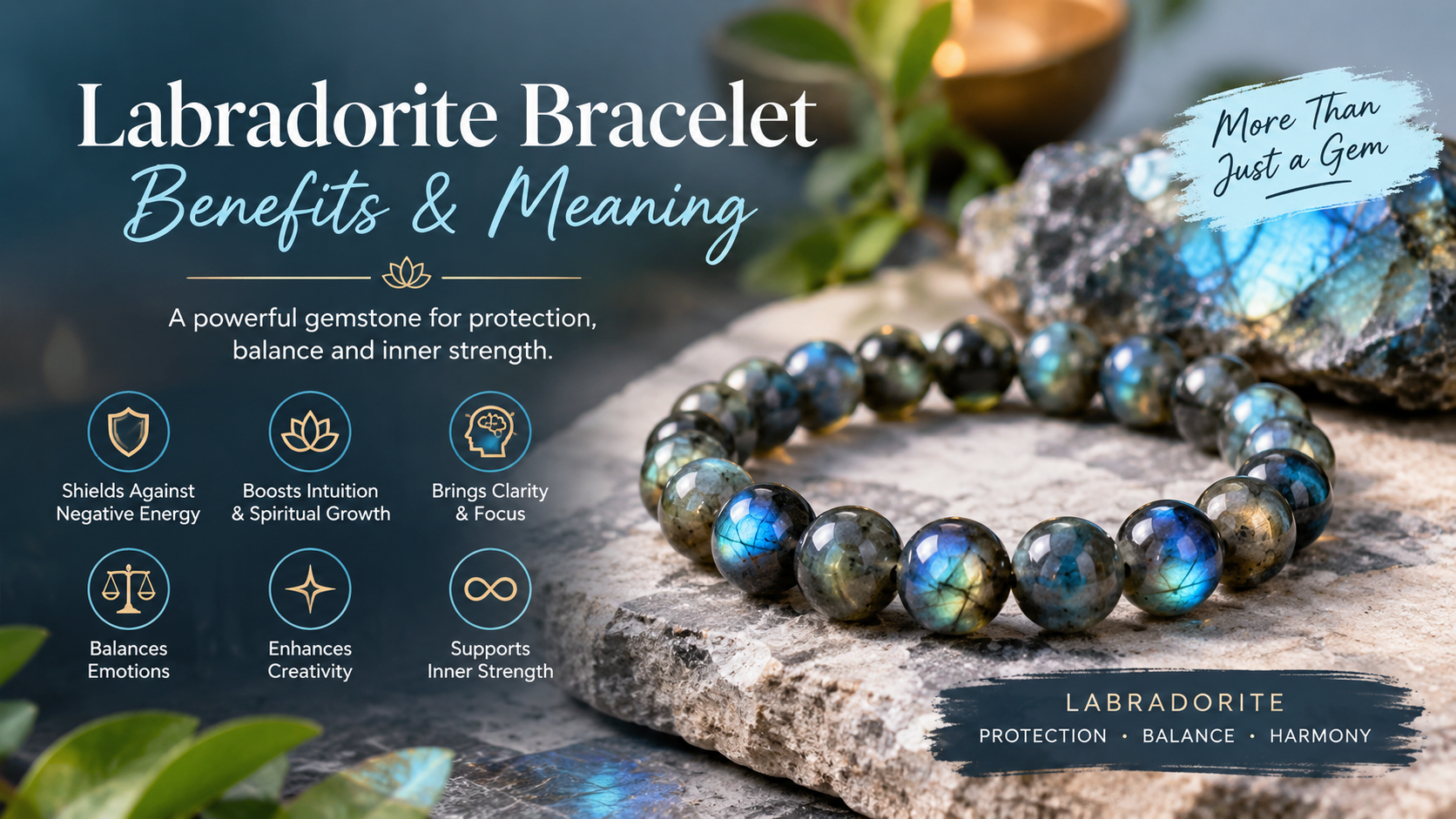
A labradorite bracelet is traditionally worn as a stone of transformation, intuition and gentle energetic protection. associated with the third eye with steadying yourself through big life changes and with trusting your own read on a situation. Labradorite is a plagioclase feldspar that rates 6–6.5 on the Mohs hardness scale which means it needs more care than quartz.
Expect to pay roughly $15–$35 for a decent commercial-grade 8mm bracelet, $40–$85 for strong blue-and-gold flash and $100+ for full-spectrum or Spectrolite-grade stone. A labradorite bracelet can look like a row of gray river pebbles. Dull. Almost disappointing. Then you turn your wrist toward a window and the whole strand ignites electric blue, peacock green, a seam of gold and then it's gone again the moment you move.
This guide covers what labradorite actually is, what people wear it for, what the flash-and-fade is telling you about quality, how much you should expect to pay in the US and how to keep a strand alive for years instead of months.
Labradorite belongs to the plagioclase feldspar family. the most common group of minerals in the Earth's crust. Chemically it sits in the middle of a continuous series between calcium-rich and sodium-rich feldspars.
It was formally identified in 1770 by Moravian missionaries on Paul Island, near Nain, on the Labrador coast of Canada. That's where the name comes from. The Inuit of the region knew it long before any European wrote it down.
The effect is called labradorescence. It's genuinely different from ordinary sparkle or surface shine. As labradorite cooled deep underground. it separated internally into alternating microscopic layers of slightly different composition. a structure geologists call Boggild intergrowth.
Those layers are stacked at a thickness comparable to the wavelength of visible light. When light enters the stone, it bounces between the layers and the reflections interfere with each other cancelling some colors and amplifying others.
That's why the color shifts and disappears as you move. You're not looking at a pigment. You're looking at an optical effect that only works when light, stone and your eye line up correctly. A real labradorite stone goes dark from the wrong angle.
This is your best authenticity test and I'll come back to it. The internal layering formed randomly. No two stones on a strand flash identically and no two bracelets are the same. Uniformity is a red flag, not a sign of quality.
The story about labradorite goes like this: the northern lights were once trapped inside the rocks along the Labrador coast. A warrior found them and struck the stone with his spear freeing most of the aurora into the sky where it still moves today.
But some of the light never escaped. It stayed locked in the rock which is why when you tilt a piece of labradorite you catch a flash of something that looks like it belongs in the sky rather than in your hand.
Labradorite is known as the stone of transformation, sometimes the "stone of magic." The symbolism is fairly easy to trace back to the physical stone itself. A dark unremarkable-looking rock that turns out to be holding a hidden spectrum is an almost too-convenient metaphor for potential that hasn't surfaced yet.
Change and transition : new jobs, moves, breakups, becoming a parent, starting over
Intuition : trusting the read you already have rather than second-guessing it
Protection of your own energy : specifically the kind that keeps you from getting drained by other people
Creative access : getting underneath the obvious answer
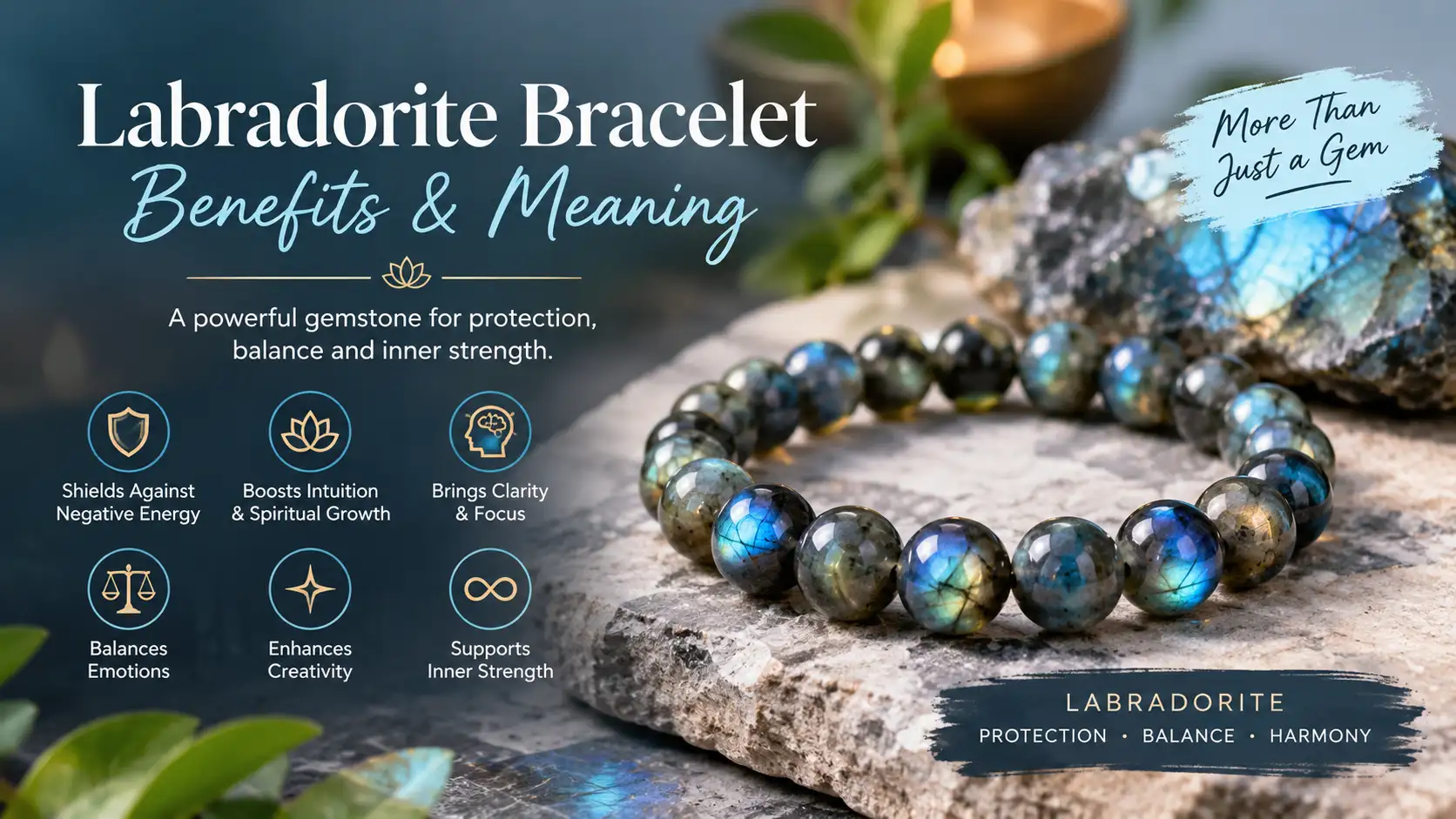
below are the benefits labradorite is traditionally associated:
It's the piece people put on when something in their life is actively in motion and hasn't landed yet. the first month of a new job, the weeks after a move, the stretch where you've decided something big but haven't told anyone.
Labradorite's third-eye association makes it the common "trust your gut" stone. People wear it to interviews, to negotiations and through decisions where the spreadsheet says one thing and their instinct says another.
protection from the particular exhaustion of being around draining people. A bracelet suits better than any type of jewelry because the situations where you need it are exactly the situations where you can't step away.
Not sedation labradorite isn't described the way amethyst is. The association is closer to reducing the looping: the same three thoughts circling at 11pm. People pair it with journaling or meditation for this reason.
Writers, designers and anyone whose job is producing ideas on demand are a large share of labradorite wearers. It helps you get past the first obvious answer to the second, stranger one.
Some traditions place labradorite at the throat chakra alongside the third eye. The associated benefit is saying the accurate thing rather than the safe thing useful for difficult conversations you've been putting off.
A bracelet is a physical object on your body that you notice several times an hour. If you put it on with a specific intention I'm going to stay steady today, I'm not going to take this personally then every time it catches the light you get a small involuntary reminder of that intention. That's a real mechanism. Habit researchers call it an environmental cue.
the left side is receptive, the right side is projective. Your left hand takes in; your right hand puts out. This shows up across several energy traditions and is the basis of nearly every "which hand" guide.
if you want to absorb its qualities of intuition, calm and insight. This is the default recommendation and fits labradorite's introspective associations.
if you want to project confidence going into a pitch, presence in a room, holding your ground in a conversation.
the single most common reason cited
whether that's open-plan offices, customer-facing work, or a specific relative
who need ideas on demand
who want a third-eye stone
aesthetically or energetically labradorite offers a protection association with far more visual interest.
On a cheap strand, maybe a third of the stone flash and the rest are dead gray. On a good strand, nearly every bead lights up.
Blue is the most common. Green and gold are common. Purple, orange and red are rare and command real premiums. A strand showing multiple colors across the spectrum is genuinely uncommon.
A darker base makes the flash pop harder. Pale, milky gray beads mute the effect even when the flash is technically present.
Look at the drill holes. Clean, centered, unchipped holes indicate careful cutting. Ragged holes mean fast production and they're also where a strand eventually fails.
Hold the bracelet under a single light source and slowly rotate it. Real labradorescence appears and disappears. A labradorite will blaze blue at one angle and go completely gray a few degrees later. Fakes dyed glass, coated resin, painted beads have color that stays put. If the shimmer is visible from every angle simultaneously, it's a surface treatment, not labradorescence.
Lay the strand flat. Real labradorite beads don't match each other. Different flash colors, different coverage, different base tones. That's the internal structure being random. If every bead flashes the same color with the same intensity in the same position, it was manufactured, not mined.
Stone conducts heat away from your skin. Pick the bracelet up cold real labradorite feels distinctly cool for several seconds before it warms. Plastic and resin feel neutral or faintly warm immediately. Glass feels cool but warms noticeably faster than stone.
Real stone has heft. If an 8mm strand feels suspiciously light for its size, suspect resin or plastic.
Under a phone camera's zoom or a cheap loupe, glass imitations often show tiny trapped air bubbles and sometimes a faint mold seam running around the bead. Natural stone shows neither. What it does show is natural inclusions, fine internal fractures and slight color variation imperfections are evidence for authenticity, not against it.
This is where coatings give themselves away. Look inside the hole: if the interior is plain gray or white while the outside is vividly iridescent, you're looking at a coated bead. On natural labradorite the material is consistent all the way through.
Products sold as aura-coated or mystic-finish labradorite have had a metallic layer vapor-deposited onto the surface. That's a legitimate product if disclosed, it's just not natural labradorescence and the coating wears off with contact.
Take it off for showers, swimming, dishwashing and hot tubs. Chlorine and prolonged soaking are the worst offenders. The bigger issue is often the elastic cord which degrades faster when it's repeatedly soaked and dried.
Put the bracelet on after lotion, sunscreen, perfume and hairspray. Take it off before you start on any of them. Alcohol and oils dull the polish over time.
This is the one that actually saves bracelets. A single sharp impact along a cleavage plane chips a stone and no amount of gentle handling afterward undoes it.
Ultrasonic vibration finds cleavage planes and exploits them. This is the fastest way to destroy a labradorite stone.
A soft, barely damp cloth, then dry immediately. Mild soap and lukewarm water occasionally if it needs more than detergents, solvents, or jewelry dips.
In a soft pouch or its own compartment. Loose in a jewelry box, harder stones will scratch it. Don't hang it stretched over a hook, which tires the cord.
Don't leave it on a car dashboard and then run it under cold water.
In crystal practice, these are two different things: cleansing clears what a stone has picked up; charging restores it.
Smoke : sage, palo santo, or incense. Safe and traditional.
Sound : a singing bowl or bell. Zero physical risk to the stone.
Selenite : rest the bracelet on a selenite plate overnight.
Brief running water : acceptable if you dry it immediately, though the cord makes this less ideal.
Moonlight is the traditional choice, especially the full moon. Labradorite's lunar and intuitive associations make this the standard recommendation.
Brief morning sun is fine if you prefer solar charging. Avoid long exposure to harsh midday sun the concern is heat and thermal stress rather than fading.
Setting an intention hold the bracelet, name what you want from it. Whatever you believe about the energetics, this is the step that makes the bracelet function as a reminder.
There's no scientific evidence. Many people's benefits are expectation effects, the ritual of setting an intention and the bracelet acting as a physical reminder throughout the day.
Left to absorb its qualities (intuition, calm, insight) right to project outward (confidence, presence). Left is the standard default for labradorite. It's also usually your non-dominant hand, which means fewer impacts and a longer-lasting bracelet.
Yes and most people do. Take it off for showering, swimming, workouts, cleaning and sleeping. That routine alone will double its lifespan.
Brief contact is fine, dry it right away. Avoid prolonged soaking, salt water, chlorine and hot tubs. The elastic cord is more vulnerable to water than the stone is.
Tilt it under a light. Real labradorescence appears and vanishes as the angle changes and every stone differs from its neighbors. Real stone feels cool for several seconds when you first pick it up and has noticeable weight. Check inside a drill hole if the interior is plain gray while the outside is iridescent, it's a coated stone.
In the US, roughly $12–$25 for budget, $30–$55 for good commercial grade, $60–$120 for high grade and $130+ for Spectrolite or collector material. Prices rise steeply with size.
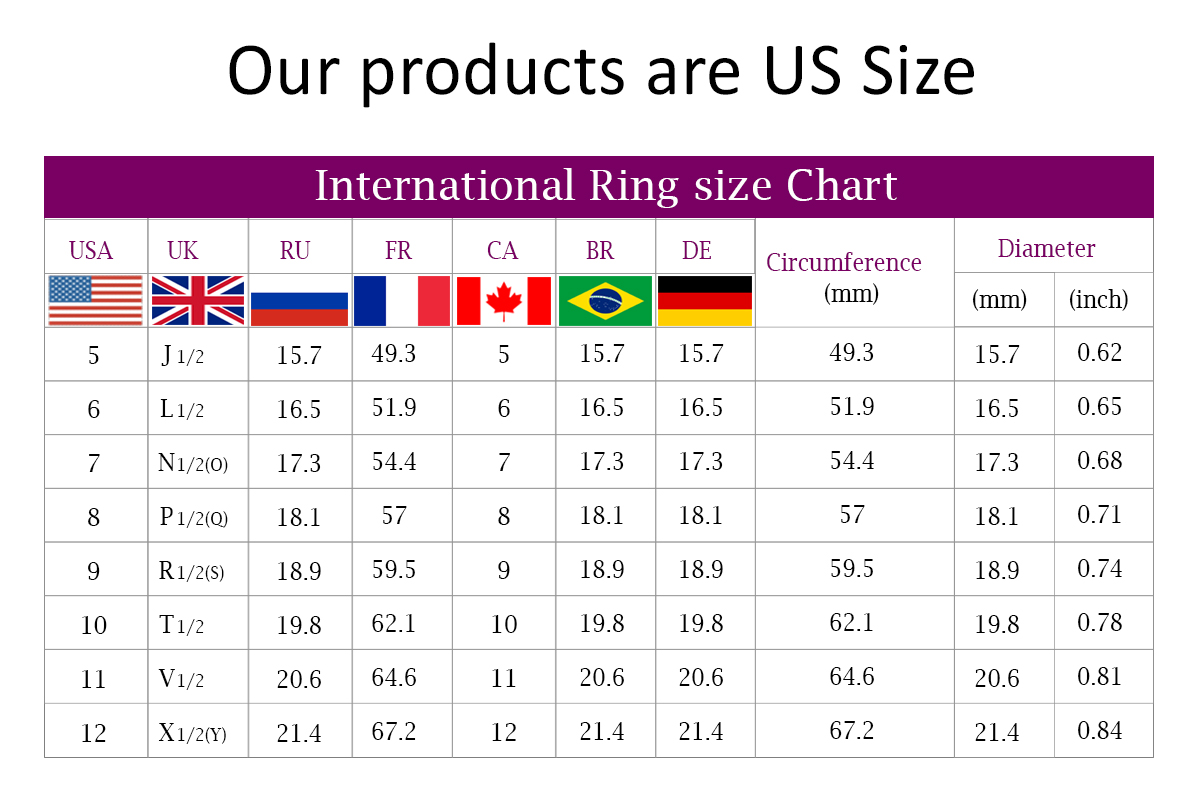
Measure your wrist with a soft tape, then add 0.5–0.75 inches. Add a full inch for a relaxed fit or for 10mm and larger.
Primarily the third eye. Some traditions also connect it to the throat (communication) and crown (spiritual connection).
Most commonly Leo, Scorpio, Sagittarius and Aquarius. In Western astrology it's associated with Uranus; in Vedic astrology, with Rahu.
Not quite. Rainbow moonstone is usually white labradorite, a close relative in the same family, but pale and translucent with a soft blue glow rather than dark with electric flash. They look entirely different in person.
Spectrolite is a trade name for exceptional labradorite from Finland with a very dark body and full-spectrum flash including rare oranges and reds. Same mineral, top-tier material, significantly higher price.
Yes. There are no gender associations attached to labradorite in any tradition and it's one of the more popular crystal bracelets among men.
Almost always a dulled surface from lotions, sunscreen, oils, or micro-scratches. Wipe it with a soft, barely damp cloth and dry it. If flash is genuinely gone, the polish is worn and a jeweler can repolish though on a low-cost strand, replacing is usually cheaper.
A labradorite bracelet is one of the few pieces that's worth owning even if you're completely unmoved by the metaphysics. The optical effect is real. Buy from a seller who shows video rather than a single perfectly-lit photo. Check the flash shifts when you tilt it. Get the fit right. Take it off before the gym. Do these things and you'll have a bracelet that still catches the light in five years.