7 Days Shipping in “Ship Now” Collection
WORLDWIDE SHIPPING EXCEPT INDIA
Minimum Order Value: $1000
25 May, 2026
Is Rubellite and Ruby the Same Thing?
Is rubellite and ruby the same? The most common mix-ups I have come across in the gemstone trade are: Both stones are red. Both names sound similar in the market. And both end up sitting in the same conversation when buyers walk in looking for "a red stone."
So, are they the same thing? Not even close. But the way some sellers throw these names around, you would think they are interchangeable. They are not.
I think you already know the basic look of both stones, which is why you are reading this. What you most probably want is the actual differences that matter when you are buying, pricing, or selling them. That's what this blog is built around.
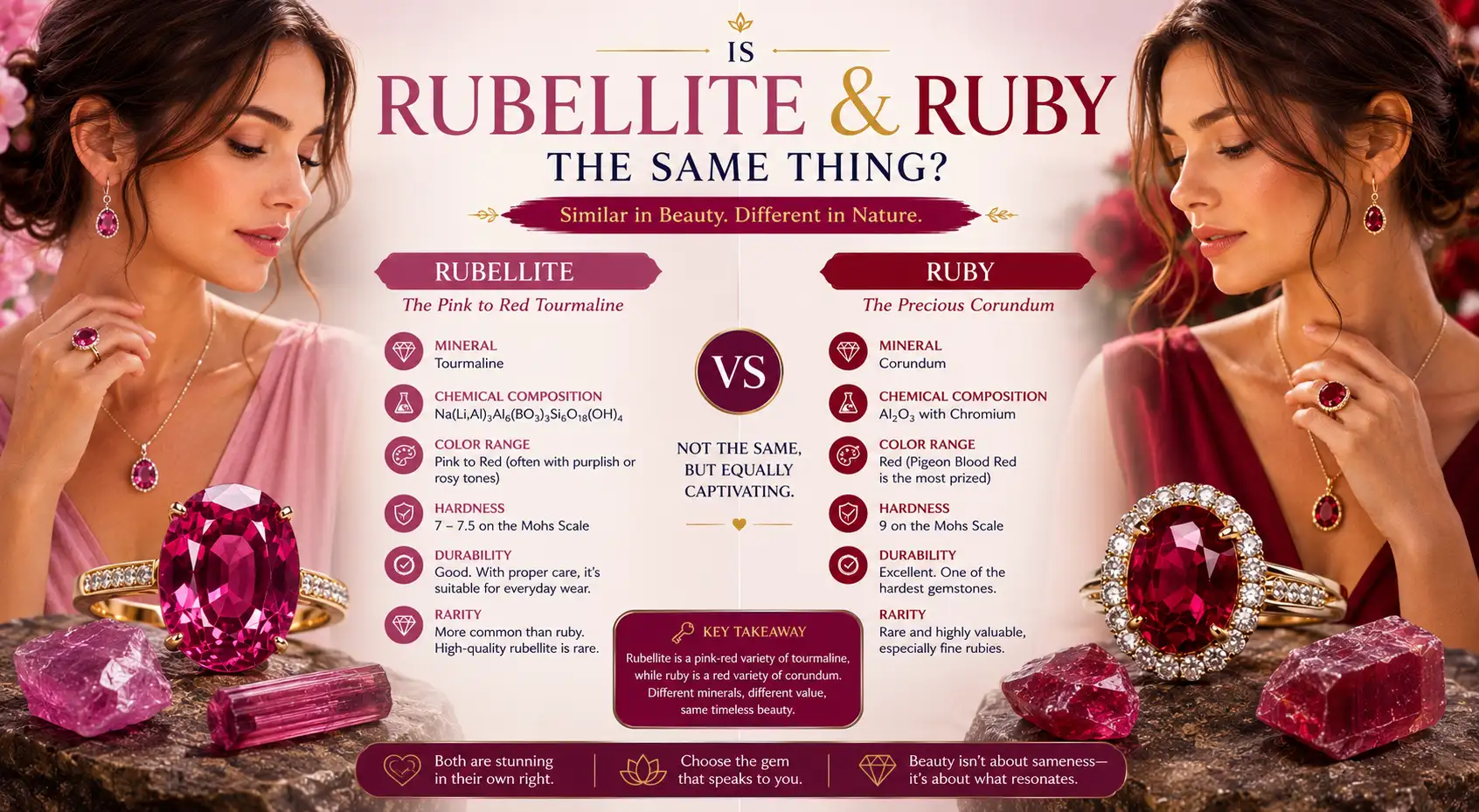
Ruby sits in the precious stone category, right next to diamond, emerald, and sapphire. It scores 9 on the Mohs scale. Rubellite is a red variety of tourmaline, a semi-precious stone scoring around 7 to 7.5. Same color family, but the similarity pretty much stops there.
At JewelPin, we have handled both stones for years, so the differences I am going to share are based on what we have actually seen in the trade, not picked up from some article online.
So, let's get into it.
Ruby is a corundum.
Rubellite is a tourmaline.
This is the simplest and quickest answer to the question of whether they are the same.
Now, what does this mean in simple words? Corundum and tourmaline are two different mineral families.
The red in ruby comes from chromium sitting inside the stone. The red in rubellite comes from manganese. So, you can say that they are two different elements doing the coloring job for each stone.
Now, if you might say that when both look red, why does their family even matter? I would say, look at it like this. Silver and platinum both look silvery-white; nobody calls them the same metal. The same logic applies here.
That's all on the family difference.
Ruby is expensive. Rubellite is not.
That's the short version of the price difference between rubellite and ruby.
Long version, a one-carat ruby with decent quality starts around $1000 per carat. Push the quality up, add a Burmese origin tag, skip the heat treatment, and you are crossing $15000 to $20000 per carat. Some auction-grade rubies have sold for over $1 million per carat. Yeah, per carat.
Rubellite of the same size, even at top quality, sits between $200 and $2000 per carat. Auction-grade rubellite tops out around $3000 per carat. That's the ceiling.
Why such a big gap?
Ruby is in the precious stone category. Rubellite is semi-precious.
Simply saying, Ruby is harder to find in good quality. While rubellite is more available. So, the price difference between them is huge.
Ruby scores 9 on the Mohs scale. On the other hand, rubellite rests between 7 and 7.5.
As you know, the Mohs scale defines the durability of the gemstone. Thus, it is the biggest difference between ruby and rubellite.
So, you can say that ruby is one of the hardest natural stones, sitting right below diamond. While rubellite is softer, not weak, just softer.
In simple words. Ruby handles daily wear without much trouble, such as rings, bracelets, and anything that takes regular hits during the day. Ruby holds up. While rubellite needs more care. A daily-wear rubellite ring picks up scratches over time. While the corners can chip if the stone hits something at a bad angle.
I might sound biased to you on this difference, but this is something that has been seen for years and remains constant.
Ruby sells itself. While rubellite needs the retailer.
If you are a jewelry retailer, then this is the difference you should have an idea of.
Now, if you might ask whyRubyy sells itself? Simply saying, the name has weight. Customers walk in already knowing ruby is precious. They expect a higher price tag. So, you can say that half the selling is already done before the conversation even starts.
Rubellite is different. Most customers go blank when they hear the name. While some ask if it's a type of ruby. Some have never heard the word.
So, the retailer has to explain what the stone is before getting to the sale.
Now, if you might ask, which retailers actually move rubellite well? Simply saying, the ones who stopped using Ruby as the reference point. They sell rubellite as its own stone. Pink-red, semi-precious, beautiful, affordable.
While the retailers who keep comparing it to Ruby in the conversation, they lose the customer to Ruby itself.
So, the rubellite sale comes down to how the retailer talks about it.
Ruby is almost always heat-treated.
Rubellite goes through different treatments, mostly heat, too.
This is the difference that catches most buyers off guard, especially the ones who assume natural means the same thing across both stones.
Now, if you might ask why Ruby is almost always heat-treated? Simply saying, an untreated ruby with good color is extremely rare. So, you can say that around 90 to 95 percent of rubies in the market have been heated to improve color and clarity. While untreated rubies, the ones with natural, strong color, sell at much higher prices. Sometimes, 5 to 10 times more than the treated ones.
Rubellite is different. Heat treatment is common, but the rules are looser.
Some rubellite is heated to lighten the tone or remove brownish patches. While some is left untreated because the natural color is already good enough.
Ruby and rubellite are not the same thing.
There are a lot of differences, such as different families, different prices, and different rules in the market. Both are red, yeah, but that's where the similarity ends. Ruby is precious, harder, costlier, and sells on its name. Rubellite is semi-precious, softer, and more affordable, and needs the retailer to do the talking.
At JewelPin, we have worked with both long enough to know each one has its own buyer. So, if anything in this blog cleared the confusion, don't sit on it. Pick the stone that fits your store. The right one always pays back.