7 Days Shipping in “Ship Now” Collection
WORLDWIDE SHIPPING EXCEPT INDIA
Minimum Order Value: $1000
17 September, 2026
If you've searched this question before you've probably noticed something frustrating. One site tells you moonstone and labradorite clash. The next site recommends that exact pair. One guide swears tiger's eye and hematite fight each other. Another calls them a perfect stack for focus.
Somebody is wrong. Possibly everybody.
So here's a different approach. This guide separates the crystal conflicts that are actually verifiable from the ones that are a matter of belief shows you where the popular lists contradict each other and gives you something to do about each pairing instead of just telling you to keep your stones apart.
Use this as a starting point not a rulebook. The rest of this guide explains why and when the exceptions apply.
I went through the most popular crystal pairing guides and here's what they disagree on:
Ametrine is a real gemstone where amethyst and citrine occur in the same crystal purple and gold zones side by side. According to the Gemological Institute of America there's essentially one commercial source on earth the Anahí mine in eastern Bolivia. Chemically amethyst and citrine are the same mineral silicon dioxide differing only in how iron atoms oxidized while the crystal formed.
these need to be handled separately because they have different solutions.
Hardness water solubility light sensitivity toxic content. These are mineralogy they're documented and they apply whether or not you believe crystals carry energy. Ignoring them will cost you money and ruin stones.
Energetic conflicts are a framework
They describe how a pairing tends to feel to people working with it and how clear your intention is. There's no measurable field for two stones to cancel. The most-cited study on crystal effects run by Dr. Christopher French at Goldsmiths University of London in 2001 gave participants either real quartz or an indistinguishable fake and found both groups reported the same sensations. His conclusion was that the effects track with placebo rather than with the stone.
The Mohs scale runs from 1 to 10. Any mineral will scratch anything softer than itself. In a shared bowl or a drawer ordinary handling does the damage.
anything under a 5 gets its own pouch or compartment. Selenite calcite malachite fluorite celestite and angelite should never ride loose in a bowl with quartz.
Some stones genuinely degrade in water and "cleanse your crystals under running water" is advice that has destroyed a lot of collections.
Keep out of water: selenite and satin spar (gypsum dissolves it will get cloudy and pitted) halite calcite celestite angelite malachite azurite pyrite (it oxidizes and can release sulfuric compounds as it degrades) lapis lazuli turquoise and hematite (it can rust and lose its shine).
Prolonged direct sun fades amethyst rose quartz citrine fluorite aquamarine celestite smoky quartz and kunzite. A windowsill charging setup will bleach a good amethyst over a season or two. Moonlight or indirect light does the same job without the damage.
Cinnabar contains mercury. Don't handle raw specimens don't tumble or carve it and wash your hands after contact.
Bumblebee jasper (not actually jasper) contains arsenic and sulfur compounds. Handle polished pieces only never raw or powdered.
Malachite contains copper. Polished and sealed is fine for handling. Raw dusty or chipped malachite is not something you want on your skin for hours or under your pillow.
Galena contains lead. Stibnite contains antimony. Realgar and orpiment contain arsenic.
Never make an elixir by putting stones directly in drinking water unless you've verified the mineral. The indirect method where the stone sits outside a sealed glass container avoids the whole problem.
Here's where the actual pairing advice lives. For each one: what the concern is and what to do instead.
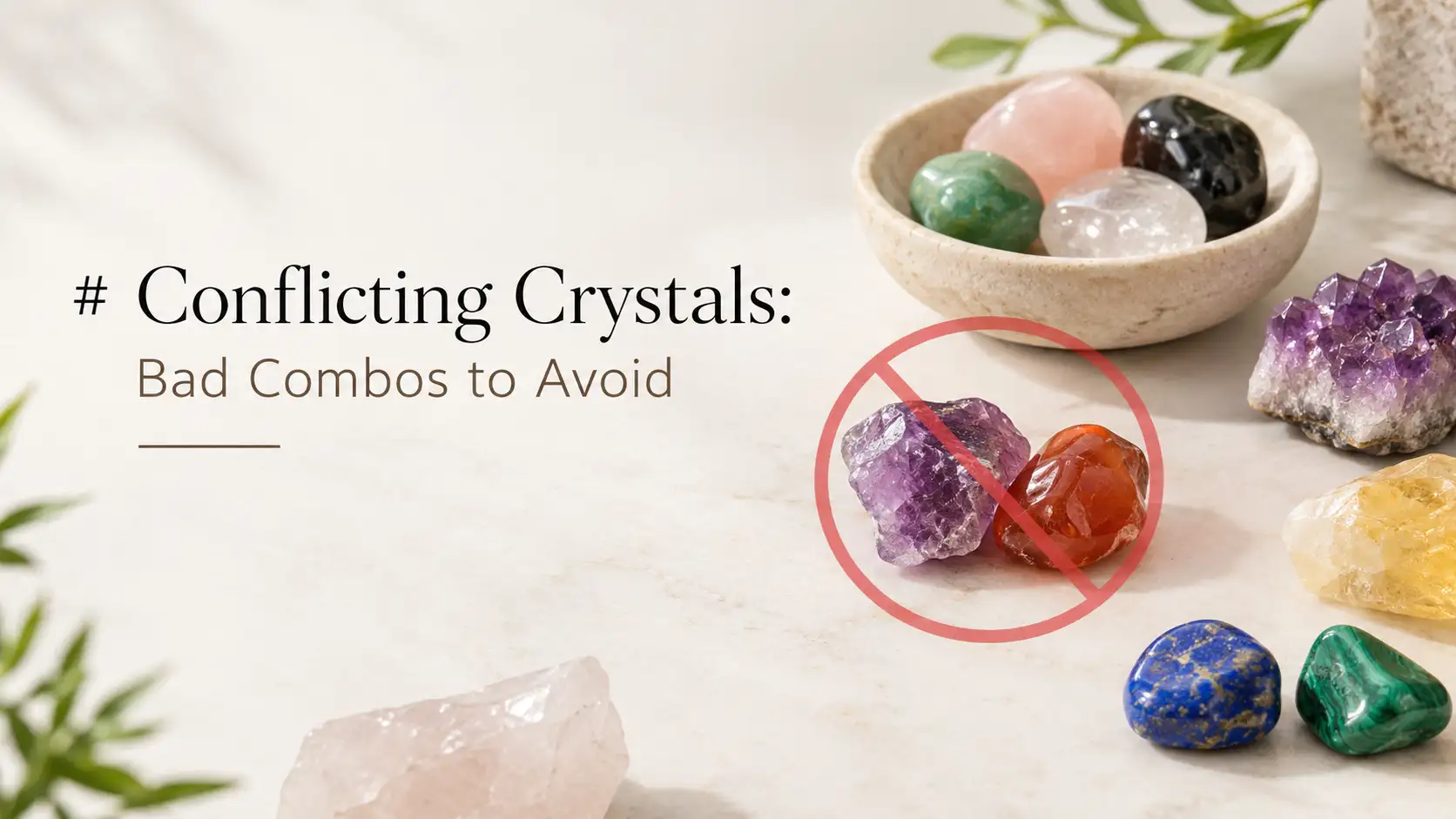
The most consistently flagged pair across every source and the logic is straightforward. Carnelian is an activator tied to the sacral chakra associated with drive and physical momentum. Amethyst is associated with stillness introspection and sleep. Asked to do both at once many people report feeling wired and sedated simultaneously which reads as restlessness.
Instead: split them by time of day. Carnelian in the morning and through work. Amethyst after dinner. Same two stones no conflict.
Same shape of conflict. Citrine points outward toward manifestation and confidence amethyst points inward. Worn together while you're trying to wind down citrine keeps the mental engine running.
Instead: day and night split again. Or if you genuinely want both qualities at once during creative work or a big life transition ametrine exists precisely for that and the pairing stops being a contradiction.
Clear quartz amplifies. Malachite is associated with digging up buried emotional material. Amplified emotional excavation is a lot and this pairing is the one beginners most often describe as making them feel destabilized or low.
Instead: if you're doing intentional emotional work with malachite anchor it with smoky quartz or hematite rather than amplifying it. Save clear quartz for when you want more of something not deeper into it.
Moldavite is already intense. People report headaches vivid dreams and emotional turbulence from moldavite alone which the community half-jokingly calls a moldavite flush. Adding an amplifier accelerates something most people would rather take slowly.
Instead: moldavite on its own in short sessions with a grounding stone nearby. Build up. This is the one where "start small" is genuinely good advice.
One boosts energy the other discharges it. Whatever the smoky quartz is working to clear the clear quartz pushes back into the room.
Instead: give them separate jobs in separate places. Smoky quartz near the door or the entry to your space. Clear quartz where you actually practice.
Root-chakra activation against throat-chakra calm. Fire and air. Blue lace agate is one of the gentlest stones in common use and red jasper tends to steamroll it.
Instead: pair blue lace agate with amethyst howlite or lepidolite if calm and clear communication is the goal. Red jasper belongs with carnelian or tiger's eye in an energy stack.
Tiger's eye is about executing in the physical world. Labradorite is about intuition and the interior. Together they pull attention in opposite directions which often reads as mental restlessness rather than clarity.
Instead: tiger's eye for the workday and anything requiring follow-through. Labradorite for meditation creative work and journaling.
This is the honestly contested one and anyone who tells you it's settled is overstating.
Rose quartz works by softening defenses. Black tourmaline works by building them. Some practitioners find that contradictory. Others deliberately combine them arguing that the tourmaline's boundary is exactly what lets the heart open safely which is a reasonable thing to want if you're an empath or you're going into an emotionally demanding situation.
Instead: decide which you're actually after. If you want pure openness drop the tourmaline. If you want protected openness keep both and notice how a week with them feels.
Bedrooms have one job. Stones that support drive focus and outward momentum work against it.
citrine carnelian tiger's eye sunstone pyrite red jasper moldavite and clear quartz. Clear quartz in particular amplifies whatever's already in the room including a racing mind.
lepidolite (it contains natural lithium which is a nice piece of trivia but isn't doing anything transdermally) howlite blue lace agate rose quartz and amethyst.
A caveat on amethyst and selenite. Both are standard sleep recommendations and both are associated with the crown and third eye which some people find mentally activating rather than settling. If you've had amethyst by your bed for months and still sleep badly try moving it. It's not a failure of the stone or of you.
clear every crystal out of your bedroom for four nights. Then bring back one. You'll learn more from that than from any list including this one.
Vedic gemstone practice has its own compatibility system and it's much stricter than Western crystal work. Stones are tied to planets and planetary antagonism determines what can be worn together.
Combinations traditionally avoided include ruby with pearl blue sapphire with ruby or red coral emerald with red coral and diamond with yellow sapphire. Cat's eye and blue sapphire are often worn alone entirely.
These rules are internally consistent within that tradition and they're prescribed based on an individual birth chart not applied universally.
Two or three with a shared purpose will do more for you than eight with mixed ones. That's the practical consensus and it holds up.
The reason has less to do with energetic overload and more to do with attention. If a stone is a reminder of an intention then six stones is six intentions which is the same as none.
If you love stacking stack by theme. All grounding or all abundance or all calm. A wrist full of contradictory reminders is the actual problem not the quantity.
Rose quartz + rhodonite for heart work one opening and one healing
Citrine + pyrite + green aventurine for abundance and confidence
Amethyst + lepidolite + howlite for anxiety and sleep
Black tourmaline + obsidian for protection both grounding no conflict
Fluorite + clear quartz for focus with hematite added if you tend to drift
Carnelian + citrine for motivation and creative output both solar
Moonstone + rose quartz for emotional softness and intuition
There's no measurable physical mechanism for it. What people are describing is real though: two stones tied to opposite intentions leave you unclear about what you're doing and unclear attention feels like static. Call it competing signals rather than cancellation.
Anything under Mohs 5 needs to be stored separately in its own pouch. Selenite calcite malachite fluorite celestite and angelite should never go loose in a bowl with quartz tourmaline or garnet. This is physical damage and it's permanent.
Yes. They occur fused naturally as ametrine. The traditional objection is about intention not chemistry. If you want both calm and drive at once the combination makes sense. If you specifically want to wind down the citrine is working against you.
It depends on your goal and the sources genuinely disagree. Protected openness yes. Pure openness drop the tourmaline.
Citrine carnelian tiger's eye sunstone pyrite red jasper moldavite and clear quartz are the usual suspects. Try removing all of them for a few nights and reintroducing one at a time.
Energetically the worst outcome is discomfort. Physically yes some stones are genuinely hazardous. Cinnabar contains mercury bumblebee jasper contains arsenic galena contains lead. Handle those carefully or not at all and never put unverified stones in drinking water.
For energetic purposes different rooms or different times of day is plenty and the specific distances you'll see quoted online are made up. For physical incompatibility distance isn't the issue at all. Separate pouches are.
Two or three sharing one intention. More than that and you're diluting your own focus.
If it's part of your practice sure. Just don't use water on selenite malachite pyrite calcite lapis turquoise or hematite. Smoke sound or a night in indirect moonlight work for everything.
Clear quartz with one caveat: it magnifies whatever it's next to. That's a benefit when you've chosen deliberately and a problem when you haven't.
There is no universal list of forbidden crystal combinations and the guides that present one contradict each other on at least seven major pairings. What actually exists is two separate things wearing the same name.
Physical incompatibility is real documented and mostly ignored. Hardness water light and toxicity will cost you stones and occasionally your health. Learn those.
Energetic incompatibility is a framework for noticing when you've asked for two contradictory things at once. It's genuinely useful for that and it stops being useful the moment it turns into a rulebook you're afraid to break.
Pick one intention. Choose stones that point the same direction. Keep the soft ones wrapped. Give it a week write down what happens and let your own experience be the tiebreaker.