7 Days Shipping in “Ship Now” Collection
WORLDWIDE SHIPPING EXCEPT INDIA
Minimum Order Value: $1000
27 November, 2026
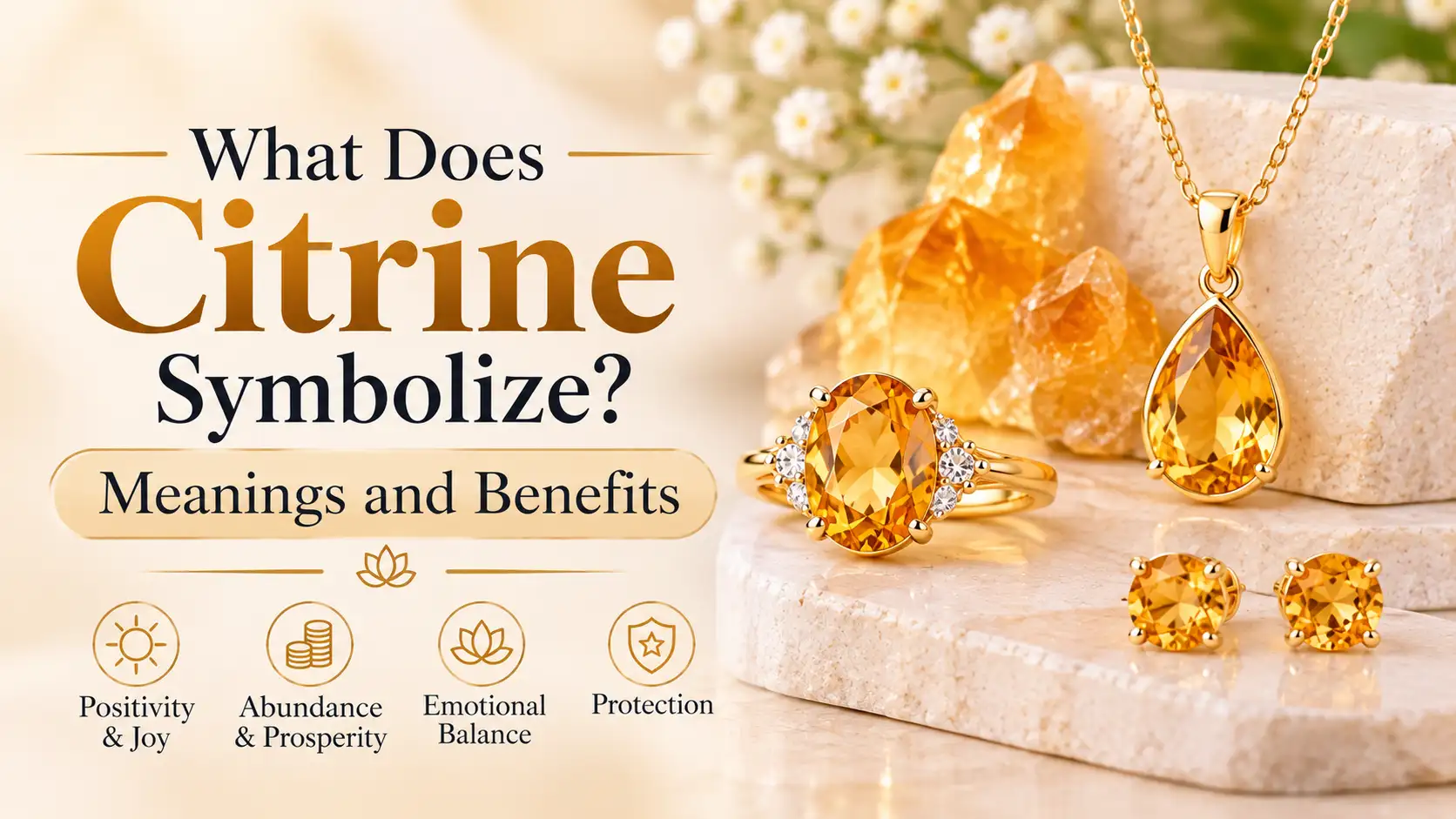
Citrine symbolizes abundance, optimism and personal power. This golden variety of quartz is nicknamed the "merchant's stone" because people have long kept it close to attract prosperity, confidence and fresh starts. It's also one of the two official birthstones for November and the traditional gift for a 13th wedding anniversary.
That's the short answer. The longer one is more interesting, and a lot more useful if you're thinking about buying a piece.
Ask ten crystal websites what citrine means and you'll get ten slightly different answers. One will pair it with four zodiac signs, the next with two completely different ones. Another will tell you to charge your citrine in direct sun, then warn you a few paragraphs later that sunlight can fade it. Some will promise it fixes your digestion.
We wanted to write the guide we'd actually hand to a friend. Below you'll find what citrine has meant to people over the centuries and where those beliefs came from. We'll be clear about which parts are tradition and which parts are gemology, and we'll cover what to look for when you're choosing citrine jewelry for yourself or someone you love.
Here's the quick-reference version before we get into the stories behind it.
At its core, citrine stands for warmth turned into action. Its color looks like late-afternoon sun through a glass of white wine, and nearly every meaning people have attached to it grows out of that color: light, energy, plenty, a good mood. Here are the meanings you'll see most often, and what they actually mean in plain English.
This is the big one. Shopkeepers and traders have long been said to keep a piece of citrine in the cash drawer or money box, which is how it picked up the nicknames "merchant's stone" and "money stone." Today you'll still find it on desks, in wallets and next to registers at small businesses.
A fair warning, though: citrine won't pay your rent. The more useful way to read this symbolism is as abundance in a wider sense, the feeling of having enough and the habit of noticing what's going well. A lot of people keep citrine as a reminder of a goal rather than a charm that's supposed to deliver it.
Citrine is tied to the solar plexus chakra, the energy center that crystal traditions link to willpower and self-esteem. That's why it's often described as a stone for speaking up, making decisions and trusting your own judgment. If you're starting a new job, pitching a business or simply trying to stop second-guessing yourself, this is the meaning people usually have in mind.
It's hard to look at a bright golden stone and feel gloomy. Citrine has been called a "sunshine stone" for that reason, and it's widely associated with cheerfulness, lightness and getting through a gray season. That makes it a popular pick for November birthdays, when the days are getting noticeably shorter across most of the U.S.
You'll often see citrine described as a stone for clear thinking and fresh ideas, which makes it a favorite with writers, artists and anyone who spends their day solving problems. Its transparency helps the metaphor. Good citrine is usually clean inside, so you look straight through to the color.
Because it's linked with light and growth, citrine is a classic gift for milestones like a new home, a new baby, a graduation or a business launch. Crystal traditions also connect it with generosity, the idea that abundance is something you share. That's a nice thought to attach to a gift.
Citrine isn't one color. GIA describes it as running from pale yellow to brownish orange, and each shade has picked up its own personality. Nobody in ancient Rome sorted citrine by shade, so treat these as modern associations, but they're a genuinely helpful way to choose.
The most valuable citrine is a saturated yellow to reddish orange with little or no brown in it. That's straight from GIA's buyer's guide, which adds that dealers also look for stones without color zoning or visible inclusions. In the trade, the deep reddish-orange end of that range is called "Madeira," and it usually sells for the highest price per carat.
Two things most guides leave out:
"Madeira" is a color, not a place. The International Gem Society notes the name describes the wine-like hue, not where the stone was mined.
That deep color usually comes from heat. Natural citrine tends to be pale yellow, often with a smoky tint. The rich oranges and Madeira reds almost always come from heating amethyst with the right iron content. That isn't a scam, and we'll explain why further down, but it does mean a pale stone isn't automatically worse and a deep one isn't automatically "more natural."
One more useful fact from GIA: larger citrines don't cost dramatically more per carat than small ones. That's unusual for a gemstone, and it's why citrine is one of the best ways to get a big, bold stone without a big bill.
Citrine's history is real, but it's messier than most websites admit. For centuries, almost any yellow gemstone was called "topaz," and citrine was sold under names like "Madeira topaz" and "Brazilian topaz." So when you read that some ancient culture treasured citrine, the honest answer is often "probably, but the records just say yellow stone." Here's what we can actually point to.
"Citrine" traces back to the French citron, meaning lemon, through the Old French citrin, meaning lemon-colored. The name describes the color, which tells you how people thought about the stone long before anyone could test what it was made of.
This part is well documented. Hellenistic and Roman engravers carved citrine into intaglios, small gems with a design cut into the surface, used in rings and as seals. A citrine intaglio of the god Dionysus from the Hellenistic period sits in the Cabinet des Médailles of the national library of France. Closer to home, the J. Paul Getty Museum in Los Angeles holds a thumbnail-sized 1st-century citrine engraved with Bonus Eventus, the Roman spirit of "good outcomes." It's a nice coincidence that one of the oldest surviving citrines shows a god of success.
The idea of citrine as a stone for traders and shopkeepers is the meaning everyone repeats, and it's the hardest to date. It shows up all over modern crystal writing, and the custom of keeping a piece in the cash box is still very much alive. Whether it started with medieval merchants or with 20th-century crystal books, nobody can say for sure. It has stuck because the color makes the connection feel obvious: it looks like gold.
Queen Victoria fell in love with the Scottish Highlands, and Scottish-style jewelry became a fashion craze across Britain in the mid-1800s. Citrine and its smoky cousin from the Cairngorm mountains were set into brooches and kilt pins, many of them shaped like the dirk, the traditional Highland dagger, often alongside polished Scottish agate. Plenty of these pieces survive and still turn up at antique dealers today.
In the 1920s and 1930s, citrine became a headline stone. Art Deco designers loved large, geometric, strongly colored gems, and big emerald-cut and cushion-cut citrines went into cocktail rings and pendants set in platinum and the newly fashionable white gold. Old Hollywood is often linked with the trend, with Greta Garbo the name that usually comes up.
Topaz was November's only birthstone on the American list from 1912. In 1952, the Jewelry Industry Council of America added citrine alongside it, at the same time alexandrite joined June and tourmaline joined October. Citrine was more affordable and easier to find than golden topaz, which made it an easy addition.
Two giants are worth knowing about:
The Malaga citrine, at 20,200 carats (close to 9 pounds), is generally described as the largest faceted citrine in the world. The rough was found in Minas Gerais, Brazil, in 1990 and cut in 2009 for the Art Natura museum in Málaga, Spain. The museum closed in 2012 amid a legal dispute, and the stone hasn't been on public view since.
The Smithsonian's smoky citrine, at 19,747 carats, is the largest faceted citrine in the National Gem Collection in Washington, D.C. It came from Bahia, Brazil, was faceted in 1987 by gem cutter Michael Gray, and joined the collection in 2013. It belongs to the same national collection as the Hope Diamond.
Spiritually, citrine is treated as a stone of personal power, manifestation and positive energy. Different traditions get there by different routes, and it's worth knowing which belief comes from where, because they don't always agree.
In chakra-based practices, citrine belongs to the solar plexus chakra, or Manipura, which sits in the upper belly between the navel and the bottom of the breastbone. Manipura is Sanskrit for "city of jewels," and this center is linked to confidence, willpower and a sense of control over your own life. Its color is yellow, which is why citrine, amber and tiger's eye are the usual matches.
Practitioners place citrine on the upper stomach during meditation or wear it close to that area as a pendant. Some also connect it with the sacral chakra (creativity) and the crown chakra (spiritual connection). If you're building a set, our guide to chakra jewelry explains how the seven centers and their stones fit together.
In modern crystal circles, citrine is one of the go-to stones for manifestation: setting an intention, especially around money, career or confidence, and holding the stone as a focus. It's also widely described as a stone that doesn't hold on to negative energy, so it supposedly never needs "cleansing" the way other crystals do. That's a belief rather than something you can measure, but it's one reason citrine is so popular with beginners.
In feng shui, citrine is one of the best-known wealth stones. It's traditionally placed in the wealth area of a home or office, usually identified as the southeast corner, and small "citrine trees" made of tumbled stones on wire branches are a common decor piece. Many business owners keep a cluster near the register or front door.
In India, citrine is known as Sunela. In Vedic astrology it's considered an upratna, a substitute stone, for yellow sapphire (Pukhraj), the gem of Jupiter. Jupiter, or Guru, governs wisdom, learning and prosperity, so citrine is worn as a more affordable way to strengthen that influence. Traditionally it's set in gold and worn on the index finger of the right hand, and astrologers recommend checking your birth chart first.
Not by name. The Bible lists precious stones in the high priest's breastplate (Exodus 28) and in the foundations of the New Jerusalem (Revelation 21:20), including stones translated as "topaz" and "chrysolite." Scholars agree those ancient names don't map neatly onto modern minerals, and some reconstructions of the breastplate use citrine for the yellow "topaz" position. For many Christians, wearing citrine is simply about appreciating a beautiful piece of creation rather than using it as a spiritual tool, and that's a perfectly good reason to love it.
A quick, honest note: these meanings come from cultural, religious and astrological traditions. There's no scientific evidence that citrine, or any gemstone, changes your finances, mood or health. That doesn't make the meaning any less real to the person wearing it. It just means the stone is a reminder, not a remedy.
The real benefits of citrine are a mix of the symbolic and the very practical. Here's how people put it to work, with the claims kept honest.
A reminder of a goal. This is the most common use and, frankly, the most effective one. A citrine ring you see every time you type, or a stone on your desk, becomes a small cue to stay focused on whatever you're working toward.
A focus for meditation or intention-setting. Holding a stone gives your hands something to do and your mind something to anchor to. The practice of pausing and reflecting is what does the work, and citrine is a pleasant companion for it.
A confidence boost you can wear. There's nothing mystical about feeling good in a piece of jewelry you love. Bright, warm colors read as cheerful, and a golden stone near the face flatters a lot of skin tones.
A meaningful gift. Because it carries ideas like success, joy and fresh starts, citrine says something specific. That's more than most gifts can manage.
A durable everyday gem. At 7 on the Mohs scale with no cleavage, citrine holds up to daily wear far better than softer stones like opal or pearl, and it costs a fraction of yellow sapphire.
You'll see websites claim citrine improves digestion, detoxes the kidneys or cures insomnia. We don't repeat those claims, because there's no evidence for them, and a stone should never stand in for seeing a doctor.
The symbolism isn't gendered. Confidence, creativity and abundance mean as much to men as to women. Citrine is simply a very popular stone in women's jewelry because of its warm color and its role as a November birthstone and a 13th anniversary gift. It also works beautifully in men's rings, cufflinks and signet styles.
From a health and safety point of view, nobody needs to avoid citrine. It's quartz, the same mineral as ordinary rock crystal, and it has no known side effects. The question usually comes from three other places:
Vedic astrology. Since citrine stands in for yellow sapphire, astrologers apply the same rules to it as to other Jupiter stones. Many traditional lists advise people with Taurus, Gemini, Virgo, Libra, Capricorn or Aquarius ascendants to avoid Jupiter gems, though the lists vary from one astrologer to the next. If you follow Vedic astrology, have your chart read before you buy.
Religious preference. Some people are comfortable wearing gemstones as jewelry but would rather not use them as spiritual tools. You can enjoy citrine purely for its looks and its history.
Hard-wearing hands. Quartz is tough, not indestructible. If you work with your hands, garden a lot or rock-climb, choose earrings or a pendant, or a ring with a protective bezel setting, and take rings off before heavy work.
If you want one answer, it's Sagittarius. It's the only sign that shows up in all three systems people use to match citrine to the zodiac. Scorpio is a close second for anyone with a November birthday.
The reason every website gives you a different list is that they're quietly using different systems:
So a crystal shop that says "Leo" and a jeweler that says "Scorpio" aren't contradicting each other. They're answering different questions. Leo's association is the easiest to understand, since Leo is ruled by the Sun and citrine is the classic sun stone.
None of this is a rule. Anyone can wear citrine, and plenty of people pick it simply because yellow makes them happy. If you'd like to see how other stones line up with your sign, our guide to gemstone jewelry for your zodiac sign covers all twelve.
Citrine shares November with topaz, and in practice it's the one most people choose. It's warmer, easier to find in rich golden shades and usually much easier on the budget. It fits the month, too. Citrine's colors match the fall leaves and Thanksgiving tables of a late-autumn November, and its meaning of abundance and gratitude lines up neatly with the season. You can see where it sits among the other months on our birthstone chart.
It's also the traditional gemstone for the 13th wedding anniversary, as listed on GIA's anniversary gemstone guide. The traditional gift for year 13 is lace, so a citrine piece wrapped in lace ribbon is a thoughtful way to nod to both. You may see citrine listed as an alternate for the 11th anniversary on some lists, but turquoise is the standard stone for that year.
For the anniversary idea, take a look at our three-stone designs, which are available in citrine along with many other gemstones. Our full range of citrine jewelry covers rings, pendants and earrings in gold and sterling silver.
Most citrine on the market started life as amethyst. GIA states it plainly: yellow quartz is rare in nature, so most citrine is made by heating lower-grade purple amethyst until it turns gold. Some is also made by heating smoky quartz.
Here's the part that gets lost in a lot of scary "fake citrine" articles. Heated citrine is real quartz. The heating, done at several hundred degrees, roughly 800 to 1,000°F, usually happens right at the mine. It's permanent, it's stable and, according to the International Gem Society, it's fully accepted in the gem trade. The only real problem is when a seller hides it or charges a "natural" premium for a heated stone.
Color. Natural citrine is usually pale: lemon, champagne or light honey, often with a smoky tint. Strong orange, reddish or brownish tones almost always point to heat treatment.
Clusters and geodes. If it's a druzy cluster or a geode half with bright orange tips fading to a chalky white base, it's heated amethyst. Natural citrine doesn't grow that way.
Even color. Natural citrine tends to have soft, fairly even color. Heated material sometimes shows patchy zones left over from the original amethyst.
Dichroism. Through a gemologist's dichroscope, natural citrine shows two slightly different shades of yellow. Heated amethyst doesn't. (Heated smoky quartz can, so it's a clue rather than proof.)
For cut stones in jewelry, you usually can't tell by eye. GIA does offer an identification report, but it's rarely worth it, because the report can cost more than the citrine. The practical move is to ask the seller directly whether the stone is heated and get the answer in writing.
Glass. Look for tiny round bubbles, swirl marks and edges that chip or scuff easily. Glass also warms up in your hand faster than quartz.
Lab-grown citrine. Quartz can be grown in a lab, and some of it becomes lab-grown citrine. It's legitimate if it's labeled; it's a problem if it isn't.
Mislabeled "topaz." Old trade names like "Madeira topaz" and "Brazilian topaz" were used for citrine for decades. A cheap "golden topaz" is very often citrine.
These three get confused all the time. Here's how they actually compare.
If you want the look of a yellow gem for everyday wear at a sensible price, citrine is hard to beat. If you want an heirloom that will survive decades of daily knocks, yellow sapphire is the upgrade.
Citrine is one of the most affordable genuine gemstones you can buy. Most faceted stones sell for roughly $5 to $50 per carat, and color is what moves the price. Here are typical ranges for loose, faceted stones, based on current market price guides:
In finished jewelry, the metal and the craftsmanship usually cost more than the stone itself. That's good news: you can choose a bigger or better-colored citrine without the total price jumping much.
Lively, saturated color. Avoid stones that look muddy or brownish unless you specifically want a smoky look.
An eye-clean stone. Most faceted citrine has no inclusions you can see without magnification, so there's no reason to settle for a cloudy one.
A good cut. Tilt the stone. If the center looks washed out or see-through, the cut is too shallow and the color will look weak once it's set.
Honest disclosure. Ask whether it's heated. A good seller will just tell you, and most citrine is.
Quality metal and a sensible setting. Look for a hallmark such as 14K or 925. For rings worn daily, a bezel or a sturdy four-prong setting protects the edges best.
If you run a boutique or an online shop, citrine is an easy stone to sell well. It's affordable, it photographs beautifully and customers come in already knowing what it means. Stock a spread of shades, from lemon to Madeira, and label heat treatment clearly, because buyers increasingly ask. JewelPin supplies citrine jewelry wholesale in gold and 925 sterling silver, and our custom order service can set citrine into your own designs.
Citrine is one of the easiest colored gems to wear, because warm yellow goes with denim, black, white, neutrals and most fall colors. A few choices make a big difference, though.
Yellow gold makes citrine look warmer and richer. It's the classic pairing, and it's especially good with golden and Madeira shades.
Rose gold softens the look and flatters deep orange stones beautifully.
White gold, platinum or sterling silver makes citrine look brighter and more lemony, with a crisper, more modern feel. Silver is also the budget-friendly way to wear a big stone.
A rough rule if you're stuck: warm skin undertones tend to love golden or Madeira citrine in yellow gold, and cool undertones often prefer lemon citrine in a white metal.
Amethyst: its quartz sibling and its opposite on the color wheel. Purple and gold together look regal.
Blue topaz, sapphire or aquamarine: yellow and blue is a classic, cheerful contrast.
Peridot: fresh and summery, great for lighter pieces.
Garnet: rich and autumnal, perfect for November.
Diamonds or white topaz: a halo of white sparkle makes the color pop.
Pearls: soft and vintage-looking, especially with pale citrine.
For everyday rings, a single-stone design in a bezel setting is hard to beat. Oval, cushion and emerald cuts are the most popular shapes for showing off citrine's color.
In everyday Western fashion, any finger works. Wear it wherever it feels comfortable and looks best. If you'd like to follow tradition, two systems happen to agree:
Palmistry links the index finger to Jupiter, ambition and leadership, which suits citrine's meaning of confidence and success.
Vedic astrology recommends wearing citrine on the index finger of the right hand, set in gold, and many people put it on for the first time on a Thursday, the day associated with Jupiter.
The ring finger is a lovely choice for a birthstone or anniversary ring, and the middle finger is perfect for a bold cocktail-style citrine that you want people to notice.
Citrine is low-maintenance. The two things that can actually hurt it are heat and hard knocks. GIA's care advice is simple: warm, soapy water is always safe, and abrupt temperature changes can fracture the stone.
Soak the piece for a few minutes in warm water with a few drops of mild dish soap.
Brush gently with a soft toothbrush, getting behind the stone where lotion and dust build up.
Rinse in clean warm water, not cold, to avoid a temperature shock.
Pat dry with a soft, lint-free cloth.
An ultrasonic cleaner is usually fine for clean, eye-clear citrine. If your stone has visible inclusions or fractures, stick to hand cleaning.
Steam cleaners, boiling water and saunas. Heat can fade heat-treated citrine, and sudden temperature swings can crack it.
Harsh chemicals. Bleach, strong household cleaners and pool chlorine can damage gold and silver settings, and some harsh chemicals can etch the stone itself. Take rings off before cleaning the house or swimming.
Weeks on a sunny windowsill. Long, strong light exposure can slowly fade some citrine. Wearing it outdoors is completely fine, but don't display it in full sun day after day. If you like to "charge" crystals, an hour of early-morning sun or a night under the full moon is plenty.
Tossing it in with other jewelry. Diamonds and sapphires will scratch citrine, and citrine will scratch softer gems like opal and pearl. Store each piece in a soft pouch or its own compartment.
In crystal traditions, a cracked or broken citrine is often read as a sign that a cycle has ended, or that the stone has done its job and absorbed what it needed to. Some people keep the pieces, and others return them to the earth by burying them in the garden.
The practical explanation is usually simpler: a sharp knock on an exposed edge, an internal fracture that was already there, or a sudden temperature change. If a stone in your jewelry chips or cracks, have a jeweler check the prongs before anything else falls out. Because citrine is so affordable, replacing the stone is usually quick and inexpensive, and a small chip can sometimes be polished out by a gem cutter.
Spiritually, citrine symbolizes personal power, manifestation and positive energy. It's linked to the solar plexus chakra, the center of confidence and willpower, and it's often used when setting intentions around career, money or self-belief. In Vedic astrology it's connected to Jupiter and wisdom.
Not in any way science can measure. Citrine's reputation as the "money stone" comes from tradition, especially the custom of keeping it in a cash drawer. Many people find it works well as a visible reminder of a financial goal, which can help them stay focused on it.
In many traditions, yes. It's considered a stone of good fortune, success and prosperity, and in feng shui it's one of the most popular stones for a home or office's wealth corner. That makes it a popular good-luck gift for new jobs and new businesses.
No. Citrine is one of the most affordable genuine gemstones, with most faceted stones selling for about $5 to $50 per carat. Deep Madeira-colored stones cost more, but even fine citrine is a small fraction of the price of yellow sapphire.
Sagittarius is the strongest match, because it appears in birthstone, crystal and Vedic traditions alike. Scorpio also qualifies through November birthdays, and modern crystal guides often add Leo, Aries and Gemini. Anyone can wear it.
Brazil is by far the biggest source, both of natural citrine and of the amethyst that gets heated into citrine. Other sources include Bolivia, Madagascar, Zambia, Russia, Spain and the United States, where citrine has been found in Colorado and North Carolina.
No. Heat-treated citrine is genuine quartz whose color was changed by heating amethyst or smoky quartz. The treatment is permanent and widely accepted. A citrine is only "fake" if it's glass, or if a lab-grown or heated stone is sold as something it isn't.
Yes. With a hardness of 7 and no cleavage, citrine is durable enough for daily rings, earrings and pendants. Just take it off for heavy work, keep it away from high heat and clean it with warm soapy water.
In crystal traditions, citrine is often called self-cleansing, so many people never cleanse it at all. If you do like to charge it, keep sun exposure short, since long periods in strong light can fade some stones. Moonlight is a gentler option.
Yes. Citrine is quartz, so water won't harm it, and warm soapy water is the recommended way to clean it. Avoid very hot water, boiling and sudden temperature changes.
They're the same mineral, quartz, in different colors. Amethyst is purple and citrine is yellow to orange, and most citrine on the market is actually heated amethyst. When both colors occur naturally in one crystal, the stone is called ametrine.
Citrine has meant roughly the same thing for as long as people have been wearing it: warmth, plenty and the confidence to go after what you want. Roman gem cutters engraved it with a god of good outcomes, Victorian Scots pinned it to their kilts, and today it sits on desks and cash registers from Seattle to Miami. You don't have to believe a stone can change your luck to appreciate what it stands for. Sometimes a little gold-colored reminder on your hand is exactly the nudge you need.
If you're shopping, buy the shade that makes you smile, ask whether it's been heated, and keep it away from steam and boiling water. That's really all there is to it. When you're ready, browse our citrine jewelry collection or explore our gold gemstone rings.