7 Days Shipping in “Ship Now” Collection
WORLDWIDE SHIPPING EXCEPT INDIA
Minimum Order Value: $1000
27 November, 2026
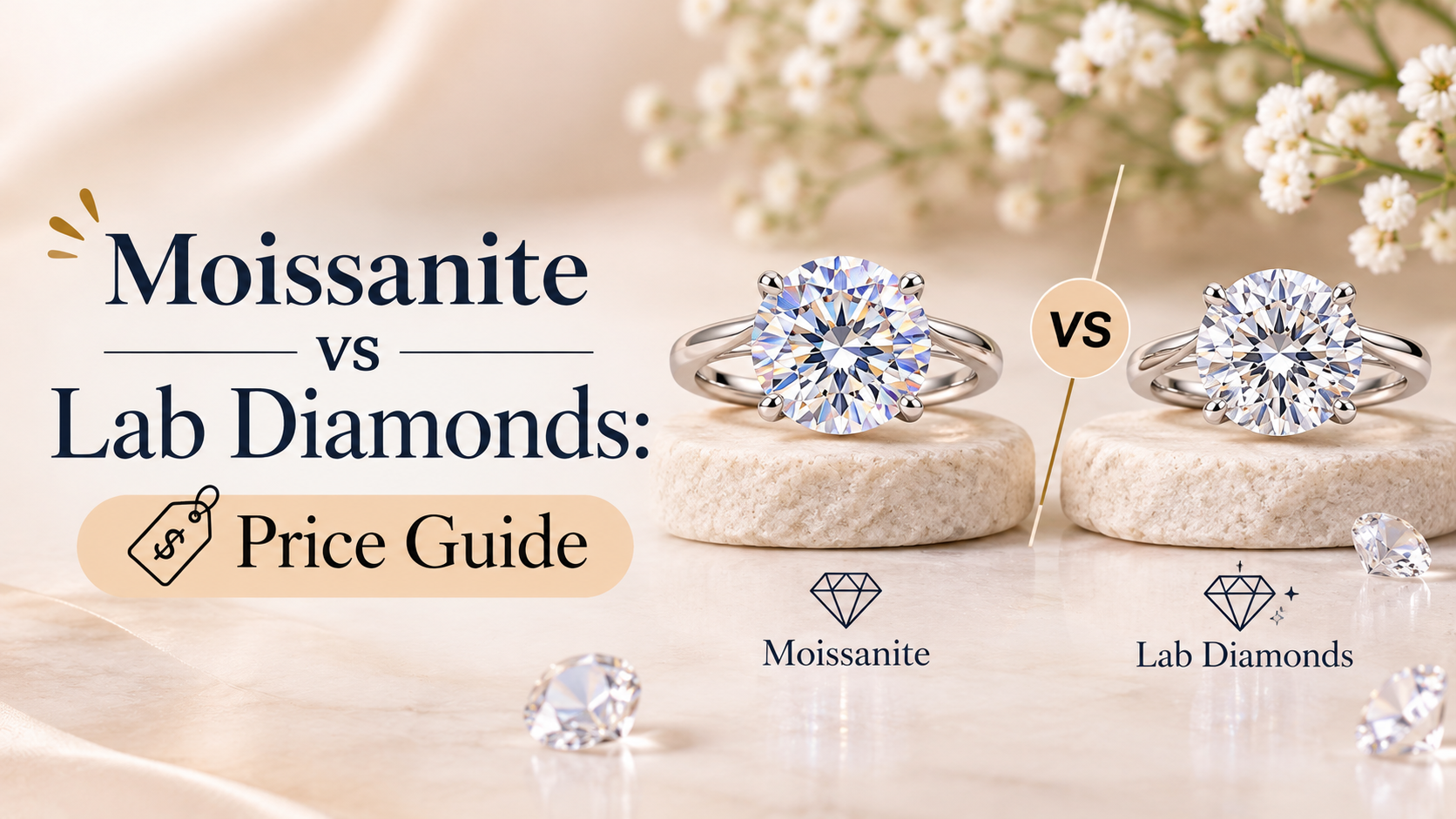
If the moissanite vs lab diamond price guide you read last year said moissanite costs 70 to 90 percent less, it's out of date. In late 2026 it only holds if you're comparing unbranded marketplace moissanite, or shopping at a jeweler that still charges traditional markups on lab diamonds.
Lab diamond prices fell another 27 percent in the twelve months to October 2026. Online, a 1-carat lab diamond now averages about $503, a 2-carat about $1,020 and a 3-carat about $1,562 (StoneAlgo index, via Clairamor). A good colorless moissanite runs $300 to $600 at 1 carat, $600 to $1,200 at 2 carats and $1,200 to $2,500 at 3 carats (Barkev's).
Look at those ranges side by side. They overlap at every size.
Here's what that means when you actually shop:
Unbranded marketplace moissanite is still far cheaper. Loose stones are listed for as little as $25.
Premium moissanite and lab diamonds bought online now cost about the same from 1 to 3 carats. You're choosing on looks, not price.
Lab diamonds at traditional jewelers can carry big markups, which is why you still see the old "70 to 90 percent cheaper" line quoted.
Below are the real 2027 numbers by carat and by millimeter size, the reasons every site quotes something different, what each budget buys as a finished ring, and the mistakes that cost buyers the most money.
From half a carat to five carats, the average lab diamond sold online now lands inside the price range of a premium moissanite. These are loose-stone prices for round stones, checked against sources published in September and October 2026.
Moissanite ranges: Barkev's 2026 moissanite price guide (the 0.5 ct figure covers all stones under 1 carat). Lab diamond averages: StoneAlgo's index on October 18, 2026. Cheapest graded stones: Clairamor's live inventory on October 19, 2026, IGI, GIA or HRD reports. Both lab figures are from Clairamor's 2026 price report.
Three things jump out.
First, at 1 carat the average lab diamond (503)costslessthanthetopofthepremiummoissaniterange(600). Ten years ago that would have sounded like a typo.
Second, lab diamonds no longer get expensive as they get bigger. The cheapest graded rounds in that inventory ran about $640 a carat at 1 carat and about $541 a carat at 5 carats. Moissanite prices also rise roughly in line with size, so neither stone punishes you for going big anymore.
Third, moissanite itself got cheaper. When Charles & Colvard launched its colorless Forever One line about a decade ago, an 8 mm round (sold as 2 carats) cost $1,349 loose. Today the premium 2-carat range starts at about half that.
One stone doesn't fit this table: unbranded marketplace moissanite. Sellers list loose D-color, VVS1 stones with a GRA card for as little as $25, and the material is usually genuine moissanite. What you give up is cut precision, color consistency and anyone standing behind the stone.
For context, a natural 1-carat diamond averaged $3,841 on the same index, so both options are still a fraction of mined-diamond prices.
Search this topic and you'll find 1-carat lab diamonds quoted anywhere from $500 to $3,000, and 1-carat moissanite from $50 to $800. Five things explain almost all of that spread.
1. Which moissanite. A $25 marketplace stone and a $500 premium stone are the same material. The difference is how precisely it was cut, how consistent the color is, how much quality control happened before it shipped, and who will replace it if something goes wrong.
2. Which lab diamond seller. Markups on lab diamonds are enormous. In the third quarter of 2026, IGI-graded 1 to 3 carat rounds traded between dealers for $73 to $142 per carat. A top-grade 1-carat D VVS went for about $87 per carat. The same high-grade stones sell at retail for $800 to $900 per carat, roughly ten times wholesale (Edahn Golan Diamond Research data, via Draco Diamond). Price-focused online sellers often come in below that band, and the October 2026 online average for a 1-carat was about $503. Some jewelers still list a 3-carat lab diamond at $5,000 or more.
3. Loose stone or finished ring. Many guides mix the two without saying so. The setting is now a big share of the bill. At one online jeweler, a plain 14k gold solitaire setting starts at $950, which is 60 percent of the price of its cheapest 1-carat lab diamond ring. Gold traded near $4,400 an ounce in September 2026, which puts 14k gold at about $83 a gram. A simple solitaire holds 2 to 3 grams, so the gold alone is worth $165 to $250 before anyone casts, polishes or sets it.
4. Carats that aren't really carats. Moissanite is usually sold by "diamond equivalent weight," not its true weight. Two sellers can describe the same 9 mm stone as 2.75 carats or 3 carats. More on this in the next section.
5. Old data. Lab diamond prices dropped 27 percent in the year to October 2026 alone. A guide written in 2024 or early 2025 can be off by hundreds of dollars per stone, and several pages that rank for this search still quote $800 to $3,000 for a 1-carat lab diamond.
Moissanite is lighter than diamond, so a fair price comparison has to be done by face-up size in millimeters. Carat labels on moissanite describe how big the stone looks, not what it weighs.
The reason is density. Moissanite has a specific gravity of 3.22 against diamond's 3.52, about 9 percent less. A 6.5 mm round moissanite actually weighs about 0.88 carats, but it's sold as "1 carat DEW" (diamond equivalent weight) because a 6.5 mm round diamond weighs 1 carat.
The catch is that DEW isn't standardized. Barkev's lists a 9 mm round moissanite as 3 carats. Charles & Colvard has sold the same 9 mm size as 2.75 carats. Meanwhile, a real 3-carat lab diamond round in Clairamor's inventory measured 9.33 mm across.
At 1 and 2 carats the sizes match closely. At 3 carats, a "3-carat" moissanite can be about a third of a millimeter narrower than a 3-carat lab diamond. That's small on the hand, but if you're paying for size, you should know it.
It also scrambles price-per-carat math. If one seller divides by DEW and another by actual weight, the same stone can look about 14 percent more expensive per carat at the second shop. The fix is simple: filter and compare by millimeters, and ask for the measurement if a listing doesn't show it.
Moissanite still saves real money in three situations. In the comparison most people make online, it saves almost nothing.
Moissanite is much cheaper when:
You're fine with an unbranded stone. A marketplace moissanite can cost a small fraction of an online lab diamond of the same size. Expect more variation in cut and color, and inspect it in daylight the day it arrives.
You're buying from a full-markup jeweler. If the lab diamond in the case is priced at traditional retail, moissanite will still come in far lower.
Your whole ring budget is under about $1,000. Mass-market solid 14k gold moissanite solitaires start around $435 with a 1-carat-look center and around $700 with a 2-carat look (Barkev's). The cheapest 1-carat lab diamond solitaire in Clairamor's October 2026 inventory was $1,590.
It's about the same price when:
You compare a premium, branded moissanite with an IGI- or GIA-graded lab diamond from a price-competitive online seller, anywhere from 1 to 3 carats. The gap is usually a couple of hundred dollars either way, and sometimes the diamond wins.
Small accent stones barely matter. Lower-grade lab diamonds retail for roughly $200 to $250 per carat, so a band with a quarter carat of small stones carries about $50 to $65 of actual diamond. The bigger cost in a pavé or halo design is the hours of setting work, and that's the same whichever stone you pick.
When the prices are this close, the decision comes down to how each stone looks and wears. Here's where they genuinely differ.
Sparkle. Moissanite throws noticeably more rainbow color. That comes from dispersion, not refractive index, which is a mix-up you'll see on a lot of sites. The effect gets more obvious from about 1 carat up and in bright sunlight. Some people love it. Others find it reads as "too much" next to a diamond's whiter, crisper flash. If you want moissanite but a calmer look, step cuts like emerald and asscher show broad flashes instead of confetti.
Color. Current premium moissanite is sold as colorless (DEF). Older or discounted stock can show a faint yellow or green tint, mostly in bigger stones and step cuts, so color is the one moissanite grade worth paying up for. With lab diamonds, color is almost free right now: in October 2026, moving a 2-carat round from G to D color cost only $207 in Clairamor's inventory.
Toughness. Diamond is harder, so it resists scratches better. But hardness and toughness aren't the same thing. Diamond has cleavage planes and can chip if it takes a sharp knock at the wrong angle. Moissanite is generally considered tougher in that respect. Both hold up fine to daily wear for decades.
Can people tell? Across a dinner table, most can't. A jeweler with a loupe can, because moissanite is doubly refractive and the facet edges look doubled. A basic thermal "diamond tester" pen often reads moissanite as diamond; testers that also check electrical conductivity separate the two.
A lab diamond can come with an independent grading report you can verify online. Moissanite usually comes with a seller's card and a warranty, and those are different things.
Lab diamonds: IGI still grades the 4Cs, GIA no longer does. IGI reports list color, clarity and cut grades the same way natural diamond reports do. Since October 1, 2025, GIA has issued a different document for lab diamonds, a Laboratory-Grown Diamond Quality Assessment, which sorts each stone into just two tiers (GIA):
Premium: D color, VVS clarity or better, excellent polish and symmetry, and an excellent cut grade for rounds.
Standard: at least VS clarity, E to J color, and very good polish, symmetry and cut.
Stones below Standard get no GIA assessment at all. Every assessed stone is laser-inscribed with "Laboratory-Grown" and its number. One practical point: "Standard" covers everything from E to J color, so if exact color matters to you, ask for the IGI grades or look at the stone yourself.
Moissanite: a GRA card is a spec sheet, not proof of quality. GIA doesn't grade moissanite. Most stones ship with a GRA report that confirms it's moissanite and lists its color, clarity and size. Those cards come with stones at nearly every price, including $30 rings, so they don't explain why one stone costs $50 and another $500. IGI does grade some moissanite, which is a stronger document if you can get it.
A warranty is only as good as the company behind it. Charles & Colvard, the brand that brought moissanite to market and sells the Forever One line, filed for Chapter 11 bankruptcy in March 2026, citing falling lab diamond and moissanite prices. In July 2026 it was acquired by AJS. Whoever you buy from, ask in writing what a "lifetime warranty" covers and who will honor it.
Moissanite has essentially no resale market, and lab diamonds lose value fast because new ones keep getting cheaper. Buy either one to wear, not to sell.
Moissanite. There's no meaningful secondary market for the stone. When a moissanite ring is sold, pawn shops and buyers typically pay for the gold and little else.
Lab diamonds. Some sites still claim lab diamonds hold value "like natural diamonds." They don't. Retail prices fell 27 percent in the year to October 2026, and a dealer making you an offer is comparing your stone with what they can buy wholesale, which in the third quarter of 2026 was $73 to $142 per carat for 1 to 3 carat rounds. That's the realistic ceiling on what a used stone fetches.
There is one new wrinkle. Wholesale lab diamond prices rose about 2 percent in the third quarter of 2026, the first rise after years of declines (Edahn Golan data, via Draco Diamond). It may be a floor forming. Nobody knows yet, so don't buy expecting prices to recover.
The metal is the part that holds value. A solid 14k gold setting keeps its melt value, about $83 a gram in September 2026. A ring described as "14K gold finish," "FN" or "gold tone" is plated, and the plating is worth nothing at resale.
Whatever you buy, get it appraised and insured for replacement value. Your insurer cares about what it would cost to replace the ring, not what a pawn shop would pay.
Below about $1,000, moissanite is the easiest way to get a 1-carat look in solid gold. Above about $2,000, a 2-carat lab diamond solitaire costs about what a handcrafted 2-carat moissanite ring does. Here's what real 2026 retail prices get you, setting included.
Moissanite ring prices: Barkev's, September 2026. Lab diamond ring prices: Clairamor, October 19, 2026, 14k gold. Your local prices will differ, but the pattern holds.
For reference, The Knot's 2026 Real Weddings Study, which surveyed more than 10,000 US couples married in 2025, found that 61 percent of engagement rings had a lab-grown center stone, up 239 percent since 2020. Couples spent an average of $4,300 on a lab-grown ring and got a center stone of about 2 carats. Moissanite was the second most popular non-diamond center stone, behind sapphire (JCK).
At today's prices, that average lab budget buys a 3-carat stone or bigger. So once you're spending in that range, moissanite's advantage isn't really price anymore. It's the fire, or the option of a very large stone with money left over for a more elaborate setting.
Choose moissanite if you love its fire or your total budget is tight. Choose a lab diamond if you want a diamond and can spend roughly $1,600 or more on the finished ring.
Moissanite makes more sense if:
You want the most sparkle and color play you can get.
Your whole ring budget is under about $1,000.
You want a very large stone (4 or 5 carats) and would rather put money into the setting.
It doesn't matter to you that the stone isn't a diamond.
A lab diamond makes more sense if:
You want a diamond, full stop.
You prefer a whiter, crisper sparkle.
You want an independent IGI or GIA document you can verify.
Your budget is around $1,600 or more for a 1-carat ring, or $2,100 or more for a 2-carat.
Before you pay, check these seven things:
Compare by millimeters. Put the mm size side by side, not the carat label.
Get two prices. Ask for the loose stone and the setting separately, so you know where your money goes.
Read the metal line. "Solid 14k gold" is gold. "14K gold finish," "FN," "gold tone" or "gold plated" means a thin layer over silver or base metal.
Verify the report. For a lab diamond, look up the IGI or GIA number on the lab's website and match it to the girdle inscription.
Treat a GRA card as a spec sheet. For moissanite, ask for DEF color and find out who cut and stands behind the stone.
Get the warranty in writing. Ask exactly what it covers and which company will honor it.
Don't pay for grades you can't see. In October 2026, an internally flawless 2-carat lab round cost $2,228 against $1,138 for a VS2 with the same look to the naked eye. Spend that difference on size or the setting instead.
Sometimes, but by much less than it used to be. Unbranded moissanite is still far cheaper. A premium colorless moissanite and a lab diamond bought from a price-competitive online seller now cost about the same from 1 to 3 carats, roughly $300 to $600 versus about $500 at 1 carat.
New, a quality colorless 1-carat (6.5 mm) moissanite costs about $300 to $600 as a loose stone, and unbranded stones are listed for as little as $25. Secondhand, the stone itself is worth very little. A used moissanite ring is usually valued for its gold.
They cost about the same new at most sizes, and neither holds its value well. What a lab diamond gives you that moissanite doesn't is that it is a diamond, and it can come with an independent IGI or GIA report.
Its strong rainbow fire looks different from a diamond, especially in larger stones and sunlight, and some people don't like it. Older or cheap stones can show a yellow or green tint. A jeweler can identify it with a loupe, and it has almost no resale value.
Some do. People buy moissanite as a travel ring, as a stand-in for a valuable piece kept in a safe, or simply because they'd rather spend the money elsewhere. There's no reliable data on who wears what, so be skeptical of celebrity lists online.
Yes. Under a loupe, moissanite's facet edges look doubled because it's doubly refractive. A basic thermal tester can read moissanite as diamond, but testers that also measure electrical conductivity tell them apart.
Nobody knows. Retail prices fell 27 percent in the year to October 2026, but wholesale prices rose about 2 percent in the third quarter, the first increase after years of declines. If you find the right stone now, waiting for a small drop rarely makes sense.
No. Both are made in a lab, but moissanite is silicon carbide and a lab diamond is carbon with the same structure as a mined diamond. They're different gemstones.
For years the pitch for moissanite was simple: the same size for a fraction of the price. In 2026 that's only half true. If you're comparing a premium moissanite with a lab diamond bought online, price has stopped being the deciding factor.
So look at both in daylight before you decide. If the rainbow fire makes you smile, buy moissanite and put whatever you save into a well-made solid gold setting. If you keep drifting back to the whiter flash, the old price argument against a lab diamond is mostly gone.