7 Days Shipping in “Ship Now” Collection
WORLDWIDE SHIPPING EXCEPT INDIA
Minimum Order Value: $1000
28 September, 2026
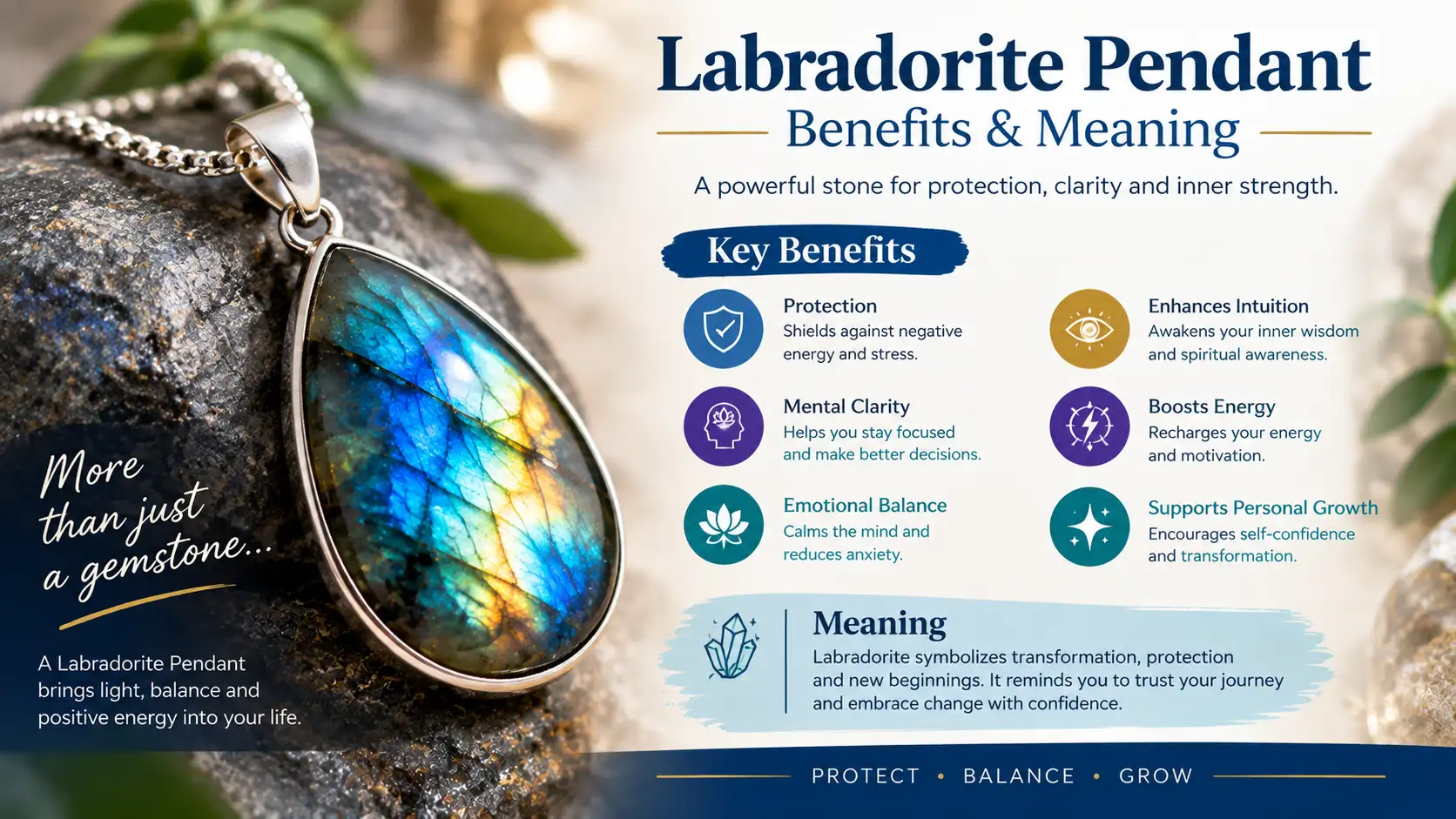
A labradorite pendant is worn as a protective talisman and a symbol of transformation. People choose it for energetic protection sharper intuition calmer thinking during big life changes and clearer self-expression. It sits over the throat and heart which is why it's traditionally linked to the Throat Third Eye and Crown chakras. Labradorite is a plagioclase feldspar 6–6.5 on the Mohs scale and it needs gentler care than most people realize.
Labradorite is a gray rock until it isn't. Turn it a few degrees under a lamp and the whole surface ignites electric blue seafoam green a streak of gold that wasn't there a second ago. Then you shift your hand and it goes flat again. That vanishing act is the entire appeal and it's the reason this stone ended up as one of the most-worn pendants in the gemstone world.
If you're here because you're thinking about buying one or you already own one and want to know what it's supposed to do this guide covers all of it the meaning the benefits people wear it for the real geology behind the flash how to tell a genuine stone from a dyed or glass fake and how to clean it without wrecking it.
Labradorite is a mineral in the plagioclase feldspar family made mostly of sodium and calcium aluminum silicate. On its own it's usually a dull gray smoky blue-gray or near-black stone. Nothing about the raw material suggests fireworks.
The fireworks come from something called labradorescence and it's a genuinely different optical effect from ordinary iridescence or a simple shine. As labradorite cooled deep in the earth it separated into microscopically thin alternating layers called lamellae stacked like pages in a closed book.
When light enters the stone it bounces between those layers and the reflected waves interfere with each other. Some wavelengths cancel out. Others reinforce and come blazing back at you as color. Because those internal layers all sit at roughly the same angle the flash only appears when the light the stone and your eye line up correctly.
That's why labradorite looks dead from one angle and spectacular from another. It isn't surface color. It's structural color generated inside the stone the same physical principle that makes a soap bubble or a peacock feather shift hue as you move. A few specs worth knowing before you buy:
Hardness: 6–6.5 Mohs. Softer than quartz softer than sapphire softer than the sand and dust that settle on everything.
Cleavage: Perfect in two directions. This is the important one. Labradorite has natural internal planes where it prefers to split. A sharp knock at the wrong angle can chip or fracture it in a clean line.
Transparency: Opaque to translucent.
Cut: Almost always a cabochon a smooth domed unfaceted top. Faceting would break up the light path and kill the flash. If you see a heavily faceted "labradorite" pendant with rainbow sparkle be suspicious.
Where it comes from: Finland Madagascar Canada Russia Mexico Norway India Ukraine and parts of the United States.
Across modern gemstone practice labradorite carries one dominant meaning: transformation. It's the stone people reach for when something in their life is mid-change and the outcome isn't visible yet a career switch a move a divorce a diagnosis a decision they've been circling for months.
The symbolism is almost embarrassingly literal. A stone that looks ordinary holds hidden light and only reveals it when the angle changes. Of course it became the stone of transformation. Three other meanings come up constantly:
Labradorite is considered a shielding stone something that sits between you and whatever you're absorbing from the people and environments around you. It's especially popular with empaths and anyone who finishes a day of meetings feeling wrung out for no clear reason.
It's associated with perception beyond the obvious with trusting the read you already have on a situation instead of overriding it with logic.
Older gemstone literature calls labradorite the magician's stone and describes it as a bridge between the seen and unseen.
an Inuit warrior found the Northern Lights frozen inside the rocks along the Labrador coast struck them with his spear and released most of the light back into the sky leaving the rest trapped in the stone.
labradorite was formally described by Europeans in 1770 when Moravian missionaries encountered it on the Labrador Peninsula in what's now Newfoundland and Labrador Canada. The stone takes its name from that region. Indigenous peoples of the area knew the material long before that date.
Most gemstone guides treat rings bracelets and pendants as interchangeable. They aren't and there are practical reasons a pendant is the better format for this particular stone.
A pendant hangs over the upper chest and throat. In chakra tradition that puts labradorite directly over the Throat chakra (communication honest expression) and near the Heart chakra. Since labradorite's most commonly cited associations are the Throat and Third Eye a pendant sits closer to its traditional zone than a ring or anklet does.
This is the underrated one. Labradorite is 6–6.5 Mohs with perfect cleavage. A ring takes constant impact doorframes steering wheels keyboards countertops. Labradorite rings chip. A lot. A pendant hangs free absorbs almost no knocks and will realistically outlive a ring by years.
A pendant catches your own eye when you look down and catches the light when you move. If you're wearing the stone as a reminder of an intention that matters.
A labradorite cabochon in a clean bezel looks like a designer piece not a gemstone-shop purchase. You can wear it to work without it announcing anything.
The most cited benefit. Labradorite is worn as a buffer something that keeps other people's moods tension and demands from landing directly on you. Empaths and highly sensitive people gravitate to it hard.
Touching your pendant before you walk into a difficult room is a two-second ritual that signals to your own nervous system that you're about to need your boundaries. That's a real and useful thing regardless of what you believe about energy.
Transitions are where labradorite earns its reputation. New job new city ending a relationship starting over at forty. The stone is traditionally worn to hold your center while everything around you is rearranging itself.
Labradorite is commonly used for stress anxiety and the 2 a.m. overthinking loop. People describe it as quieting mental noise rather than sedating them.
Worn to help you see what's actually happening in a situation and to trust your read on it. Frequently used by people in the middle of a hard decision who keep talking themselves out of the answer they already have.
Because of the Throat chakra association and the pendant's placement labradorite is often worn before difficult conversations a salary negotiation a boundary you've been avoiding setting a presentation. It's associated with saying the true thing in a way people can hear.
Artists writers designers and founders wear it for imagination and idea flow and for breaking out of creative ruts.
The confidence labradorite is associated with is the quiet kind the settledness of someone who knows what they think not someone performing certainty.
It's one of the most popular stones for meditation dream work and spiritual exploration. Hold it look into the flash let it hold your focus.
Labradorite is most strongly associated with three upper energy centers:
It's most often linked to Leo Scorpio and Sagittarius. Leo for creative expression Scorpio for its transformation-and-rebirth themes and psychic reputation Sagittarius for seeking and change. it assigned to water and air signs generally.
labradorite regulates metabolism lowers blood pressure strengthens bones and teeth balances hormones improves fertility relieves arthritis and gout treats bronchitis and colds or blocks electromagnetic radiation from your laptop. Labradorite is a silicate mineral.
Flash quality is the single biggest factor in what a labradorite pendant is worth and it has four parts:
What percentage of the stone lights up? A pendant where only a corner flashes is a low-grade stone. You want color across most of the face. This is the number one thing to check.
Does the color pop in ordinary indoor lighting or do you need a flashlight and the right angle? Good material flashes under normal room light.
Blue is the most common and most popular. Green is common. Gold is less common. Purple violet and especially red are the rarest and command a premium. Multicolor stones that shift through several hues cost more than single-color ones.
Cheaper stones show flash in one narrow window. Better stones hold color across a wide range of viewing angles which matters enormously for a pendant that's constantly moving as you do.
A dark even gray-to-black base makes the flash look brighter by contrast. Muddy brown or chalky bodies dull it.
Run your eye across the dome. It should be glassy and even with no pitting or scratchy patches.
Look for open cracks reaching the surface and chips at the edges. Internal inclusions are normal and fine. Surface-reaching fractures are a durability risk in a stone with perfect cleavage.
Bezel settings (a metal rim wrapping the whole edge) are better than prongs for labradorite because they protect the vulnerable edges from knocks. Prongs look delicate and leave the stone exposed.
The loop your chain passes through. Soldered metal bails last. Glued-on bails fail — often in the shower often over a drain. Ask or look closely for adhesive residue.
Sterling silver (.925) is the classic pairing and the cool tone flatters blue flash. Gold vermeil and 14k warm it up and suit gold-flash stones. Plated base metal is fine for a $20 piece but will wear through and can turn skin green.
Small (10–15mm stone): everyday layers well understated.
Medium (18–25mm): the standard. Visible still wearable daily.
Large (30mm+): statement piece. Heavier and weight is what stresses bails and chains.
Flash appears and disappears as you tilt it. It's directional.
The flash lives inside the stone below the surface.
Base color is gray blue-gray brown-gray or near black.
The stone is cool to the touch and stays cool for a few seconds in your hand.
It has weight to it. Feldspar is denser than plastic or resin.
Natural imperfections: fine internal lines slight color variation tiny inclusions.
Uniform all-over rainbow that never changes as you tilt: Real labradorescence is angle-dependent. Constant rainbow from every direction usually means coated glass or an assembled piece.
Air bubbles: Look into the stone under bright light. Bubbles mean glass or resin. Natural feldspar doesn't have them.
Warm to the touch or light for its size: Plastic and resin warm up almost instantly.
A visible seam around the side: Doublets and triplets are thin slices of real stone glued to a backing or a glass cap over a thin layer. Check the edge in profile.
Impossibly saturated neon color : that looks more like an oil slick than a mineral. Dyed and coated material is on the market.
"Opalite" being sold as labradorite: Opalite is manufactured glass with a milky blue glow. Totally different look very different value.
Price far below the ranges above : for a stone with dramatic flash.
Clean with lukewarm water a drop of mild dish soap and a soft cloth or soft toothbrush. Wipe rinse briefly dry immediately and completely.
Dry thoroughly especially where the stone meets the setting. Trapped moisture dulls the stone's face and tarnishes silver from underneath.
Store it separately in a soft pouch or its own compartment. Anything harder quartz topaz sapphire diamond most gold chains will scratch it.
Put it on last take it off first. After perfume hairspray lotion and sunscreen. Before the gym the pool the shower and bed.
Give the silver a gentle polish with a jewelry cloth keeping the cloth off the stone's surface.
No salt water soaking ever: Salt is abrasive it works into cleavage planes and any microfracture it corrodes sterling silver and it eats through the adhesive on glued bails. This single piece of bad advice has ruined a lot of pendants.
No ultrasonic cleaners: Vibration plus perfect cleavage is exactly how a stone splits.
No steam cleaners: Thermal shock.
No prolonged direct sunlight: Hours of UV can dull the surface over time and will fade any dyed or coated material outright. Brief sun is fine. All-day windowsill charging is not.
No harsh chemicals: Bleach ammonia acetone commercial jewelry dips chlorinated pool water.
No sleeping or showering in it: Chains snap and bails wear out.
If you cleanse and charge your stones stick to methods that don't put the pendant at risk:
Moonlight overnight ideally at the full moon. Traditional popular and completely harmless to the stone.
Selenite or a clear quartz cluster : rest the pendant on or beside it. No water no heat no risk.
Sound : singing bowl bell or tuning fork.
Smoke : sage palo santo or incense passed around the piece.
Intention and breath : hold it breathe set your intention. Costs nothing.
Brief running water is acceptable if you dry it right away. Don't soak it.
It's genuinely unisex the dark base and cool flash read as neutral and it looks as natural on a leather cord as on a fine silver chain. Every stone is unique so you're not giving something mass-identical.
And the meaning suits a specific moment: someone starting a new job graduating moving recovering or rebuilding. "This one's for transformation" is a real thing to say when you hand it over. Just include a small care card with it. Half the value of a gift like this is the recipient still having it in five year.
It's worn for protection from negative or draining energy stronger intuition calm during periods of change clearer communication and creative inspiration. Because it hangs at the throat it's especially associated with honest self-expression.
Yes. At 6–6.5 Mohs a pendant is durable enough for daily wear since it takes far less impact than a ring. Take it off for showering swimming sleeping and workouts and it'll last for years.
Brief contact is fine. A quick rinse with lukewarm water and mild soap dried immediately won't hurt it. Do not soak it and never use salt water salt corrodes silver settings degrades glued bails and can work into the stone's cleavage planes.
Briefly yes. For hours no. Extended UV exposure can dull the polish over time and will fade dyed or coated stones. Use moonlight for charging instead.
Tilt it under a single light source. Real labradorite flashes only at certain angles and goes gray at others. Fakes glow uniformly from every direction. Also check for air bubbles (glass or resin) a seam around the edge (an assembled doublet) warmth to the touch (plastic) and prices far below market.
No. It isn't an official traditional or modern birthstone though it's commonly associated with Leo Scorpio and Sagittarius.
Primarily the Third Eye Throat and Crown. A pendant sits directly over the Throat chakra which makes it a good format for communication and self-expression work.
Many people find it calming and use it to quiet overthinking. That said gemstones are not a treatment for anxiety disorders. Wear it if it helps and see a licensed professional if anxiety is affecting your daily life.
Spectrolite is a trade name for exceptional-grade labradorite originally from Finland with full-surface coverage and the complete color spectrum including rare reds and violets. Same mineral higher grade higher price.
Roughly $15–$35 for a small entry piece $40–$90 for a good sterling silver pendant with strong flash $100–$200 for larger multicolor stones and better craftsmanship and $250+ for top-grade or Spectrolite material.
Absolutely. The dark base color and cool metallic flash read as completely unisex and it's one of the most commonly worn gemstone pendants among men.
It's better not to. Chains break bails wear out and the stone can get pinched or knocked. Some people also find it too stimulating at night. Keep it on your nightstand instead.
There's no rule. Common practice is monthly at the full moon or whenever it feels dull or heavy to you. Physically wipe it down every week or two.
Yes. Moonstone amethyst black tourmaline clear quartz and citrine are the usual pairings. When layering physically keep chains spaced apart so harder stones don't scratch the labradorite.
A labradorite pendant is a small strange beautiful object. a gray stone holding a light it only shows you at certain angles. That's most of the reason people wear it. Whether you're drawn to the tradition of protection and transformation or you just like that it turns electric blue in the right lamp the things that will actually determine whether you love it in five years are practical.
Buy a stone with real coverage and real intensity. Get it in a bezel setting with a soldered bail. Keep it away from salt ultrasonic cleaners and long hours of sun. Store it where nothing harder can scratch it. Do that and it'll still be flashing at you long after the reason you bought it has resolved itself.