7 Days Shipping in “Ship Now” Collection
WORLDWIDE SHIPPING EXCEPT INDIA
Minimum Order Value: $1000
19 September, 2026
almost every article on this subject gets wrong should know better: pigeon blood is not a grade. There is no international standard for it. that separates a pigeon blood ruby from a merely excellent one.
It is a trade term that a handful of gemological laboratories have each defined for themselves using their own master stones their own lighting boxes and their own rules about what disqualifies a stone.
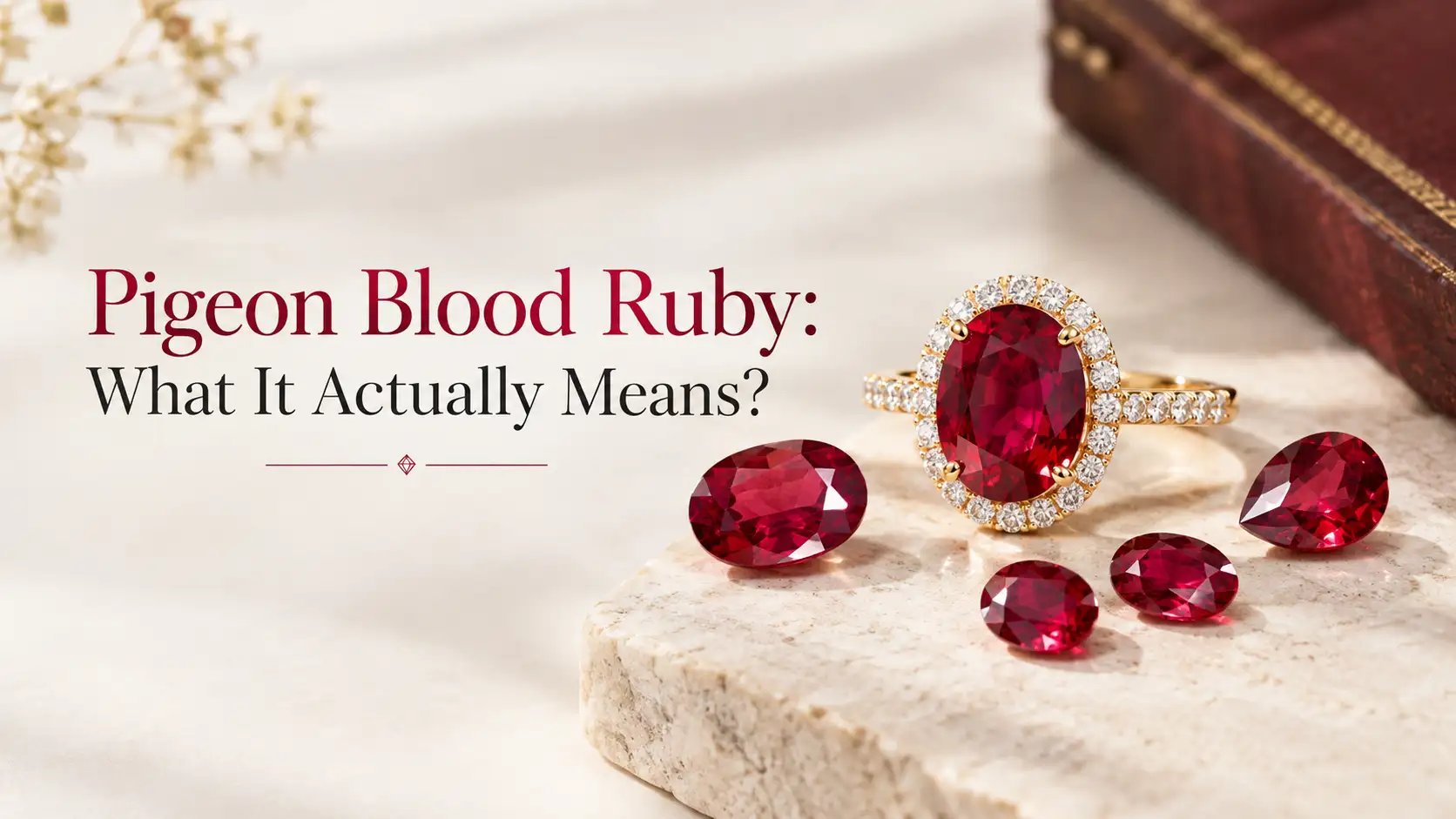
A pigeon blood ruby is a ruby with a pure to slightly purplish red hue vivid saturation medium tone and strong red fluorescence confirmed by a recognized gemological laboratory. The combination produces an appearance of internal illumination that ordinary red rubies do not have.
You will read everywhere that Burmese miners named the color after the first two drops of blood from a freshly killed pigeon. That story circulates because it is vivid not because it is settled.
The competing explanation argued by Richard Hughes of Lotus Gemology is that the reference is to the bright red ring in the iris of a living pigeon's eye. By 1888 a British publication on the Mogok mines recorded that the most valuable stones were "the colour of pigeon's blood," and the Gemological Institute of America's own journal was using the phrase for Burmese rubies by the 1930s.
Burmese dealers never used the phrase as a single label. It was the top rung of a five-step ladder.
Ruby is corundum aluminum oxide colored red when chromium substitutes for aluminum in the crystal lattice. Same mineral as sapphire. The only difference is which trace elements got in.
But chromium alone does not make a pigeon blood ruby. Plenty of rubies have abundant chromium and look flat. Three things have to happen together.
Under ultraviolet chromium in corundum fluoresces red. Ordinary daylight carries enough UV to trigger it. So a fine ruby is doing two things at once: reflecting red light and emitting it.
Iron quenches that fluorescence. This is the whole reason origin matters. Mogok's deposits are marble-hosted and unusually iron-poor so the glow survives. Basalt-hosted material from Thailand and Cambodia carries far more iron and glows weakly or not at all. Those stones can have a perfectly respectable red body color and still look dead in the hand which is exactly why shopping from a color chart fails.
Fine rutile needles inside the stone scatter light into the facets that would otherwise go dark as you tilt it. Cut the extinction zones add fluorescence on top and the stone reads as lit from within instead of reflecting.
Here is the elegant part. That same silk in a cabochon is what produces a star ruby. A six-rayed star and pigeon blood color are two outcomes of one inclusion. Too much silk kills transparency. The right amount gives you the velvety quality dealers pay for.
Which leads to the sentence to keep in mind for the rest of this guide: pigeon blood is a description of how a stone looks face-up not a chemical specification.
Where do they come from?
The Mogok Stone Tract sits roughly 130 miles northeast of Mandalay at about 1,500 meters elevation and has produced ruby for over eight centuries. The geology is dolomitic limestone altered where igneous rock intruded it which is why the material is iron-poor and glows.
Mogok's supply situation has been constrained for a long time. Private mining was banned and the trade nationalized in 1969 then relegalized in 1992. Much of what reaches the market today as fine Burmese pigeon blood is historical material recirculating through dealers and auction rooms rather than fresh production. The premium has held firm because the supply has not improved.
Discovered in 2009 and now the most significant new ruby source in decades. Only a small fraction of Montepuez output meets pigeon blood criteria but that fraction transformed availability. Before Montepuez finding a fine ten-carat ruby was close to impossible. Within about six years it became a matter of choosing among several.
Mozambican rubies sit chemically between Burmese and Thai material. Less iron than Thai more than Mogok. They generally lack Mogok's purple undertone tend to be cleaner and arrive in larger crystals. Many designers prefer the glassier look. The trade discount relative to comparable Burmese material runs roughly 30 to 50 percent meaning Mozambican stones typically transact somewhere around half to seven-tenths of the Burmese per-carat figure at the same quality level.
And then there is the Estrela de Fura 55.22 carats unheated Mozambican which sold for $34.8 million in 2023. Whatever hierarchy existed in people's heads before that sale the top tier is no longer a Burmese monopoly.
Vietnam's Luc Yen region is marble-hosted like Mogok and was the first source to seriously challenge Burma on color and glow together. Madagascar produces qualifying material.
Thailand and Cambodia are where pigeon blood essentially does not happen. High iron weak fluorescence darker and browner overtones. Large clean and still not in the running.
More than nine in ten newly mined rubies are heated. Heat is permanent stable has been standard practice for generations and is fine as long as it is disclosed. The problem is never treatment. The problem is undisclosed treatment.
Here is the full landscape ordered roughly from acceptable to avoid.
Typically 1,200 to 1,800°C. Improves color dissolves silk clears transparency. Under magnification a lab sees rutile needles broken into trains of tiny droplets that still trace the old pattern; intact dart-shaped needles suggest no heat. Heated stones often show a chalky glow under short-wave UV that is close to unknown in untreated corundum. Assume your ruby is heated unless a report says otherwise and expect to pay a real premium when it does.
The current headache for laboratories. Gentler treatment leaves fewer of the classic indicators and detection now depends on FTIR pattern analysis and heat-sensitive inclusions rather than obvious silk damage. The absence of visible evidence is not proof a stone is unheated.
Borax-class fluxes dissolve fracture surfaces and grow new corundum inside them as the stone cools sealing breaks that plain heat cannot close. Common in Mong Hsu material and some Mozambican goods. It sits in an uncomfortable middle ground between heating and filling and it shows up as dark residue inside the healed fracture.
Lead-glass filling
A different category entirely and the one that costs American consumers the most money. High-refractive-index glass is infused into the fractures of heavily included low-grade material. The result looks vividly red and remarkably clean for the price.
It also is not durable. The glass is soft reacts to jeweler's acids and cannot survive a torch. A lead-glass-filled ruby cannot be sized retipped or ultrasonically cleaned the way real corundum can. Some have been visibly damaged by household cleaners.
The tell is visible with a $15 loupe: an oily or colored flash effect when you rotate the stone under angled light sometimes with gas bubbles in the fractures. If a large vividly red "ruby" is priced surprisingly low this is almost always why. In the United States these must be disclosed under the FTC's Jewelry Guides and the honest term in the trade is composite ruby not ruby.
Performed above 1,800°C altering color in a surface layer. Must be disclosed detectable by trace-element chemistry and excluded from pigeon blood designation by every lab that uses the term.
Rough is sometimes soaked in oil at the mine to improve apparent clarity and the fact rarely survives the journey downstream. It is not permanent.
Ruby was the first gem successfully synthesized. Auguste Verneuil's flame-fusion process was announced in 1902 and published in full in 1904 and by 1913 Cartier was setting cabochon synthetic rubies in a tiara now held by the Victoria and Albert Museum. Both Cartier and Van Cleef used small synthetics as calibré accents during wartime shortages.
This is the big one. Following the February 2021 military coup the U.S. Treasury's Office of Foreign Assets Control designated Myanma Gems Enterprise the state entity that controls Myanmar's gemstone sector. That designation remains in force. Because essentially all legally mined Burmese gem material passes through that entity newly sourced Burmese rubies sit in restricted territory for U.S. persons.
The history matters for understanding why this is confusing. The JADE Act of 2008 specifically banned Burmese ruby and jadeite imports including stones finished in third countries. Those restrictions were eased in 2016 as relations normalized. Then the coup happened and the restrictions came back though through a different legal mechanism than before.
A Burmese ruby that has been in the United States for decades or sits in a 1930s estate piece is in a completely different position than a stone coming in now. Age and chain of custody are not just romance here; they are compliance.
Ask for documented provenance on any Burmese-origin stone including when and how it entered the country.
Mozambican material avoids the question entirely which is part of why Montepuez reshaped the U.S. market so quickly.
This is not legal advice. Sanctions programs change. If you are buying at a level where this matters financially confirm current OFAC guidance or consult counsel before you wire funds.
The FTC's Jewelry Guides require disclosure of treatments that are not permanent that create special care requirements or that significantly affect value. Lead-glass filling triggers all three.
Get treatment status in writing on the invoice not verbally. A seller who will not put it on paper is telling you something.
The seller's appraisal is a sales document. You want an independent appraiser credentialed through the American Society of Appraisers the National Association of Jewelry Appraisers or the American Gem Society working from the lab report rather than in place of it.
The lab report identifies the stone. The appraisal assigns a value for insurance. They are different documents and you want both.
A standard homeowner's or renter's policy typically caps jewelry loss at a low figure often $1,000 to $2,500 and may not cover mysterious disappearance at all. For anything meaningful you want a scheduled personal property rider listing the piece individually.
the supply of unheated vivid red corundum is genuinely finite demand from collectors has been strong for two decades and top-tier stones have held and increased their value.
The gap between retail purchase price and realistic resale is wider on colored stones than almost any other category. Losing half of a retail purchase price on resale is common not exceptional. You are buying at retail and selling into a wholesale or auction market.
Buyer's premiums at major houses run around 26 percent on the first tranche. If you bought at auction someone paid that on top of the hammer price. If you sell at auction you pay a seller's commission out of the result.
The most tradable segment is roughly two to five carats with strong documentation. Below that you are competing with abundant supply. Above it the buyer pool is small enough that timing determines everything.
Significant stones move through closed dealer networks and auction consignment. There is no public order book. Knowing which dealer is holding what at any moment is an actual skill acquired over years and it is the reason dealers capture the spread.
None of this means a fine ruby is a bad purchase. It means you should buy one because you want to own it and pass it down and treat any appreciation as a bonus rather than a thesis. Buy the glow at the size your budget honestly allows. That is a better decision rule than any price chart.
This number appears in several articles and traces back to nothing. Color is assessed as hue tone and saturation against master stones. There is no percentage threshold.
The claim is that a real ruby clears fog in about two seconds and glass takes five. This is not a valid test and it will not distinguish ruby from glass spinel garnet or synthetic corundum. Use a loupe and a lab report.
A handful of the greatest rubies ever offered have achieved that. It is a record not a market rate. Quoting it as a category norm is how people end up dramatically overpaying.
Ruby is Mohs 9 diamond is 10. Corundum does have an advantage in one specific sense: diamond has perfect cleavage and can split on a sharp blow while corundum has none. That is a real point about toughness but "harder than diamond" is wrong and "more durable" without qualification is misleading.
Only if the report came from SSEF or Gübelin. GRS and Lotus apply the color term to heated stones and disclose treatment separately.
Historically accurate currently outdated. The auction record is a Mozambican stone. Most fine ruby on the market today is Mozambican. Burma still commands the premium and the premium is partly reputational.
No. There is no international colorimetric standard for it and GIA has said so publicly. It is a trade term that individual laboratories have defined internally using their own master stones and their own criteria. Two labs can reach different conclusions about the same ruby and both be applying their standards correctly.
It depends on the laboratory. SSEF and Gübelin restrict the designation to untreated stones; any heating disqualifies. GRS and Lotus Gemology will apply the color term to heated rubies and report treatment separately. This is the most commercially significant difference between labs and the reason you should always ask who issued the report.
No. The term originated with Mogok material and Burmese stones still command the highest premium but Mozambique Vietnam Madagascar Afghanistan and Tajikistan have all produced qualifying material. The current auction record holder is Mozambican.
Roughly $15,000 to $45,000 per carat for certified unheated Mozambican material in the two-to-three-carat range and from about $30,000 per carat for comparable Burmese stones rising steeply with size. Exceptional five-carat-plus Burmese stones exceed $300,000 per carat. These are indicative ranges; actual pricing depends on the specific stone the issuing lab and market conditions.
Estate and pre-restriction stones are widely traded. Newly sourced Burmese material sits under U.S. sanctions tied to the designation of Myanma Gems Enterprise after the 2021 coup. Ask for documented provenance and confirm current guidance before any significant purchase. This is general information not legal advice.
Not reliably at home and be skeptical of any guide that says otherwise. A 10x loupe will reveal some things: curved growth lines and round gas bubbles suggest flame-fusion synthetic; an oily flash in fractures under angled light suggests lead-glass filling; a completely inclusion-free stone is suspicious rather than impressive. For anything of value a current report from a recognized laboratory is the only answer.
Chemically nothing. Both are corundum colored by chromium with more chromium producing red and less producing pink. A red-dominant stone with sufficient saturation is a ruby; a clearly pink one is a pink sapphire. No number divides them which is why two labs occasionally disagree on the same stone. The pricing difference between the two calls can be substantial.
Buy it because you want to own it. Fine rubies have held value well over decades but the gap between retail purchase price and realistic resale is wide the market is opaque and liquidity is concentrated in a narrow band of sizes and documentation quality. Treat appreciation as a bonus not a plan.
For untreated and conventionally heated rubies warm soapy water and a soft brush are safe and ultrasonic cleaning is generally acceptable. For anything fracture-filled flux-healed cavity-filled or dyed use a damp cloth only. Never hand a ruby to a bench jeweler for soldering retipping or cleaning without telling them the treatment status first. A lead-glass-filled stone can be damaged beyond repair by routine shop work.
The words on a certificate are powerful and they are only the beginning of due diligence. A pigeon blood call from SSEF and a pigeon blood call from GRS describe two different things and the market prices them accordingly even when sellers do not explain the difference.
Learn which lab issued the call. Learn what that lab permits. Get treatment status in writing. See the stone in daylight before you commit. Do those four things and you will be better informed than most people spending ten times as much.