7 Days Shipping in “Ship Now” Collection
WORLDWIDE SHIPPING EXCEPT INDIA
Minimum Order Value: $1000
11 May, 2026
What is the Difference Between Ethiopian Opal and Australian Opal?
If you are a jewelry retailer, you might agree with me that selecting between the Ethiopian opal and the Australian opal is beyond the aesthetics. You also have to consider the factors, such as sourcing decisions, meeting your customers expectation for pricing, and durability.
Both are genuine opals that have hydrated silica spheres that refract light into spectral colors. However, the difference between Ethiopian opal and Australian opal lies in their geological environments, physical properties, and market behaviors, which vary greatly.
Here in this blog, we will help you with the information needed to draw a clear difference between both of them, so you can make an informed decision confidently.
Australian opal formed approximately 65-100 million years ago. According to studies, it was developed largely in the Cretaceous inland sea basin that once covered much of central Australia. So, that’s the reason why it is named Australian opal.
With time, the sea receded, and as a result, the silica-rich groundwater seeped into cavities, which kept collecting opal over millions of years.
The key mining regions for Australian opal are:
Lightening Ridge – black opal
Coober Pedy – white/crystal opal
Quilpie – boulder opal
On the other hand, Ethiopian opal is considered to be the younger version, as it was formed around 5-30 million years ago.
It is made through the volcanic activities, when silica-rich fluids settle into the cavities within rhyolite and ignimbrite (volcanic ash) rock.
The primary source of the Ethiopian opal was discovered in 2008, which is the Wollo Province (Welo/Wegel Tena district).
If you ask me why we are discussing the origin of these stones, how does it matter in the difference between them? The answer is no-frills: the volcanic source is the root reason for the most significant difference between Ethiopian opal and Australian opal, which is water-absorbent porosity.
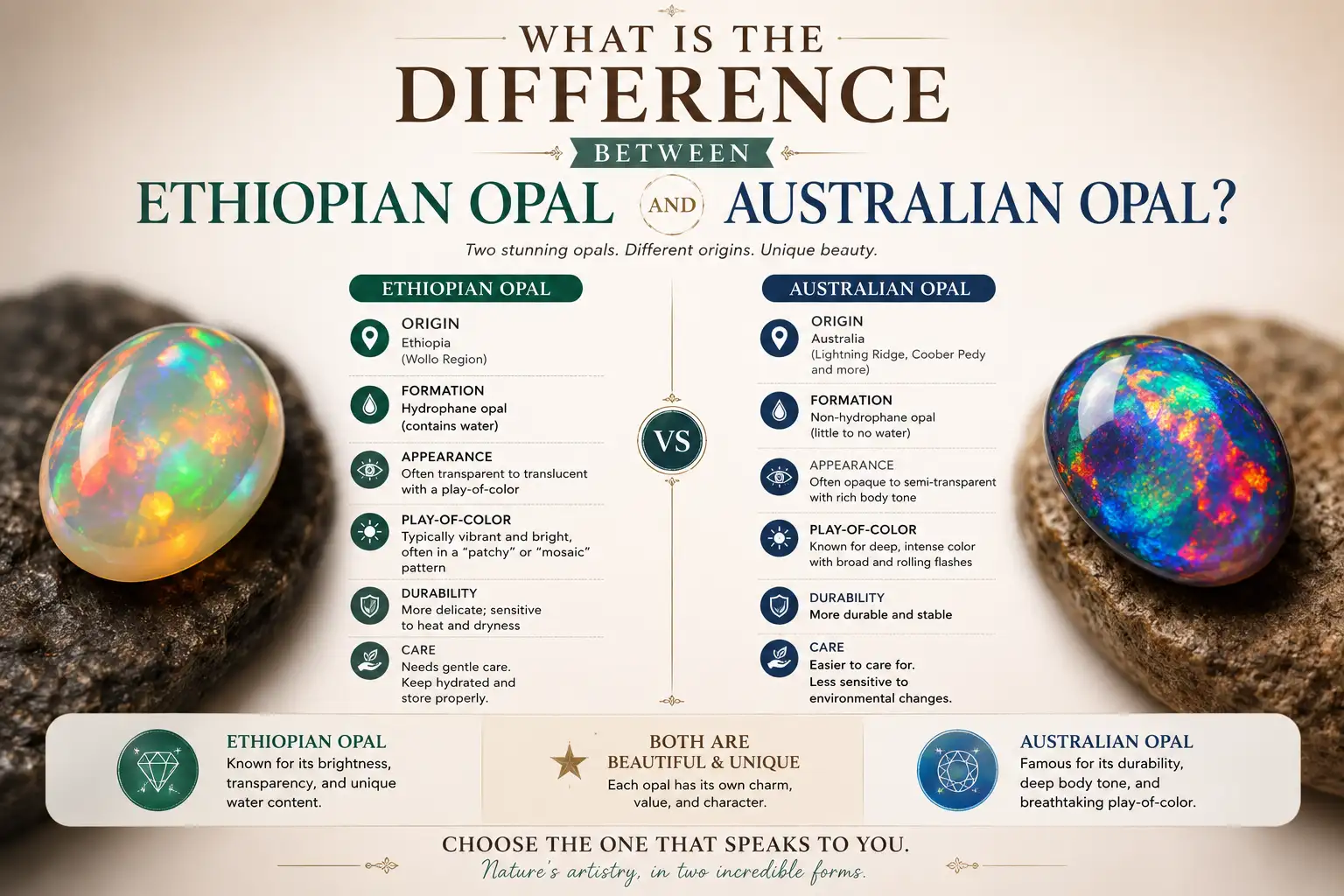
The first visible difference between Ethiopian opal and Australian opal is body tone, which refers to the base color of the stone.
Australian opals mainly have darker body tones such as black, dark grey, or deep blue beneath the color flares.
On the other hand, Ethiopian opals have white, yellowish-white, or crystal (transparent to semi-transparent) body tones. Additionally, you can also find this opal in darker, smoky brown or gray body tone.
Another obvious difference is the overall transparency.
Australian opals are commonly opaque or slightly translucent. While Ethiopian opals are often more translucent or semi-transparent.
Put simply, Australian opals usually appear solid and darker, while Ethiopian opals tend to look lighter, glowing, and more transparent.
The play of color simply refers to the flashes of different colors visible inside an opal.
Ethiopian opals have scattered and dynamic color patterns. The flashes can appear as small shifting spots or rolling color across the stone. Additionally, many Ethiopian opals are translucent; therefore, colors may appear deeper inside the gemstone rather than only on the surface.
Australian opals, on the other hand, have strong and well-defined color flashes. The colors of the stone usually appear to be sharp and apparently segregated.
Put simply, Australian opals have bold surface and color patterns, while Ethiopian opals have floating or moving colors within the stone.
Generally, opal is considered to be a soft gemstone as they are measured between 5.5 and 6.5 on the Mohs hardness scale. This is a universal opal characteristic, and Ethiopian and Australian opals are no exception.
Australian opals are considered to be more stable for jewelry manufacturing, as they are non-pronouns. Simply saying, they do not absorb water easily, so they can maintain them for a long period of time, during normal wear.
Ethiopian opals, on the other hand, are hydrophane. Simply said, they can absorb water and other liquids more easily. Therefore, these opals may temporarily change color or become cloudy when they come into contact with water. As a result, Ethiopian opals require more careful handling in jewelry, especially in rings that are worn daily.
Simply saying, Australian opals are more durable and predictable, while Ethiopian opals require more mindful care.
Ethiopian opal, as said earlier, was discovered in 2008 and made available commercially after that. It is marketed as an affordable alternative to the Australian opal.
As estimated, Ethiopian opal generally trades at $10–$150+ per carat. This is a general estimation; the price may vary according to body tone, play-of-color intensity, and clarity.
Australian opal pricing varies in different ranges. For example, the white opal price is estimated at $30–$80 per carat wholesale, boulder opal from $50–$300+ per carat, and fine Lightning Ridge black opal can command $500–$5,000+ per carat at wholesale for top-grade material.
If you are a jewelry retailer zeroing in on mid-market retail customers who are looking for budget-minded product lines, then Ethiopian opal can be bought at a lower price. On the other hand, if your customers are looking for premium opal, then Australian opal would be the appropriate option.
The simple answer to the question of when to choose Ethiopian opal vs Australian opal is pricing.
Choose Ethiopian opal when the goal is to emphasize strong play-of-color at a more accessible price. Additionally, these stones are easily available in different sizes and vibrant color patterns.
Ethiopian opal can be appropriate for earrings, pendants, and occasional-wear jewelry. These jewelry types reduce exposure to water and physical impact.
Put simply, you should choose Australian opal when long-term stability is the priority. Most Australian opals are non-porous and do not absorb water easily. Therefore, you should choose it for rings and everyday jewelry.
In simple terms, Ethiopian opal works well when the focus is on color variety and affordability, while Australian opal is often chosen for durability and long-term jewelry use.