7 Days Shipping in “Ship Now” Collection
WORLDWIDE SHIPPING EXCEPT INDIA
Minimum Order Value: $1000
25 May, 2026
What is the Difference Between a Ruby and a Rubellite?
Ruby and rubellite are both red. That’s where the confusion starts.
A customer walks into a store, sees a red stone, and most of them probably assume it’s Ruby. Simply saying, sometimes it is, but sometimes it is a rubellite.
So when we discuss the difference between Ruby and rubellite, we should think beyond the color. They both differ from each other in a lot of aspects.
Here in this blog, I wil help you with the comparison of Ruby and Rubellite, helping you to draw a clear line of difference.
So, let’s get started.
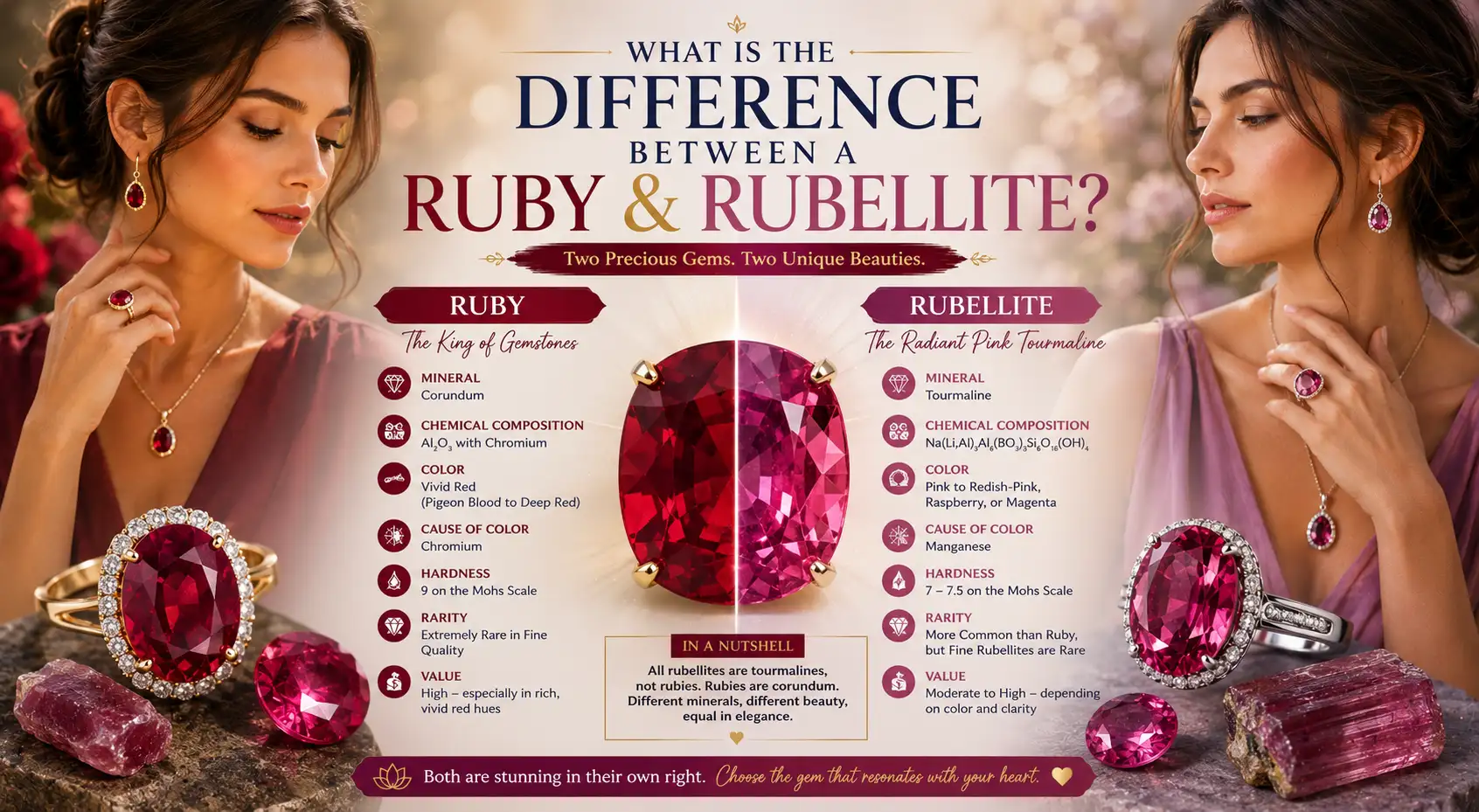
The first difference between Ruby and rubellite starts with their family. Most buyers don't even think about this part, but it is the reason every other difference exists.
Ruby comes from the corundum family. It is the same family from which sapphire comes, so you can say that Ruby and Sapphire are siblings.
On the other hand, rubellite comes from a different family altogether, the tourmaline family.
Now you might wonder why the family matters. Simply saying, the family decides whether the stone is precious or semi-precious.
For example, Ruby, being a corundum, is automatically a precious stone. While rubellite, being a tourmaline, is a semi-precious stone, it does not matter how good it looks.
Ruby red is deeper than rubellite red. That is the simple way to put it. In a good Ruby, you will also notice a slight blue or purple undertone sitting in the stone, and that is the thing making Ruby look richer than other red stones in the market.
Rubellite is more on the pink-red side. Some rubellite is properly red, yes, but most of them are sitting between pink and red, and that is the truth most sellers don't say openly.
Now the bigger issue is not even the color itself. It is how the color behaves when light changes around it.
Take both stones and check them under the shop's yellow light first, then take them out in daylight. Ruby is not going to change. The red stays red.
Rubellite is going to change. A rubellite that was looking red inside the shop can start looking pink outside in sunlight. This is the reason rubellite has more returns than people realise. The customer takes it home, sees the stone in daylight, and feels something is off.
Check rubellite in daylight before paying. Shop light is not the right light for this stone.
Ruby is 9 on the Mohs scale. Rubellite is 7 to 7.5. The number gap is small, but the wearing gap is not.
Ruby is one of the hardest natural stones we have. Just below the diamond. So a Ruby ring worn daily is fine, a Ruby bracelet worn daily is also fine, basically anything Ruby goes through normal life without trouble.
Rubellite is softer, so the same daily wearing will not work for it. Wear a rubellite ring every day, and after a few months, you will see scratches showing on the stone's surface. One bad hit on a hard corner, and the edge can chip from the stone; this is something we have seen happen.
Rubellite is better in pieces that are not getting hit constantly. Pendants are safe. Earrings are safe. Rings that come out only sometimes are also fine.
Most Ruby in the market is heated. That is the reality. Around 90 to 95 percent of the Rubies you see in stores have gone through heat treatment to improve the color and clean up the clarity. An untreated Ruby with strong color is rare, very rare, and that rarity is the reason untreated Rubies sell for 5 to 10 times the price of treated ones.
Rubellite has heat treatment too, but the rules are different. Some rubellite is heated to lighten the tone or to clear out brownish patches sitting in the stone. Some rubellite is left as it is because the natural color is already good enough to sell. Both versions are accepted in the market.
Now the real question is which treatment matters more in pricing. For Ruby, the untreated tag adds huge value. For rubellite, the untreated tag also adds value, but the jump is not as dramatic as it is in Ruby.
There is also another thing buyers should know. Ruby sometimes goes through other treatments beyond just heat, like glass filling or beryllium diffusion, and these treatments crash the value of the stone badly. Rubellite does not have these heavy treatments commonly, so the buyer is mostly worried about heat only.
Always ask the seller directly if the stone is heated or not. For Ruby, ask about other treatments also. For rubellite, the heat question is usually enough.
Ruby in top quality is one of the rarest things in the gem world. Burmese Ruby with pigeon-blood red color and no treatment, finding that today is harder than finding a top diamond. The mines are running low, the supply is shrinking every year, and that is why Ruby prices keep climbing instead of falling.
Rubellite is more available than Ruby. Mozambique, Nigeria, Brazil, and Madagascar are all places are producing rubellite regularly. So if you walk into a wholesale market, you will find rubellite easier than you will find good Ruby.
But here is the part most people miss. Pure red rubellite is its own kind of rare. Most rubellite coming out of mines is pink or pinkish-red; the proper deep red rubellite without any pink showing in it is not common at all. So, rubellite as a stone is available, but pure red rubellite is not.
This is the reason a top rubellite still gets a premium price. Not Ruby level price, but premium for its own category. Buyer thinking all rubellite is the same is going to overpay for a pink piece or underpay for a true red one.
Ruby is rare across the board. Rubellite is rare only when you are looking at the deep red ones. That is the difference in how rarity works for these two stones.
Ruby goes into anything. Rings, bracelets, earrings, pendants, it doesn't matter what setting you put it in, Ruby holds up. The hardness of 9 on Mohs is doing the work here. So a Ruby engagement ring worn daily for 20 years is going to look almost the same as the day it was bought, with just normal cleaning in between.
This is why Ruby is the go-to stone for daily-wear pieces. Brides choose Ruby rings for the same reason: the stone is not going to give up on them.
Rubellite is a different story. The 7 to 7.5 hardness is fine for jewelry, but not fine for everything in jewelry. Rubellite in a daily ring is going to suffer over time; you will see scratches, you will see edge damage, the stone is just not built for that kind of constant use.
Where rubellite actually shines is in pieces that are not getting hit all day. Pendants are perfect for rubellite. The stone is sitting on the chest, protected, with no constant rubbing against surfaces. Earrings are also a safe place for rubellite, for the same reason, no impact happens to the stone.
Cocktail rings worn occasionally also work for rubellite. The buyer is not wearing it to clean dishes or to the gym, the stone is going out for dinners and events only, and that level of usage rubellite handles fine.
So the simple way to think about it is, Ruby is for everyday, and rubellite is for occasions. Putting rubellite in a daily ring is setting up the customer for disappointment in a year or two.
Ruby and rubellite are not the same stone; that is the main thing to take away from this blog. Different family, different hardness, different price, different rules. Ruby is precious and sells its name. Rubellite is semi-precious and sells in its color. Both are red, yes, but the similarity ends right there.
At JewelPin, we have worked with both for years, so we know each one has its own buyer and its own place in a store. So if this blog cleared the confusion, don't sit on it. Pick the stone that fits your shop and move on it.