7 Days Shipping in “Ship Now” Collection
WORLDWIDE SHIPPING EXCEPT INDIA
Minimum Order Value: $1000
30 September, 2026
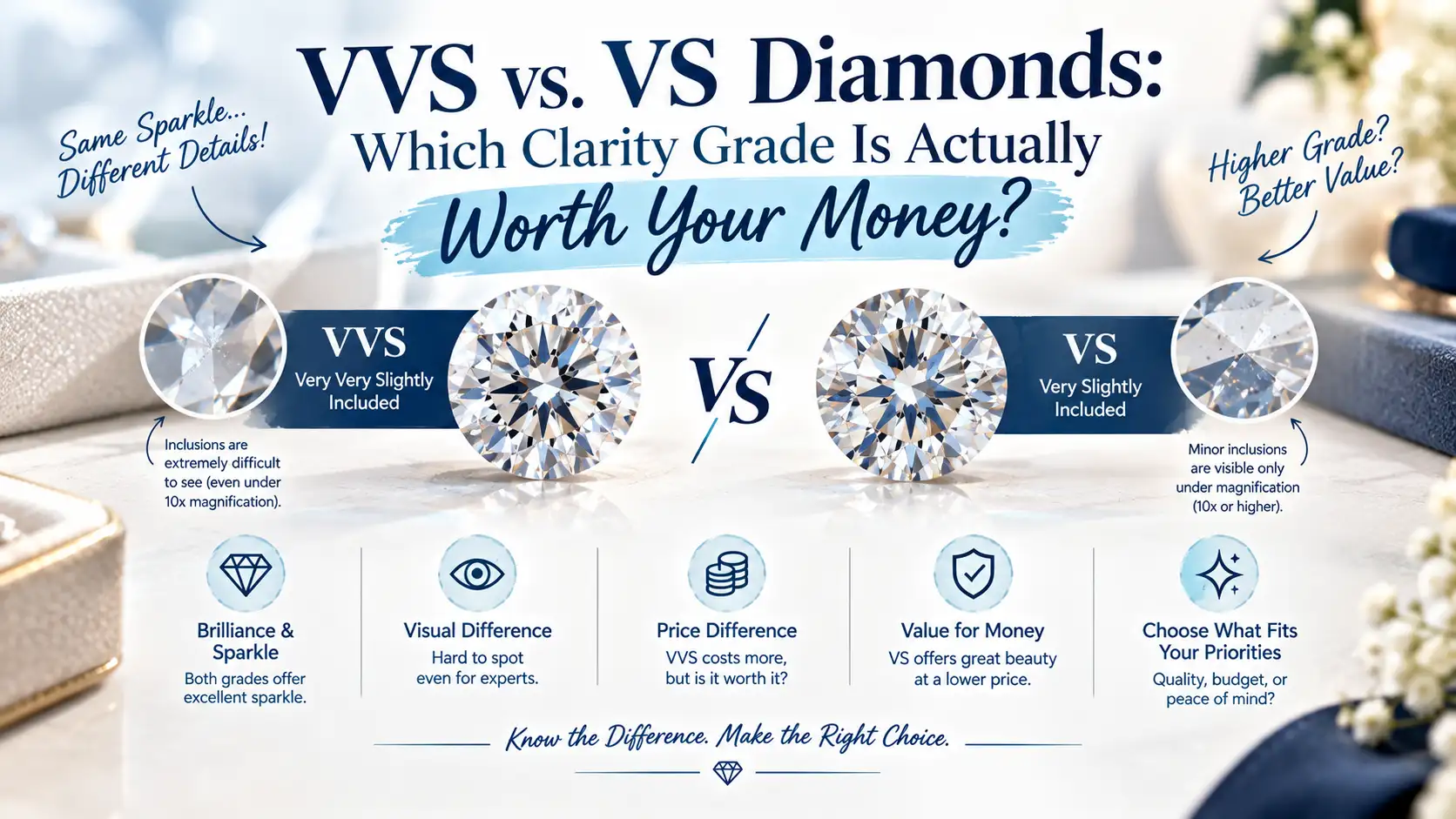
Both VVS and VS diamonds are eye-clean. Nobody will ever see the difference while you wear the ring. VVS costs roughly 15–40% more than VS at the same carat color and cut and that premium buys you something only a jeweler's loupe can find. For most American buyersVS1 or VS2 is the smarter purchase and the savings are better spent on cut quality or carat weight.
Every diamond mined or grown in a lab forms with tiny internal features called inclusions and small surface features called blemishes. The trade term is clarity characteristics not "flaws," because they are a normal product of how diamonds crystallize.
Clarity is a grader's judgment of how few and how small those features are examined face-up under 10× magnification. That last part is the whole ballgame. GIA graders use microscopes at higher power to identify what they're looking at but the grade is assigned based on what is visible through a standard 10× jeweler's loupe looking down through the top of the stone.
VVS (VeryVery Slightly Included): inclusions are minute and range from extremely difficult (VVS1) to very difficult (VVS2) to see at 10×.
VS (Very Slightly Included): inclusions are minor and range from difficult (VS1) to somewhat easy (VS2) to see at 10×.
Two diamonds can contain the exact same inclusion and land on different grades. GIA graders weigh five things:
Size : how large the inclusion is relative to the stone. The same 0.3mm crystal is trivial in a 5-carat diamond and grade-setting in a 0.30-carat one.
Number : how many characteristics are visible face-up at 10×including reflections of inclusions off the pavilion facets.
Location : the single most underrated factor. An inclusion directly beneath the table drags the grade down hard. The same inclusion near the girdlewhere a prong will cover itmay barely register.
Relief : how much the inclusion contrasts with the surrounding diamond. A transparent white feather is far less penalized than a black crystal of identical size.
Nature : what the characteristic actually isand whether it threatens durability. A surface-reaching feather is treated more seriously than an internal pinpoint.
The inclusions are so minor they're often only findable from the pavilion at the bottom of the stone which makes them nearly impossible to locate face-up at 10×. Typical grade-setters: a single pinpoint wisp of internal graining needle.
The same character of inclusion is slightly easier for a grader to find face-up. Might be a tiny feather that a prong will eventually cover anyway. In the hand indistinguishable from VVS1.
Minor inclusions that take a trained eye a moment to spot at 10× a small crystal feather a defined cloud. Eye-clean in essentially every case.
Still minor but the grader finds it without hunting often because it sits under the table rather than off to the side. The large majority of VS2 stones are eye-clean. At 3 carats and up or in a step out confirm with your own eyes or a high-resolution video.
This is where the decision gets real and where most guides go quiet. Here's the structure of the premium:
The VVS premium scales with color. In high colors where buyers are already chasing perfection the gap is brutal. In near-colorless stones it narrows.
Put that in dollars. On a 1-carat G-color excellent-cut round moving from VS2 to VVS1 typically costs an extra $900–$1,400. That money redirect buys you:
Roughly 0.15–0.25 additional carats at the same color and clarity or
A jump from a good cut to a true ideal/super-ideal cut which is the only upgrade visible from across a room or
A one-to-two-grade color improvement which you can actually see in a yellow-gold-free setting
In lab-grown diamonds high clarity is not rare. CVD and HPHT growth reliably produce VS and VVS material and the market is flooded with it. The clarity premium has compressed to the point of near-irrelevance.
On a typical 2-carat lab-grown round the spread between VS1 and VVS1 is often under $150, sometimes under $50. At that gap there is no reason to compromise. If you're buying lab-grown just buy VVS. It costs almost nothing extra and it removes the one variable you'd otherwise have to inspect.
Sparkle brilliance, fire and scintillation is a function of cut: proportions, symmetry and polish. A VVS1 stone with mediocre proportions will look duller than a well-cut VS2 every single time. Clarity only begins to affect light return down at the I1–I3 end of the scale where inclusions are large and numerous enough to physically block light or in the specific cloud scenario below. Between VVS and VSthe effect on sparkle is zero.
Retail diamonds are not an investment asset and the FTC has taken a dim view of marketing that suggests otherwise. You buy at retail and sell into a wholesale market which means immediate and substantial loss regardless of clarity grade. A near-flawless diamond doesn't change that math. Buy the ring because you want the ring.
Some pages describe VS inclusions as "barely visible to the naked eye" or visible "to a keen observer." That's not what the grade means. VS inclusions are by definition minor and identified under 10× magnification. The rare exceptions involve very large stones or open step cuts which is exactly why the shape guidance below exists.
Clarity grade is only half the picture. How forgiving that grade is depends entirely on the shape and the size of the stone.
Round oval pear marquise cushions are covered in dozens of small triangular and kite-shaped facets that scatter light in every direction. All that visual noise breaks up the field and genuinely hides small inclusions.
Emerald and Asscher do the opposite. Long parallel facets and a wide open table create a "hall of mirrors" effect with nowhere for an inclusion to hide. The same feather that disappears in a round brilliant can be plainly visible in an emerald cut.
Two things drive the pattern. Size: a bigger stone has bigger facets and more open area so the same inclusion occupies more visual real estate. Openness: the more transparent/unbroken table area a shape has the more it reveals.
GIA and AGS are the strictest for natural diamonds. IGI is the standard for lab-grown and is reliable there. Be cautious with EGL and in-house "certificates" grading can run one to three grades looser which means a stone sold as VS2 may be an SI1 elsewhere. A "VVS" with no independent report is a marketing claim not a grade.
on the issuing lab's own website. Both GIA and IGI offer free report lookup. Match the laser inscription on the girdle to the report number.
Technically yes VVS sits two grades higher on the scale and is rarer. Visually no. Both are eye-clean and neither has any effect on sparkle. VVS is better on paper; VS is usually better value.
No. Not at arm's lengthnot at 12 inchesnot under a jewelry store's lighting. The difference is only detectable under 10× magnification and even then it takes a trained grader.
Roughly 15–40% more for natural diamonds at the same caratcolorand cut the premium is largest in high colors (D–F) and smallest in near-colorless (G–J). For lab-grown diamonds the premium is often negligible, sometimes under $100.
Usually unless it's an emerald or Asscher cut. At 1 carat in a brilliant cutVS2 and often SI1 are reliably eye-clean and the savings buy a meaningfully better-cut or larger stone.
Only the difficulty of locating the inclusion at 10× magnification. VVS1 inclusions are often visible only from the pavilion; VVS2 inclusions are slightly easier to find face-up. They are identical to the naked eye and typically differ by 5–8% in price.
No. Sparkle is determined by cut proportions, symmetry and polish. A well-cut VS2 will out-sparkle a poorly cut VVS1.
Rarely and it depends on shape and size. In a round brilliant under 2 carats almost never. In an emerald cut or in a stone over 3 caratsit's worth.
Yes. Lab-grown diamonds are chemicallyphysicallyand optically identical to mined diamondsand the clarity scale applies identically. The difference is origin and price, not material.
Tiffany & Co. stocks individually registered engagement diamonds only in the FL through VS2 rangestopping above SI. That's a brand standard not a gemological necessity; plenty of SI1 stones are perfectly eye-clean.
"VVS" became shorthand in American hip-hop for the highest-quality stones in a piece the term signals top-tier clarity in a way "VS" doesn't scan as well. It's a real gemological grade not slangthough in jewelry marketing the label is sometimes applied loosely to melee and pavé stones that were never individually graded.
VVS and VS diamonds look the same on your hand. They will look the same in ten years. The only meaningful differences are the price and the line on the report. Buy VVS if you're getting an emerald cut going above three carats or buying lab-grown where it costs nearly nothing. Buy VS for everything else and spend the difference on cutting the one upgrade that anyone will ever actually see.