7 Days Shipping in “Ship Now” Collection
WORLDWIDE SHIPPING EXCEPT INDIA
Minimum Order Value: $1000
25 May, 2026
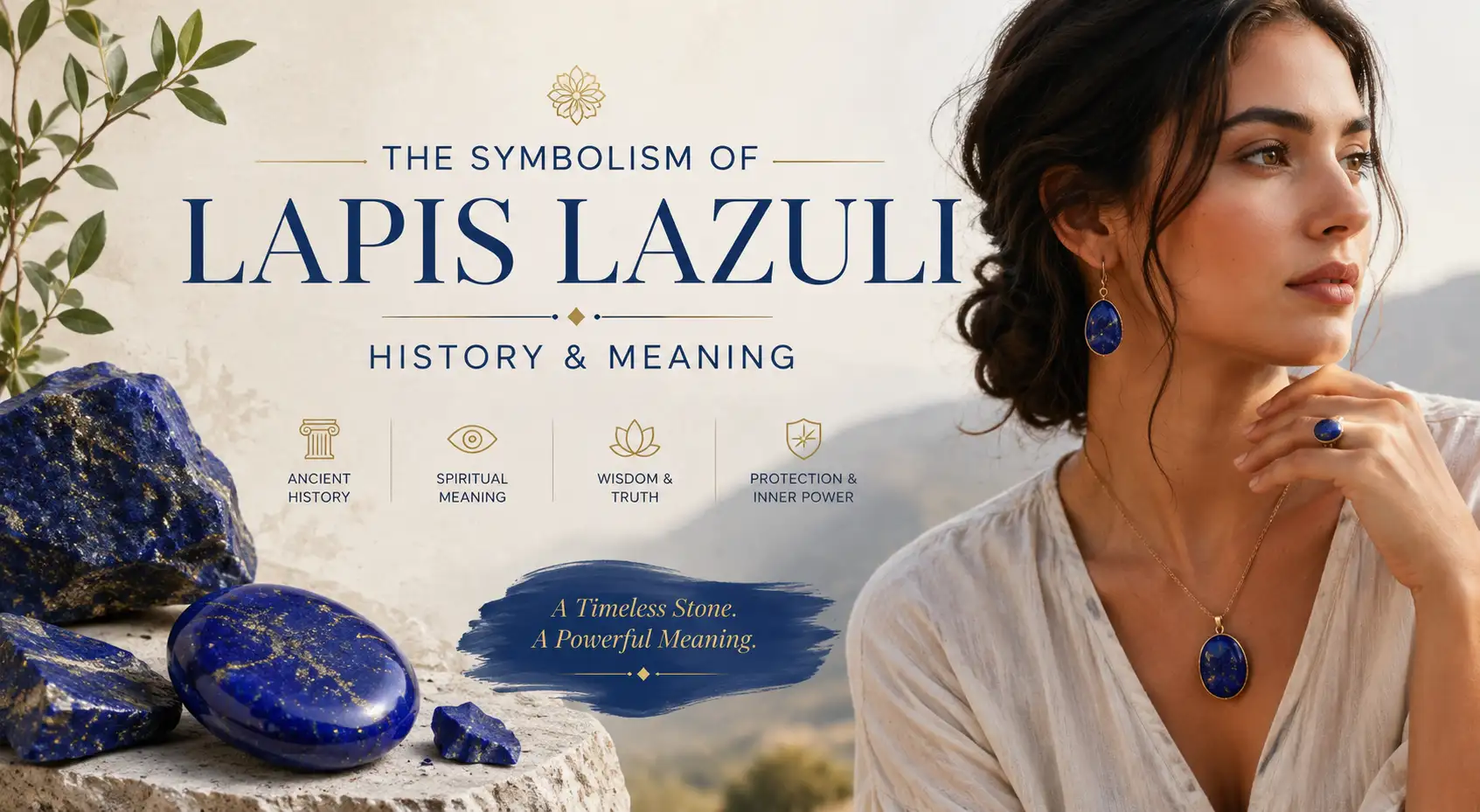
The Symbolism of Lapis Lazuli: History and Meaning
Lapis lazuli is one of those stones whose symbolism is actually older than most religions still being practiced today. Before Christianity. Before Buddhism in its current form. Before classical Hindu traditions took shape. Lapis lazuli was already carrying meaning in human civilisation.
That alone is worth pausing on. A blue stone, with gold flecks, has held symbolic weight in the human story for somewhere around 7000 years.
So in this blog, I am going through what lapis lazuli has symbolised across that long stretch of time, where the meanings came from, and why they still hold up for many people today.
So, let's get started.
Lapis lazuli has come out of one place for almost its whole history. That place is the Sar-e-Sang mines in the Badakhshan region of north-eastern Afghanistan.
Mining for lapis lazuli started in Afghanistan, somewhere around 7000 years ago, and those same mines are still working even today. These mines sit up high in the mountain valley, so getting to them is not easy, and the process of bringing the stone out of the ground.
Once mined, the lapis had to travel a long way before it reached the people who built the meaning of it. As said, it traveled a long way, coming from Persia to Mesopotamia, and then reaching Egypt.
Now, as the stone traveled through many hands, each of them added their own margin. So the stone that was used in Egypt was extremely expensive.
As we know, and it is a universal truth as well, that if anything is costly, it will automatically be treated as significant.
Egypt is the place where lapis really picked up its meanings.
The Egyptians believed the gods were sitting up in the sky, and the deep blue colour of lapis reminded them of that same sky. So the stone got tied to the heavens.
Also, Pharaohs were buried with lapis in their tombs. There was also a goddess named Maat, who stood for truth in the Egyptian belief, and lapis was linked with her closely.
Honestly, this Maat link is the deepest reason why lapis is still called a stone of truth even now.
Beyond Egypt, Mesopotamia also has a meaning for lapis. The people valued it heavily, as they believed that the statues of gods had lapis placed inside them, and priests wore the stone as a sign of being close to the divine.
So for Mesopotamia, the meaning of lapis was about power and divine connection.
So, across all the civilisations, certain meanings around lapis lazuli kept showing up again and again. Some of the meanings were truth and wisdom. These meanings kept showing up in different names.
Also, there is the idea of a connection between humans and the divine, which traveled across the centuries.
Honestly, the strange part is that these meanings did not get passed down through one shared chain. Different civilisations were landing on similar meanings on their own. Egypt did not copy from Mesopotamia. Buddhism did not borrow from the Sumerians. Each culture got there separately, and somehow they all ended up close to the same place with this stone.
Now, why did these meanings survive when so many other meanings around lapis faded away?
Honestly, the colour itself was doing most of the work. Deep blue with gold flecks naturally makes the mind think of the sky. Of depth. Of something that does not really belong to ordinary life. So the kind of meanings humans tend to attach to that visual feeling are the same kind of meanings that stuck with lapis lazuli over time.
The rarity factor added on top of this. As we know, anything that is easy to get rarely holds serious meaning for long. Lapis was never easy to get. The stone was hard to mine out of the ground. Buying it was always expensive. Supply was limited in every era. So the seriousness around lapis never dropped, which kept its meanings anchored even when fashions and traditions changed everywhere else.
That is the real reason these meanings survived. The visual side and the rarity side kept reinforcing each other, and neither one gave way for thousands of years.
Lapis lazuli is one of those rare stones whose meaning has stayed alive across thousands of years and across cultures that had no real connection with each other.
It started wth Egyptians, Mesopotamia carried it forward, and many others for a specific meaning in their region.
At Jewelpin, we have worked with lapis long enough to see that this symbolic weight still matters to modern customers in real ways. So the next time you come across a piece of lapis lazuli, just remember you are looking at something that carries 7000 years of human meaning inside it.