7 Days Shipping in “Ship Now” Collection
WORLDWIDE SHIPPING EXCEPT INDIA
Minimum Order Value: $1000
25 May, 2026
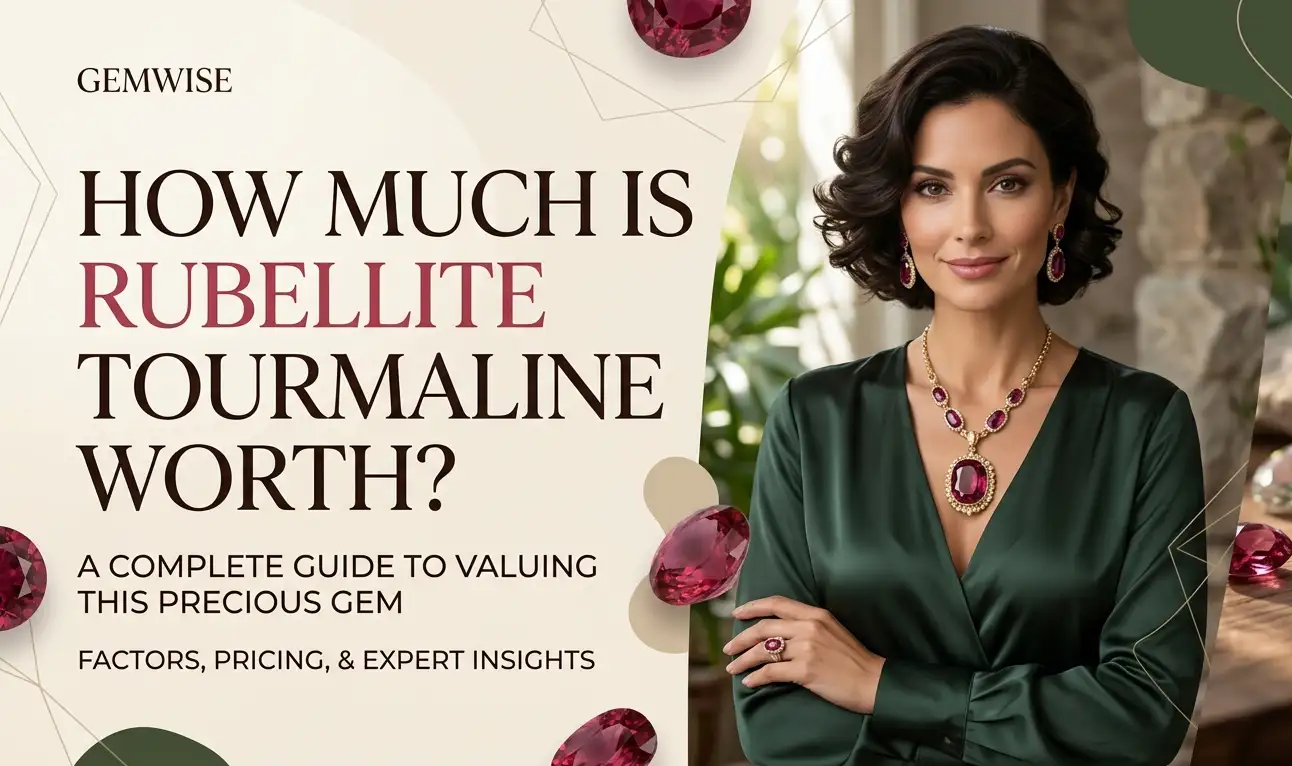
How Much is Rubellite Tourmaline Worth?
If you are here, chances are you already know what rubellite tourmaline is. So, I am not going to waste your time explaining its pink-red color or where it comes from. You know all that. I think you are here to know how much rubellite tourmaline is actually worth, so you can decide whether it fits into your buying budget or your store's collection.
Honestly, this is a question that doesn't have a single answer. The worth of rubellite changes based on a few things, and most blogs out there give you a vague price range and call it a day. That's not what I am going to do here.
At JewelPin, we have worked with rubellite tourmaline long enough to know what makes one stone worth a few dollars per carat and another worth a few thousand. So, you can expect the numbers and the reasoning shared here to come from hands-on experience rather than guesswork sitting behind a search engine.
So, let's get into it.
Color saturation is the first and foremost factor I will put into this list that defines the worth of rubellite. Everything, such as carat, weight, and other factors are secondary.
If saturation has to be explained in simple words, it would be like how deep the pink-red color sits inside the stone. It is simple, right, nothing fancy.
So, here is where things get interesting. A rubellite with weak color, the washed-out kind, sells for maybe $40 to $80 per carat. Same stone, but with rich saturated color, and blah, the price jumps to $1500, sometimes $2000 per carat. Doesn't this sound crazy, for me it does.
You may ask why such a huge difference exists. I would say it is simple, the natural characteristic of the rubellite is that it should look red. So, if it looks pale, then it means its natural characteristic is gone mean lower value.
At JewelPin, we sort rubellite parcels often. Out of 100 stones, only 8 or 10 hit the saturation level that serious buyers actually pay top money for. The rest are okay, sellable, but not premium.
Let me tell you something that will surprise you. Two rubellite stones, sitting on the same tray, both looking red to a regular eye. One is worth ten times the other. That's saturation doing the work.
Now you might ask me, why do I think that my thoughts matter? There should be a claim to prove it. I would say, yes, my thought doesn't matter, but market data does. Auction records from Sotheby's and Christie's show top saturation rubellite stones crossing $3000 per carat in recent years. Lower saturation stones from the same origin barely cross $200. Here is the proof that my thoughts do matter.
So, if you are buying rubellite, check saturation first. That's all.
This is the factor that I would say only experienced buyers actually pay attention to. I have seen many regular buyers often skip it, and honestly, that's where they lose money.
A real top-grade must have its red color under both daylight and indoor light. Therefore, the cheaper one doesn’t. Let’s make it simpler for you. A cheap one might look red in the shop under the influence of warm lighting; however, as customers step out, it might turn pink.
Now you may ask me why this matters so much. I would say the simple reason is that buyers are paying for "red." If the stone can't hold red in different lighting, then it is not really a pure red rubellite; it is a pink tourmaline being sold as rubellite. Big difference in worth.
At JewelPin, we test every rubellite under multiple light sources before adding it to the premium category. Honestly, this one test alone removes about 40 percent of the stones from the high-priced lot. The ones that pass, those are the stones that go for $1000 plus per carat. The ones that fail sit in the $100 to $300 range, no matter how big they are.
You might ask, can a normal customer even tell? I would say, I doubt, but a wholesale buyer who has been in the trade for years can tell in seconds. And that is the buyer setting the price in the market.
But here is the twist. Stones that hold red under indoor incandescent light, the kind of warm yellow light, are actually rarer than stones that hold red under daylight. So, if a rubellite passes both tests, the price doesn't just go up, it doubles or triples.
So, if you are buying rubellite for your store, ask the supplier to show the stone under a different light. If they hesitate, you already have your answer. That's how the pure red premium works.
If you ask me, this is the factor where most buyers get it wrong. They come in thinking rubellite should be clean like a sapphire or a diamond. It shouldn't.
Rubellite is a Type III stone in the trade. In simple words, that means inclusions are part of its natural personality. Almost every rubellite has them. So, if you reject a stone because you can see a small inclusion inside, you are basically rejecting the whole rubellite market.
But here is the twist. Not all inclusions are okay. Some are fine, the price barely moves. Some, however, can drop the worth of a stone by half. Sometimes more than half.
You may ask me which inclusions are okay and which are not. I would say, small silk-like or needle inclusions, those are accepted, no big deal. The ones that hurt the worth are the dark ones, the cloudy patches, and the worst, fractures reaching the surface. Those are the deal breakers.
At JewelPin, we have rejected entire rubellite lots just because the main stones had one wrong type of inclusion sitting inside. Honestly, when a fracture reaches the surface, the stone becomes risky for setting. It might crack during jewelry making. We don't take that risk for our retailers.
Let me tell you something that will surprise you. A rubellite that looks eye-clean from across the table can still lose half its worth the moment a jeweler puts a loupe on it. The high-end trade is that strict.
So, here is what I would do if I were buying. Tilt the stone. Look at it under different lights. Ask the supplier straight up what kind of inclusions are inside. If they dodge the question, you already know the answer.
That's all for clarity.
I would say this is the factor that confuses new buyers more than anything else. They walk in thinking a bigger stone equals a proportional price. Doesn't work like that with rubellite.
Let me put it in simple numbers. A 1-carat good-quality rubellite, around $500. Now, you would think a 2-carat diamond of the same quality should sit around $1000. It doesn't. It sits closer to $1500, sometimes $1800. Go up to 5 carats, same quality, and the stone is easily $5000 to $7000. The math just stops being linear.
But here is something worth knowing. A badly cut 5-carat rubellite can be worth less than a well-cut 3-carat rubellite. Weight without quality means nothing. Weight with quality is what the market pays for.
So, if a supplier is putting a price tag based only on how heavy the stone is, that is your first red flag. Ask about the cut, the color, and the clarity. Then talk price.
That's how rubellite weight actually works in the market.
As I have discussed so far, the answer to question how much is rubellite tourmaline worth has no single answer. The worth is something determined on factors such as color, clarity, weight, cut, and how the stone holds red under different lights.
A weak rubellite might sit at $40 per carat. A top one can cross $3000 per carat. That's the range you are working with.
At JewelPin, we have sorted enough rubellite over the years to know what each grade is actually worth in the market. So, if you are buying, don't go by price alone. Check the factors first. The right rubellite always proves its worth on its own.