7 Days Shipping in “Ship Now” Collection
WORLDWIDE SHIPPING EXCEPT INDIA
Minimum Order Value: $1000
25 May, 2026
What is the Difference Between Ethiopian Opal and Australian Opal?
If you have been looking at opals for your store or your collection, you have most probably come across both Ethiopian opal and Australian opal. The next question that comes is which one is better, and which one is worth the money.
Honestly, that is not the right question. The right question is which one fits what you are doing. Both opals have their own strengths, and both have their own weaknesses. One is not better than the other; they are just different.
In this blog, I will go through the actual differences between Ethiopian opal and Australian opal, so the choice becomes easier for you.
So, let's get started.
Australian opal carries more than a hundred years of history behind it. Mining started somewhere in the late 1800s in Australia, and by the early 1900s, the world was already calling Australian opal the proper opal of the market.
For most of the 20th century, if anybody said opal, they were talking Australian. Nothing else was around to compete at that level seriously.
Ethiopian opal came into the picture much later than this. The first find was in 1994 in Shewa province, but that material was not impressive enough to shake anything in the market.
The change came in 2008. Opal from Wollo province started coming out, and that material was brighter, sizes were good, and the mines were giving decent quantities for the wholesale trade to actually work with.
So, Ethiopian opal in serious market presence is around 16-17 years old today. Australian opal has crossed the 100-year mark long ago.
One technical thing separates these two opals more than anything else, and most buyers are not even aware of it.
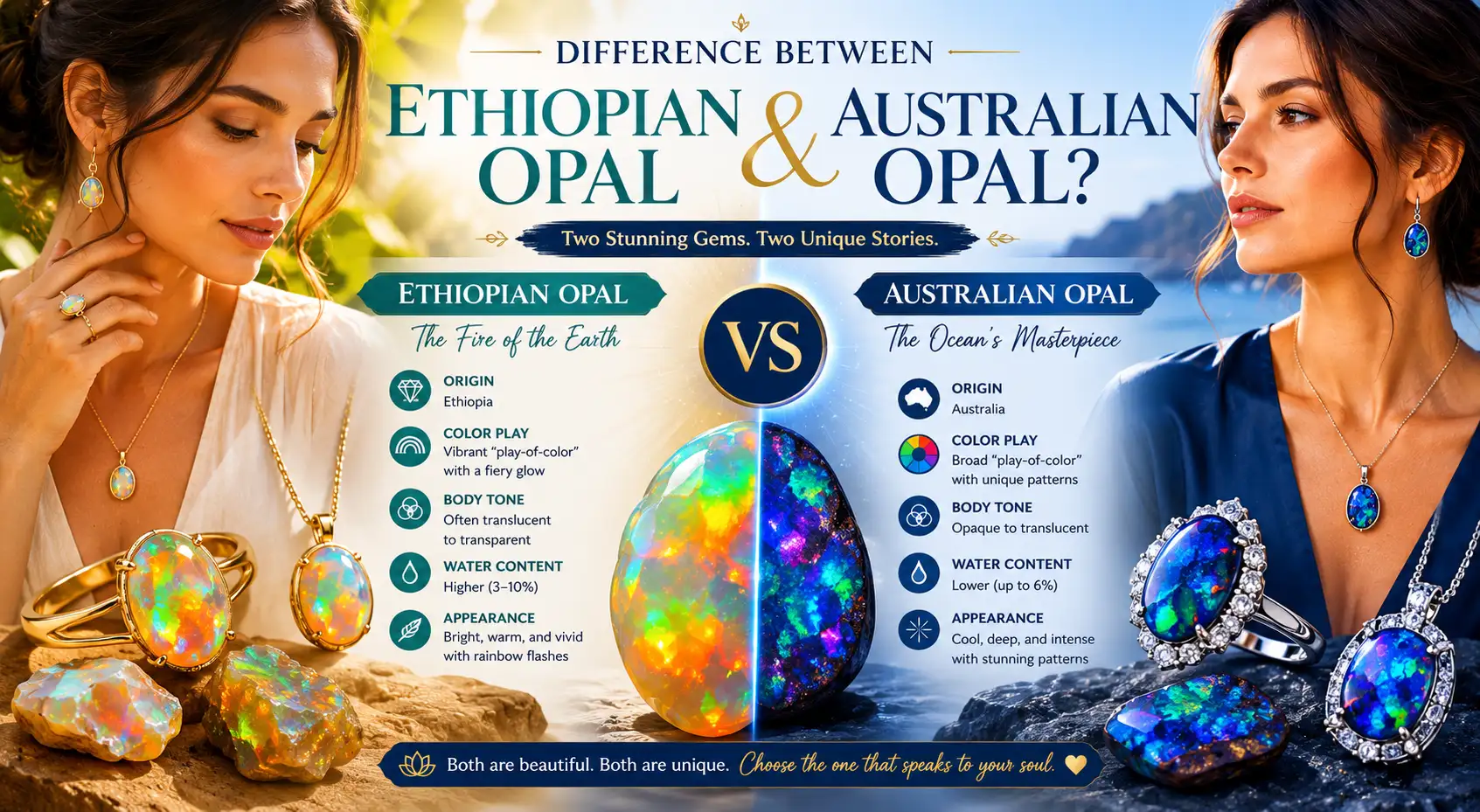
Ethiopian opal is hydrophane. Simply saying, the stone can soak water into itself. Put an Ethiopian opal in a glass of water for some time, and you can actually watch it drinking the water in. The play of color also fades for a while when the stone is fully wet, and comes back once it dries out properly.
Australian opal is non-hydrophane, on the other hand. Put simply, water sits on the surface, runs off, no absorption happening, no change in the stone whatsoever.
So why is this a big deal for someone buying or selling these stones?
For a customer who wants a no-fuss daily opal, Australia is the easier choice. For someone willing to give the stone a bit of care, Ethiopian gives more brightness for less money.
The play of color story between these two is interesting.
The Ethiopian opal is the louder of the two. Flashes of color come out vivid, bright, sometimes almost glowing in normal indoor light without needing any direct sun. Reds, greens, blues, oranges, pinks, all of these can show up easily in a good Ethiopian piece, and the buyer is seeing them without having to tilt the stone in fancy angles.
Australian opal does not work the same way. The play of color is calmer here, more controlled, spread out across the body of the stone. To see the full beauty of Australian opal, you usually have to move it slightly under light, and that movement is what reveals the colors in a layered way.
Some buyers find Ethiopian opal too flashy, actually; they feel the brightness is too much, and the stone looks artificial because of how vivid the colors are. Some buyers prefer Australian opal for the same reason in reverse; the calmer play of color feels more natural and more elegant to their eye.
There is no winner here, just two different personalities sitting in the same gemstone family.
Australian opal wins the variety game. That much is clear without much debate.
White opal from Australia has a milky, pale background. Black opal is the most premium kind with a deep, dark body underneath the play of color. Boulder opal is opal stuck to its host rock and looks rustic, raw, and more natural in appearance. Crystal opal is see-through, and the play of color goes all the way through the stone instead of sitting on a surface.
Ethiopian opal is mainly white and crystal types. Chocolate opal also comes from Ethiopia, and that one has a brown body, but it is not as common as the white and crystal pieces in the wholesale market. Black-looking Ethiopian opal, sometimes seen in shops, is mostly smoke-treated or dyed material, not natural, the way Australian black opal is.
This variety thing matters mostly for retailers who want to stock opal as a serious category. Australian opal gives the retailer cheap white pieces for entry buyers, mid-range crystal for regular customers, and premium black opal for high-end shoppers, all of this under one opal section.
Ethiopian opal does not give that spread. Mostly, the offering stays in white and crystal at affordable prices, with very few options at the higher end of the market.
So a store that is heavy on opals benefits more from Australia. A store where opal is just one of many stones can manage fine with Ethiopian alone.
The price gap between these two opals is one of the biggest in the entire opal category.
Ethiopian opal is the affordable side of the market. A decent Ethiopian opal usually sits somewhere between 10 to 50 dollars per carat for regular quality. Premium Ethiopian opal with strong play of color can touch 100 to 300 dollars per carat, but rarely goes much beyond that for most stones.
Australian opal plays in a completely different price range. White opal from Australia starts somewhere around 50 to 200 dollars per carat, depending on the quality. Crystal opal goes higher than this. Boulder opal also stays in a similar range to crystal. But the real money in Australian opal sits in black opal. A good Australian black opal can go anywhere from 1000 to 10,000 dollars per carat; top-quality black opal from Lightning Ridge crosses even 20,000 per carat sometimes.
So the gap is not small. An entry-level Ethiopian opal and a top-grade Australian black opal can have a 500 times difference in price per carat, sometimes more than that.
Now the question buyers ask is whether Australian opal is worth the extra money. The answer depends on what the buyer needs. If the customer wants a beautiful stone at a reasonable price, Ethiopian opal does the job perfectly. If the customer wants a stone that holds value, behaves the same over decades, and carries the premium tag in the resale market, Australian opal is the right fit.
Both stones earn their price in their own way. Ethiopian gives bright color cheap. Australia gives stability and prestige at a higher cost.
Ethiopian opal and Australian opal are not in competition with each other; that is the main thing to walk away with. They are serving different buyers, different price ranges, and different jewelry needs. Australian opal has history, stability, and the premium tag built into its name. Ethiopian opal has bright color, affordability, and an easier supply on its side.
At JewelPin, we have worked with both opals long enough to know each one finds its own customer. So if this blog made the difference clearer, don't sit on it. Pick the opal that fits your store and your buyer, and move on it.