7 Days Shipping in “Ship Now” Collection
WORLDWIDE SHIPPING EXCEPT INDIA
Minimum Order Value: $1000
09 June, 2026
Difference Between Australian Opal and Ethiopian Opal
People usually get confused between Australian opal and Ethiopian opal after seeing them for the first time. Both stones show colorful flashes, and both look attractive in jewelry.
However, if you look closely at them, the difference between Australian opal and Ethiopian opal becomes much clearer.
For example, some people prefer Australian opal, citing its rarity and long-term reputation. While other Ethiopian opal because, the colors often look brighter, and pricing feels easier on the pocket, too.
So, the differences between them are often the biggest drivers of their buying decisions. In this blog, I have covered the difference between them, starting from the reaction to water, the durability, the maintenance, and even the overall feel in jewelry.
If you are also comparing Australian opal vs Ethiopian opal, this blog will help you with the differences in simple terms.
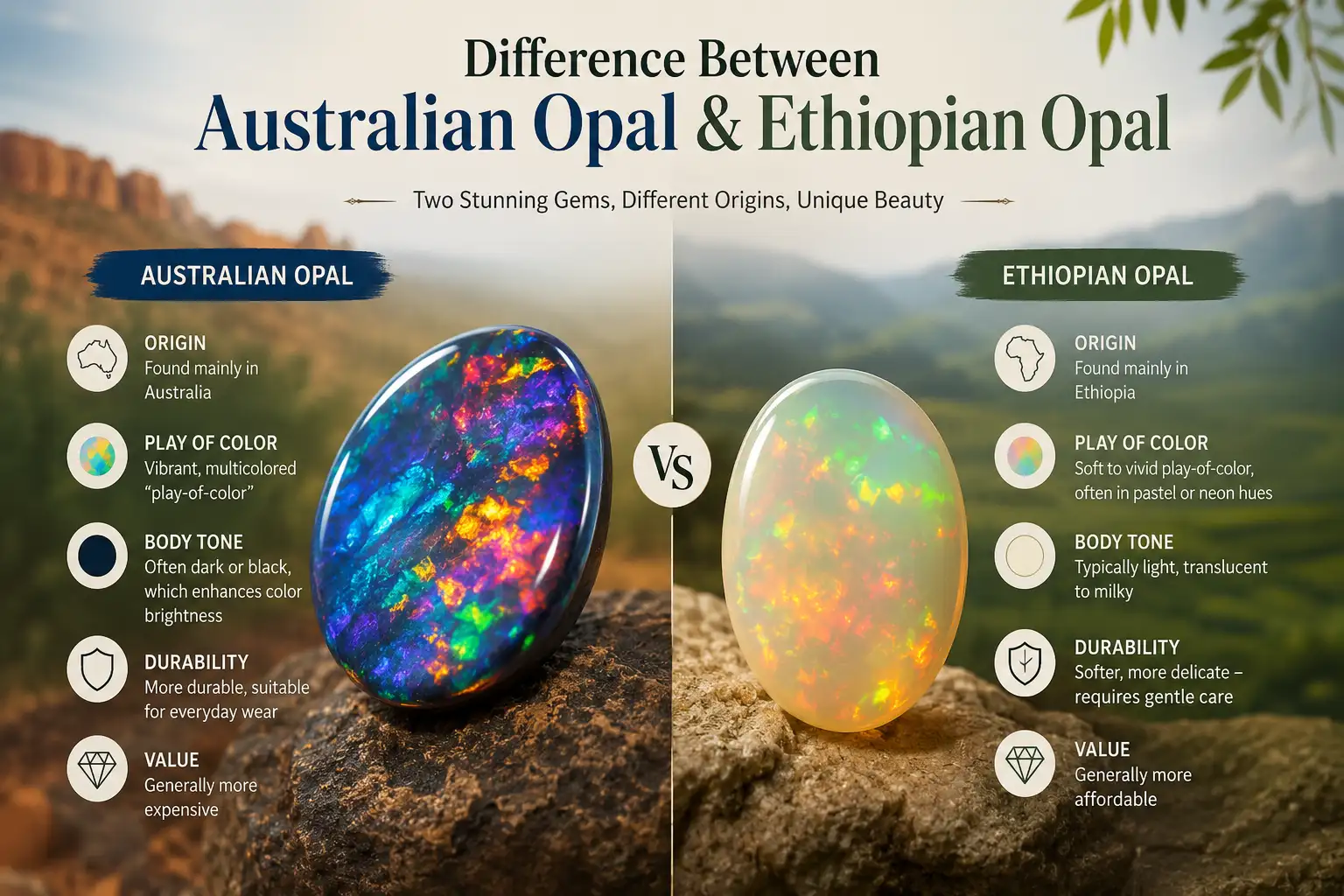
The first and obvious difference between Australian opal and Ethiopian opal is the overall look of the stone.
Ethiopian opal usually looks brighter very quickly. The color flashes often feel stronger and more dramatic under lighting. Additionally, sometimes green flashes appear, blah, suddenly orange or red starts showing from another angle.
You can say it has a play-of-color that makes it appealing to many first-time buyers.
On the other hand, Australian opal feels different visually.
The colors often look deeper and slightly calmer compared to Ethiopian opal. Instead of looking extremely flashy immediately, Australian opal usually gives richer depth when looked at closely.
So, simply saying, they both are beautiful, but in other ways. Therefore, your personal preferences will be the ones leading the decision.
This is one of the biggest technical differences between the two stones.
Ethiopian opal has a hydrophone nature. Simply saying that it can easily absorb the water and moisture, resulting in changing its colors temporarily. Most of the time, the stone may return to its natural color after drying again.
Australian opal, on the other hand, usually does not react this way. It remain its natural color even after getting in contact with water.
This is the difference that can make people buy one over others. For example, if you are planing to buy a ring, then Australian opal is the right choice as rings are prone to come in contact water, soap, and moisture more often during daily life.
Now, this does not mean Ethiopian opal is a bad gemstone. It simply means buyers need slightly more care while wearing it.
The pricing is also a point that shapes people’s decision which one to buy.
Ethiopian opal has been a budget-friendly choice in comparison to Australian opal. Therefore, it is getting popularity as an alternative of Australian opal.
You will get an extremely popular opal in the jewelry market with a strong play-of-color without a higher price tag.
Australian opal has a higher price tag thanks to its rarity. Additionally, many stones are considered to be collector-level pieces.
So, the simple difference is that one promise to be budget-friendly and the other one the uniqueness of making it a collector-level piece.
Australian opal has been dominating the market for years, especially its black opal, originating from Australia. Therefore, many buyers already associate Australian opal with luxury gemstone collections and long-term gemstone value.
On the other hand, Ethiopian opal became more popular in comparison to its budget-friendly mindfulness.
Ethiopian opal often looks brighter inside jewelry displays, showroom lighting, and online photos. The flashes appear more aggressive and eye-catching quickly.
That's exactly why Ethiopian opal performs strongly in:
Rings
Pendants
Silver jewelry
Statement jewelry
The stone itself already creates enough visual attraction without requiring overly complicated jewelry designs around it.
Australian opal jewelry feels more elegant and rich instead of highly flashy.
Now again, this difference is not about good or bad. It simply depends on what type of jewelry someone personally prefers.
This point directly connects with moisture behavior.
Ethiopian opal absorbs moisture more easily, thus, chances are that buyers need to stay slightly more careful while wearing it. Such as water exposure, perfumes, chemicals, and oils can temporarily affect the appearance of the stone.
Australian opal usually feels safer for everyday wear in comparison.
If you ask me honestly, buyers who don't want to think too much about maintenance often feel more comfortable choosing Australian opal. Especially for engagement rings and long-term daily jewelry.
Now, Ethiopian opal still works beautifully in jewelry. Many buyers happily wear it for years. The difference is simply that it needs more awareness and slightly more careful handling.
This shift happened very quickly in the jewelry industry.
The affordability and flashy appearance of Ethiopian opal helped it become part of modern fashion jewelry much faster. Especially sterling silver jewelry collections.
At JewelPin, we have seen Ethiopian opal perform strongly in minimalist jewelry and trend-based collections because younger buyers often get attracted toward brighter color play.
Australian opal still remains highly respected, but Ethiopian opal currently feels more trend-driven and social-media-friendly.
Especially in online jewelry photos and short-form videos, where brighter flashes catch attention faster.
Rarity changes how people emotionally value gemstones. And honestly, Australian opal benefits heavily from this.
Many buyers already see Australian opal as a rarer gemstone because of its limited mining reputation and strong history in the gemstone industry.
Ethiopian opal feels more available in comparison.
Now, that does not reduce the beauty of Ethiopian opal at all. However, if you ask me which stone usually creates stronger rarity perception among buyers, Australian opal most probably stays ahead there. Especially black Australian opal.
This is something people understand better after physically wearing both stones.
Ethiopian opal often feels brighter, younger, and slightly trend-focused in jewelry.
Australian opal usually feels richer, deeper, and more timeless emotionally.
Now, these things are difficult to explain scientifically because they connect more with how people emotionally react to gemstones.
But honestly, the feeling difference exists.
Some buyers instantly get attracted to flashy, colorful Ethiopian opals. Others naturally lean toward the calmer depth and reputation of Australian opal.
If you ask me honestly, the answer completely depends on what matters more to you.
If you care more about:
Rarity
Long-term gemstone reputation
Better moisture resistance
Collector value
Lower maintenance
Then, the Australian opal most probably makes more sense.
However, if you care more about:
Brighter play-of-color
Affordable pricing
Modern jewelry appeals
Bold flashy appearance
Then, the Ethiopian opal can easily become the better choice. And honestly, both stones are beautiful in their own way. That's why buyers continue comparing them so heavily.
Australian opal and Ethiopian opal may look similar initially, but once you start understanding them properly, the differences become very clear.
Australian opal usually wins in terms of rarity, stability, and long-term market reputation. Ethiopian opal often wins in affordability, brighter color flashes, and modern jewelry appeal.
If you ask me, there is no universal winner here. The better stone depends completely on what type of jewelry experience someone personally wants.
At JewelPin, we have seen strong demand for both categories because both opals attract different types of buyers for different reasons.
So, instead of asking which opal is better overall, chances are that the smarter question is which opal matches your style, budget, and expectations better.